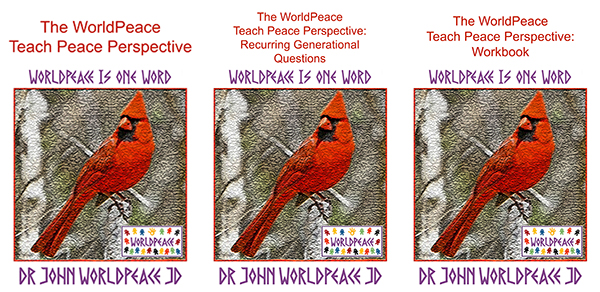
The three books above, the subject of this website, are for sale on Amazon.com.
Book one 585 pages: Book two 337 pages: Book three 566 pages.
THE WORLDPEACE TEACH PEACE PERSPECTIVE
Copyright 2026 by Dr John WorldPeace JD
This website personally created by Dr John WorldPeace JD
A NOTE BEFORE YOU BEGIN TO ENGAGE WITH THIS COMMENTARY
Teach Peace is not an organization. It is an objective with a defined method. It has no membership, no dues, no chapter to start, no leadership structure to answer to. Anyone looking for a group to join will not find one under my name because none exists and none is planned. It is a focus of many humans. I am a follower of the spiritual teachings of Jesus. At the same time I believe all religions can be related to the story of the blind men and the elephant. If you do not examine all relgions, as I have done, you will not have the whole picture of relgion as it exists in the earth dreamscape. At the core of Jesus' message he states that the earth dreamscape is a delusion and storing up treasures on earth is an illusion. Other teachers of the major relgions also teach this. I have studied the other major relgions and rewritten and published some of their major texts for my personal understanding. I have a website that has over 50,000 pages and I have written over 160 books published through KDPAmazon and available on Amazon.com. My flagship website is JohnWorldPeace.com. My life is an open book.
On Jauuary 30, 1948, my mother's 21st birthday, Mahatma Gandhi, was assassinated. On April 24, 1948, I was born in Houston, Texas. I determined to devote my life to increasing the peace in Sunday school when I was 8 years old. I have never lost that commitment. In 1965, sitting in my high school counselors office, I noticed 3 lines of a Robert Frost poem. "Two roads diverged in an a wood, and I -- I took the one less traveled by. And that has made all the difference." So has my life been. (Incidentally, I have written and published 8,000 poems from 1970 to date.)
My self designated legal name is John WorldPeace committed to on Easter Sunday, April 3, 1988. On April 5th, 1988, I legally changed my name in the District Court in Harris County, Texas. On April 24, 1988, I turned 40 years old. I had achieved every significant goal I had set for my life and I determined that advocating peace and WorldPeace was a goal that I could not achieve. But I could increase the level of peace in the world human society. This WorldPeace Teach Peace Perspective is grounded in a method regarding every human endeavor to apply the metric, "Will whatever action is contemplated by human beings, increase or decrease the level of peace in the world human society.
WorldPeace is one word and as long as it continues to be written as two words it will remain two things. This Teach Peace method responds to my fundational question; How can we increase the level of peace in the world human society if we do not include everyone (all races, all religions, all nations, all genders) in our vision of vision of peace. It cannot. My firm belief is when Peace becomes our priority, WorldPeace will beome our reality. My life has been a journey, not a destination.
THE WORLDPEACE TEACH PEACE PERSPECTIVE is a complete, ready-to-use framework for evaluating any human decision — personal, institutional, or global — against a single question: DOES THIS INCREASE OR DECREASE THE LEVEL OFPEACE IN THE WORLD HUMAN SOCIETY? Developed over five decades and brought to its current form through the founder's biography, an 88-chapter core text, and nearly 300 structured workbook questions spanning government, religion, business, and the conditions that shape daily life, it is offered here in full to any university, peace oriented organization, or individual willing to apply it honestly.
THE TABLE OF CONTENTS FOR:
"THE WORLDPEACE TEACH PEACE PERSPECTIVE"
WEBSITE TABLE OF CONTENTS
INTRO: Outreach to Universities regarding taking on the Teach Peace curriculum (click)
FOR PROFESSORS: An Introduction to Teach Peace (click)
I. THE TEXT CHAPTERS I (click) "The Home Page"
II. THE TEXT CHAPTERS II (click)
III. THE WORKBOOKS (click)
IV. THE TEACH PEACE QUESTIONS (click)
V. JWP NOTES (click)
VI. Universities Contacted (click)

SUPPORT WORLDPEACE - Buy Dr John WorldPeace JD -- BOOKS
(163 listed)
on AMAZON (click here)
TABLE OF CONTENTS FOR THIS WEBSITE PAGE
Orientation / Start Here
- A Note on This Table of Contents
- A Note to the Reader: This Is a Developing Work
- Site Scale and Orientation
- The Open Archive — No Gatekeeping
The Core Method
- Two Roles, One Person: A Supplement to the End of the Beginning
- Two Stages of the Question, and a Standing Line
- Why Teach Peace Ends in a Position, and What to Ask When It Cannot
- The Question as Method: A Backdoor Into Peace
- The Daily Five — A Standing Practice
- Questions: The Foundation of Teach Peace
- Questions Are the Foundation
- Teaching Notes: Building and Running a Teach Peace Session
- The Moderator's Role, and the Method Itself
Worked Examples / Applied in Real Time
- Teach Peace as a Permit Prerequisite: A Proactive Model
- Teach Peace in Real Time: Prime Examples of Active Application
- Teach Peace Method Applied to Daily News Articles
In the News
- Billionaire Political Spending and Government Oversight
- Extended Deployments and an Escalating War With Iran
- The IRS and University Tax-Exempt Status
- Efforts to Roll Back Civil-Rights-Era Policy
- Daily Teach Peace Question — August 25, 2026
Timeless / Generational Questions
- Generational Questions: Why Teach Peace Requires Real University Study
- Can a University Really Sidestep Teach Peace?
- The Timeless Book of Teach Peace Questions
- A Teach Peace Question: Eighty Years of Institutional Silence
- Sixty Years Late: What Stopped Them?
- Don't Ask, and You Don't Have to Discuss It
Submitted World Positions
- What Is a University For?
- Power, Institutions, and the Search for Peace
- Further Questions From the World Human Society
Family and Personal-Scale Peace
Subject Categories
- New Subject Categories Added: B10 and B11
- Archive of Questions — Government and Religious Preference
University Partnership and Outreach
- Teach Peace University Outreach Packet
- Launch and Move On: Why Question Selection Belongs to the Adopter
- Peer Pressure, Not Personal Pursuit
- Not Looking for a Job: Looking for a Place to Land It
- A Few Good Universities
- How Teach Peace Will Propagate
- From Elective to Department
- Too Much to Ignore
- Governing Growth: Why Teach Peace Needs a Curriculum Committee
- The Growth Engine: Students Who Want to Contribute
- A Core That Never Finishes Catching Up, by Design
- Half-Baked on Purpose
- Does Holding Strong Personal Views Disqualify JWP as Moderator?
- A Charge to the Universities
- Financial and Living Statement
- The Scale of What Already Exists
- Mailing Scope Notice
- Teach Peace Has Launched (Cover)
- A Proposal for University Partnership
- Teach Peace Outreach to Universities
- Teach Peace University Structure
- University Participation Structure
- Teach Peace — Full Participation Structure
- Teach Peace Recognition Policy
- Teach Peace Is Already Growing
- Corporate Application
- Two New Sections for the Teach Peace Perspective
The Case for One Voice
Who Is John WorldPeace
- Dr. John WorldPeace, JD: The Person Behind the Question
- Who Is John WorldPeace?
- The Full Monty: Why This Is Different From Gandhi, Mandela, and King
- Unloading a Lifetime: Where I Have Arrived
- Popped, Not Crawled Out
- The End of the Beginning
- My Agenda, Stated Plainly
- Road Map: Where We Started, How We Got Here
- Who Is Dr. John WorldPeace, JD — A Biography
- Dr. John WorldPeace Position Statement
- Personal Position Statement
- Dr. John WorldPeace JD's Peace Agenda — Stated Plainly
- Dr. John WorldPeace JD's Teach Peace Plan of Action
- Dr. John WorldPeace JD's Agenda Stated Plainly
- Misc Questions to John WorldPeace
On AI and This Project
- Write, Write, Write: Why Nothing Waits
- The World Is Naive About How to Use AI
- A Working Model of Human and AI Collaboration
- The Bottomless Rabbit Hole — Why Peace Is So Hard to Teach
- Why the Archive Requires AI
- How AI and the Human Brain Differ as Sources of Memory
- The Limits of Memory, Human and Artificial
- What AI Collaboration Actually Offers — Entry One: No Dog in the Hunt
Governance and Growth
- How This Project Actually Grows
- Prioritizing the Seventeen Categories
- The Global WorldPeace Movement
Foundational Statements and Voice Pieces
- Why This Book Cannot Be Put Down Once Opened
- The Impotence of Peace Groups
- Focus on Your Lane
- The Global Mantra
- Common Ground Among the Religions
- The Global WorldPeace Mantra
- The Foundational Truth and Question
- Teach Peace: A Home for Peace-Related Ideas
- Teach Peace Opening Statement (Site Version)
- If Universities Are Not Asked to Teach Peace
- A First Step Out of the Maze (Site Version)
- Teaching Peace Notes (Site Version)
- Why the World Human Society Needs One Voice for Peace
- ADDITIONAL SECTIONS
- One Question, One Hub, One Chance
- A Classroom AI Cannot Enter
- Beyond Peace: What Teach Peace's Structure Could Seed
- Socratic Roots: How Teach Peace's Method Echoes the Oldest Model of Teaching
- Teaching Peace at Scale: A Professor's Choices
- Why the Archive Needs a University Home
- Partial Consensus: Building on What Has Already Been Settled
- How Asking Increases the Peace
- Too Simple to Matter: The Case Against That Doubt
- An Open Record of How AI Was Actually Used
- Live Capture and the Rules of the Road
- The Human Leads: Why the Same AI Produces Different Results
- Grounded in the Evidence: AI as Amplifier, Not Equalizer
- Qualification Without the Traditional Path
- The Go-To University
- A Method, Stated Plainly
- A Fully Independent Path Within the Peace Movement
- Staying the Path: What an Unshaken Internal Compass Actually Looks Like
Orientation / Start Here
A Note on This Table of Contents
The sections below are grouped by title, as a first pass through a large and rapidly growing body of material. This is not a final sort, and it is not meant to be read as one. Sorting is done daily, as new sections are added and as existing groupings are reviewed against the material they actually contain. Titles themselves may change as the table of contents develops and matures.
This site is a large working index, not a commercial product concerned with polish or presentation for its own sake. What matters here is content and navigation — helping a reader find what they are looking for as accurately and quickly as possible, at whatever stage of organization the site happens to be in on any given day.
A Note to the Reader: This Is a Developing Work
This book is being built from scratch. There was no existing template to follow, no prior body of similar work to adapt, and no established academic field of "teaching peace" to draw structure from. Every section, every category, and every method described here was constructed directly, by one person, starting from nothing.
Because of that, the reader will notice places where the text feels newly added, where a section reads differently in tone or depth from the one before it, or where a topic introduced early in the book is expanded or revisited later, sometimes at length, sometimes only briefly. This is not disorganization. It is the visible evidence of a project being built in real time, in the open, rather than polished in private for years before anyone sees it.
Peace itself is not a fixed subject. It is a moving target — globally, daily, and at times moment to moment. A framework built to examine peace honestly cannot pretend to be finished, because the world it examines is not finished changing. New categories will be added. Existing sections will be revised as new understanding, new events, and new contributors reshape them. This growth is not a flaw to be corrected in some future edition. It is the intended, permanent condition of the work.
The reader is asked to approach this book the way one would approach a living document rather than a completed text: as a serious, continuously developing effort to bring discipline to a subject that has never had a structured, university-level method built around it before. What is here today is real and usable today. What is added tomorrow will make it more complete, not less honest.
Site Scale and Orientation
A Standing Reminder on Scale
This is a lot of information, drawn from more than forty years of continuous writing. That said, it is not as big as it could be.
What is presented here — across Teach Peace and the broader WorldPeace archive — is a curated selection, not the full body of work. Decades of additional writing exist beyond what has been organized and posted. The scale on display is real, but it is restraint, not excess: a fraction of what has actually been written, chosen and structured for the reader's use.
Before You Go Further: A Note on the Size of This Site
This site is large, and it is still growing. What you are about to explore is not a single document or a short introduction — it is decades of continuous work, organized here into sections that will keep expanding as more of it is added. There is no single correct entry point and no way to read all of it in one sitting.
This page exists so you are not dropped into that scale without warning. Below, you will find a guide to how the site is organized and where to start, depending on what you came here to find: the core method itself, the reasoning behind it, the person who built it, or the full archive that stands behind all of it.
The Open Archive — No Gatekeeping
How new questions enter the Teach Peace Archive, and why that matters to universities
Anyone May Propose a Question
Any human being may propose a question about peace to the Teach Peace Archive, at any time. No academic committee, department, or institution decides in advance whether a question is worth recording. This is a deliberate structural choice, not an oversight.
How a New Question Is Processed
When a question is proposed, it is placed within the Archive's existing categories — the same seventeen sections already established across this project's workbooks — or, where none of the existing categories fit, a new category is created to hold it, the way the government-and-religious-preference category was created for the question proposed just before this one. Before a new entry is added, the Archive is searched for related questions already recorded in that category, so that a genuinely new nuance is captured as its own entry rather than lost inside a near-duplicate, and so a question closely related to one already on record can be found and connected rather than treated as if it had never been asked before.
Recorded Regardless of Whether It Is Taught
Every question that meets this process is recorded in the Archive whether or not any university has yet built a class, a discussion, or a curriculum around it. Being recorded and being actively taught are two different things, and the first does not depend on the second. This is what makes every individual a genuine stakeholder in the global project of increasing peace: a person with no institutional standing, no academic credential, and no platform of their own can still see their question permanently entered into the record, waiting to be taken up.
What This Structure Exposes
Once questions are recorded regardless of institutional attention, a second and harder question naturally follows: what happens to the level of peace when certain questions are never given a forum at all — when they become, in practice if not in policy, taboo? The same open, unfiltered Archive that records every question also makes it possible to see, over time, exactly which questions keep being asked and never taken up, and exactly who decided, by inaction, to leave them unexamined. Questions comparing forms of government — democracy against communism against theocracy — are one clear example of a category many institutions avoid by default, without ever formally excluding it.
Why This Matters to Every University Considering This Agenda
A university considering whether to take on the Teach Peace agenda cannot reasonably argue that the subject will run short of material, or that this is a narrow, short-lived idea unworthy of a real department. The Archive itself is the proof otherwise: an open, permanently growing, uncontrolled record of real questions, arriving from real people, in categories that keep expanding on their own. No academic committee curates what gets asked. The questions simply keep coming, because the world keeps producing them.
Right now, no university anywhere teaches peace as a forward-looking, present-tense discipline — only as history, studying wars and treaties already settled. The Archive shows plainly that the material for something more than history already exists, in abundance, and grows every day without anyone's help. The moment for universities to build this has already arrived. It is not a future consideration. It is now.
The Core Method
Two Roles, One Person: A Supplement to the End of the Beginning
Teach Peace requires a moderator: a role that asks the question and holds the room open, without supplying the verdict. That role has to stay neutral, because neutrality is what allows a university, a skeptic, or an opponent to sit down at the table at all. A moderator who has already announced the answer is not a moderator.
John WorldPeace, the person, does not carry that same restriction outside the method itself. The prophetic voice — the one that says the king has no clothes, the fool on the hill, the old man with the sign that reads the end is near — is a separate and legitimate role, and it does not disqualify the first one. If anything, the two roles justify each other: the radical clarity of one shows exactly why the disciplined neutrality of the other is needed in the first place. A person capable of shouting the truth plainly is also the person best positioned to know why a structured, patient method is required to get anyone else to actually hear it.
This is not a contradiction to be resolved. It is a division of labor inside one life: the builder constructs the neutral method; the promoter carries the urgent, unneutral truth that the method exists to examine. Holding both, without confusing which one is speaking at a given moment, is the actual discipline — harder than choosing one role and abandoning the other.
There is a name for the process this project is actually following, and it comes from a real, respected body of theory, not just personal metaphor. In 1959, the political scientist Charles Lindblom published an essay called "The Science of Muddling Through," arguing that complex public problems are almost never solved by a single, comprehensive master plan. They are solved through continuous, incremental adjustment — testing, revising, moving forward in the direction of the goal without ever having the full picture in view at once. Lindblom's point was that this is not a failure of method. It is the only honest method available for problems too large and too fast-moving for any one mind, or any one plan, to fully contain. Dr. Tillema's 1970 handout on this subject was pointing at something real, and it describes, almost exactly, how Teach Peace itself is being built: to boldly go where no comprehensive plan has gone before, one incremental, muddling step at a time.
Two Stages of the Question, and a Standing Line
The posture of the core Teach Peace question shifts in two distinct stages, and treating both stages the same way is a mistake.
Stage one: finding a university willing to take on the hub position. At this stage, before any track record exists, the question stays soft — offered once, seriously, without repeated pressure. There is no proof yet to point to, and pushing hard on an unproven idea risks looking like advocacy rather than method.
Stage two: once a hub university has adopted Teach Peace, and a number of supporting universities follow, the method is propagating on its own — and the question itself can change in kind, not just in volume. At that point, the question is no longer "why hasn't your university adopted this," asked speculatively. It becomes: why has peace in your area not increased, when Teach Peace has demonstrably made a difference at other universities nearby? That is an evidence-based question, grounded in results, and it does not need to come from me at that stage — it is naturally asked by the hub university and its peers, exactly as established in the peer-pressure principle already documented.
A standing line will now close every Teach Peace question, after the core increase-or-decrease-the-peace question itself: Teach Peace: an idea whose time has come.
This line is deliberately advertisement, not accusation. It makes a claim about the idea's own moment — confident and forward-looking — without pointing at any specific institution or demanding a response. A reader can agree or disagree with it without feeling personally targeted, which is precisely the tone stage one requires. The accusatory version of the question, reserved for stage two and delivered by peer institutions rather than by me, is a separate and distinct tool, used only once real evidence exists to support it.
Why Teach Peace Ends in a Position, and What to Ask When It Cannot
A Teach Peace session does not end in open air. It ends with a published position — the class's collective answer, reached through structured examination, to whether the issue in question increases or decreases the peace. Without that ending, the entire process is wasted breath: a discussion that generates thoughtful conversation but produces nothing a student, a university, or a reader can point to afterward. The moderator supplies no verdict during the process, but the process itself is built to produce one by its end, arrived at by the participants, not imposed on them.
This is what makes the method credible as more than commentary: it naturally breaks any large, seemingly intractable peace question down into its component parts, and it is naive to assume that none of those parts is workable. Resolving even one part carves directly into the larger issue and reduces its overall tension, even if only incrementally. Global peace is not achieved in a single stroke; it accumulates from exactly this kind of incremental resolution, repeated across enough parts of enough issues, over enough time.
It is difficult to imagine a session that should be allowed to end with the conclusion: nothing can be done about this, simply live with it. That is not an acceptable stopping point for the method. When a class genuinely reaches the limit of what it can resolve on a given issue, a second-level question follows immediately, rather than allowing the session to end in resignation: what are the negative consequences of leaving this tension unresolved? Where does this issue lead if, at this moment, we genuinely have nothing further to offer toward resolving it?
This second-level question keeps the process itself peace-generating even in the face of an apparently unsolvable issue. It refuses to let a class end in passive acceptance of ongoing conflict. Instead, it forces continued engagement with the cost of inaction — which, in itself, becomes the next question worth examining, and often reveals a smaller, adjacent part of the issue that can, after all, be addressed.
The Question as Method: A Backdoor Into Peace
I may, in some cases, state a position directly — politically, nationally, globally — on my other sites, in my own name. But the preferred method within Teach Peace is different: to craft a Teach Peace question rather than a stated position. That question format brings the subject into local, national, and global conversation without ever handing an opponent a personal foothold to attack. A stated position can be argued against, dismissed, or turned into an attack on the person who stated it. A well-formed question, examined from multiple sides without a supplied verdict, cannot be attacked in the same way, because there is no personal claim standing exposed at the center of it.
This is the real objective of Teach Peace: a backdoor entry into peace, forcing attention onto negative peace issues without requiring me to plant a flag those issues can be used against. Using the question method, I can force a conversation regarding the level of peace in world human society without stating, outright, what is in most cases already an obvious path to anyone paying attention.
I am not a pacifist. I am not an anarchist. I am forcing a conversation — deliberately, repeatedly, and by design — about the actual level of peace in the world, using a method built specifically so that the conversation itself, not my personal position, is what stands in front of the reader.
The Daily Five — A Standing Practice
Dr. John WorldPeace, JD
The Commitment
Teach Peace requires five new questions every day. That is my responsibility to fill, not a suggestion to consider — a standing daily practice, the same discipline already applied to everything else in this project. The cost of AI performing this work, at this stage, is negligible, which means the only real constraint is my own time and judgment, not capacity.
Categories and Filing
Every new question is assigned to one of the seventeen categories already established across the 245-question workbook. Where a question genuinely does not fit any existing category, a new one is created — the same rule already governing the larger Archive of Questions. Each category functions as its own standing collection, with its own record of what has already been asked and what remains open.
The Numbering System
Each question receives a reference number in the form YYMMDD-N — the date it was written, followed by its sequence that day. This number carries no meaning beyond reference; it exists purely as a cross-referencing tool, so that any question can be located instantly by date, and, combined with its category, by subject. Over time, this numbering becomes the spine of the entire Archive — a simple, permanent address for every question ever asked.
From Questions to Credit
As any single category accumulates enough real, worked questions — roughly forty — it becomes the foundation of an actual semester course. A category that has genuinely earned forty serious questions has, in practice, already written its own syllabus. This is the mechanism by which the daily practice of asking becomes, over time, a real, credit-bearing curriculum, built one question at a time rather than designed from the top down.
Why This Matters: The Cost of Political Reversal
Consider a pattern already visible in American government: each time control changes hands in Congress or the White House, incoming officials frequently spend much of their time undoing what their predecessors built, rather than building something new. A national forest set aside to preserve pristine land under one administration is opened to drilling under the next, then the drilling is halted again under the one after that. Enormous time and resource are spent building, then destroying, then rebuilding — progress measured not in what gets accomplished, but in whose version currently holds.
Recent examples make the pattern concrete. In April 2026, the National Park Service awarded a no-bid contract to repaint the Lincoln Memorial Reflecting Pool, a project the President said would cost $1.8 million and take one week; the actual cost rose to $13.1 million. The Kennedy Center's board voted to rename the institution after the sitting president, a move contested enough to draw an active lawsuit over whether the name can legally be changed at all, given the congressional act that established it. In each case, a public institution — belonging to the public, not to any single four-year officeholder — was acted upon unilaterally, without the ordinary competitive or institutional process such decisions typically require.
This is precisely the kind of question this project exists to ask: not whether a specific action was politically popular or unpopular, but whether the underlying pattern — a public institution redirected by one official's individual decision, outside the process built to govern it — increases or decreases peace and stability in how a society governs itself.
The Longer Path: Teaching a Different Default
There is a longer-term answer to this pattern, and it runs through education rather than any single election. If children are taught consistently, from elementary school through college, to understand and respect the actual structures of government — the distinction between a law and an executive order, the difference between what any single official can unilaterally reverse and what requires a genuine process to change — they grow into adults who bring that understanding with them into positions of power. Not blind deference to whatever came before, since any law can legitimately be changed. But a working respect for process itself, and an understanding that administrative structure exists precisely to survive the transition between one leader and the next.
A generation raised this way does not arrive in office with an instinct to treat the machinery of government as something to be discarded on entry. It arrives with an instinct to understand what that machinery is for, before deciding what, if anything, should change. That single shift, built patiently over a generation, would do more to reduce the chaos of political transition than any single reform passed in any single term.
Questions: The Foundation of Teach Peace
A standing chapter, referenced throughout this book rather than repeated within it
The Act, Not the Answer
Everything in Teach Peace is built on one act: asking a question. Not stating a position, not delivering a verdict, not advancing an agenda — asking. A question, honestly framed, with no answer supplied, is not an argument. It carries no claim that can be proven false, no position that can be labeled bias, no conclusion that can be attacked as propaganda. It only asks the reader to think.
This is not a legal technicality. It is the actual, longstanding mission of education itself — to expose a mind to a real issue and let it reason toward its own understanding, rather than hand it a conclusion already reached by someone else. A university that cannot tolerate a genuine, two-sided question about a genuine, real subject has already abandoned the purpose it claims to serve.
Why a Question Cannot Be Targeted the Way a Statement Can
A statement takes a side. A side can be identified, labeled, and attacked — as bias, as an agenda, as grounds for political or financial retaliation against the institution that hosted it. A genuine question, built with no supplied verdict and real prompts pulling in more than one direction, removes that target entirely. There is no viewpoint in it to point to. This is real, structural protection, not merely a hopeful claim: viewpoint-based pressure requires a viewpoint. Where none exists, that specific pressure has nothing to attach itself to.
This protection is not absolute, and it is worth being precise rather than overstating it. A critic can still object to the choice of subject — why this issue, why now — even when the content of the question itself is unassailable. That is a real, but categorically weaker, line of attack than “this is biased,” and it is one this project is prepared to answer directly: the subjects examined here are chosen by their real presence in the world human society, not by any private agenda.
A Chapter That Outlives Its Founder
This book is being written in real time, added to daily, its chapters reorganized as new material arrives. That will continue for as long as its founder is able to continue it — and it is not designed to depend on that continuing forever. Long before that becomes a concern, and certainly after, others will begin building their own books of questions, using the same method, on subjects this book has not yet reached. That is not a threat to this project. It is the intended outcome of it — the same principle already stated elsewhere in this work: Teach Peace does not compete with what it produces. It multiplies through it.
What This Chapter Protects
Every chapter that follows in this book — whatever its subject, however difficult — rests on the discipline described here. This chapter is the reason none of them need to defend themselves individually. They are questions. Nothing more is being claimed, and nothing less is being offered.
Questions Are the Foundation
For placement at the top of Teach Peace
Everything in Teach Peace is built on one act: asking a question. Not stating a position, not delivering a verdict, not advancing an agenda — asking. A question, honestly framed, with no answer supplied, is not an argument. It carries no claim that can be proven false, no position that can be labeled bias, no conclusion that can be attacked as propaganda. It only asks the reader to think.
This is not a legal technicality. It is the actual, longstanding mission of education itself — to expose a mind to a real issue and let it reason toward its own understanding, rather than hand it a conclusion already reached by someone else. A university that cannot tolerate a genuine, two-sided question about a genuine, real subject has already abandoned the purpose it claims to serve.
Teach Peace will ask about difficult subjects. It will ask about power, about war, about religion, about history's darkest chapters, because avoiding a subject does not make it safer — it only makes it unexamined. What will never appear here is a stated conclusion on any of it. The distinction matters more than it may first appear: a question can be wrong to ask only if the act of asking itself is treated as dangerous. A society that has reached that point has already lost more peace than any single question could threaten.
Teaching Notes: Building and Running a Teach Peace Session
For instructors, moderators, and anyone preparing to lead a class
This is not more content. It is the method behind the content — how to take any real issue and turn it into a genuine Teach Peace question, and how to lead the discussion that follows without steering it toward a conclusion.
Part One: Building a Question From an Issue
Step 1 — Choose a Real Issue
Start with something real: a current news event, a historical decision, a policy, a persistent social pattern. Avoid inventing a hypothetical. A real issue carries real facts to check the question against, and real people who actually hold different positions on it.
Step 2 — Test It at the Gate
Before building anything further, run the issue through the two-part gate already established for this method. First, the Systemic Reach Test: does this affect only two identifiable parties under existing agreed rules (a mediation matter, not a Teach Peace question), or does it reflect or reinforce something larger — a pattern, an institution, a power structure? Second, the Violence Potential Test: does this carry a real, even indirect, connection to conflict or harm? An issue that fails either test belongs in ordinary discussion, not this method.
Step 3 — Write the Core Question
State a single, specific, evaluative question. It must be a genuine question, not a statement dressed as one, and it must not presuppose its own answer. Test it by asking: could a thoughtful, informed person honestly answer this either way? If the answer is obviously yes to nearly everyone, the question is too easy and needs sharpening.
Step 4 — Write the Context
State only the neutral, verifiable facts: what happened, who is involved, what has been reported. No interpretation, no framing that nudges the reader toward either answer. If a fact is disputed, note that it is disputed rather than picking a side of the dispute.
Step 5 — Identify the Agreed Factors
List the facts that all sides of the issue already accept as true, even if they disagree about what those facts mean. This list exists specifically to prevent an undisputed fact from being quietly left out of the discussion because it is inconvenient. Ask directly: can the Core Question honestly be answered if any of these facts is ignored?
Step 6 — Write Eight Guided Prompts
Write eight sub-questions that a genuine, honest discussion would raise. They should pull in different directions from each other — for every prompt that could support one answer, another should be capable of supporting the opposite. No individual prompt should state a conclusion. If all eight prompts seem to point the same direction, the question is not yet balanced and needs revision.
Step 7 — Write the Reflection
Name one distinction, complication, or nuance the Core Question does not fully capture on its own, and instruct the reader to weigh it — without resolving it for them. A Guided Prompt asks something. A Reflection tells the reader to notice something. Keep the two distinct.
Step 8 — Close With the Peace Frame
Restate the Core Question, verbatim, as the final line. Add nothing new. This closes the entry exactly where it opened.
Part Two: Conducting the Classroom Discussion
Before the Session
Distribute the full written question — Core Question, Context, Agreed Factors, and Guided Prompts — to students in advance if possible, so the room arrives already having thought about it rather than encountering it cold.
Opening the Discussion
Read the Core Question and Context aloud, exactly as written. State plainly, at the start, that the moderator will not be offering an opinion or a conclusion during this session. This ground rule matters and should be repeated if the discussion later pulls toward asking the moderator directly what they think.
Walking Through the Structure
Confirm the Agreed Factors as a group. Ask directly whether anyone disputes any of them. If a fact is disputed, note the disagreement and move on — do not resolve it as the moderator.
Work through the Guided Prompts, not necessarily all eight in a single session if time is limited. Let students respond to each other, not only to the moderator. Redirect debate back to the prompts if it drifts.
Introduce the Reflection at a natural point in the discussion, once the room has engaged with several prompts — not before, or it can prematurely narrow the conversation.
Open the floor for any final points not yet raised.
The Vote
Close the session with a vote on the Core Question itself, restated as the Peace Frame: does this increase or decrease the level of peace in the world human society? This vote is not a verdict on the underlying issue. It is a dated record of where this specific, informed group landed after full exposure to the material — nothing more, nothing less.
After the Session
Record the vote result, the date, and the size of the group, and make that record available alongside the question itself. Over time, the same question asked of different classes, in different years, becomes its own kind of evidence — not proof of a correct answer, but a real, honest record of how thinking on a genuine issue moves, or fails to move, over time.
The Moderator's Role, and the Method Itself
A position held across parts of the world human society, submitted to the Teach Peace method
There are those who believe the proper agenda for a moderator of public inquiry is peace itself — not a specific outcome, but a consistent method: taking positions genuinely held across parts of the world human society and placing them under the same lens, does this increase or decrease the level of peace, without supplying the verdict.
There are those who believe universities are the right place to do this work — to take a real, contested question into a classroom and let students reason through it together, expanding their own thinking in the process, moving incrementally toward more peaceful conclusions. Under this view, no single question or single class is expected to resolve the deep and lasting conflicts of the world human society. This work is expected to continue, question by question, for as long as it takes to move meaningfully toward a more sane and just world.
Does Incremental Classroom Questioning Actually Produce Real-World Peace?
CORE QUESTION
Does repeated, structured classroom examination of contested questions produce a measurable increase in real-world peace over time, or does it primarily change how individual students think without a demonstrated broader effect?
CONTEXT
This method rests on a claim that has not yet been tested at scale: that consistently asking one evaluative question, across many issues and many classrooms, over years, produces cumulative real-world change rather than only individual intellectual development.
AGREED FACTORS
No existing educational program has applied this specific, single-question method at the scale being proposed here.
Individual-level changes in reasoning and attitude following structured ethical or civic education have been studied in various forms.
A direct, measurable causal link between any single educational method and large-scale societal peace outcomes is difficult to establish with certainty.
GUIDED PROMPTS
What would count as legitimate evidence that this method is working, beyond individual student self-report?
Does developing better individual reasoning about peace reliably translate into different real-world behavior or advocacy?
How long would this method need to run, and at what scale, before meaningful evidence either way could reasonably be expected?
Is the goal genuinely measurable, or is it more like a long-term cultural shift that resists direct measurement?
Would this method's value hold even if a direct causal link to large-scale peace outcomes could never be fully proven?
Does the method's structure — no supplied verdict, genuine two-sided reasoning — make it more or less likely to produce durable change than a more directive approach?
What would distinguish this method succeeding from simply producing more informed, but not more peaceful, graduates?
Should the method be considered valuable on its own terms, regardless of whether a large-scale peace effect can ever be conclusively demonstrated?
REFLECTION
This question does not doubt the sincerity of the belief behind the method. It asks the harder, separate question of whether the method's central practical claim — that this process produces real peace, not just better reasoning — can actually be supported by evidence.
PEACE FRAME
Does this increase or decrease the level of peace in the world human society?
Is Incremental Progress Sufficient, or Does Lasting Peace Require Something More Direct?
CORE QUESTION
Is a slow, incremental, question-by-question approach a sufficient path toward a more sane and just world, or do the world's most serious conflicts require more direct intervention than sustained questioning alone can provide?
CONTEXT
This method commits to gradual, cumulative change through consistent, repeated inquiry rather than direct action or advocacy. Some hold that this is the only durable path to real change; others hold that some crises require faster, more direct response than an educational method alone can offer.
AGREED FACTORS
Historical examples of both gradual, education-driven social change and rapid, direct-action-driven change exist across different contexts.
The method under discussion here does not involve direct political action, protest, or advocacy for specific outcomes.
The specific pace required to meaningfully address any given conflict varies significantly depending on its nature and urgency.
GUIDED PROMPTS
Does gradual change through education risk being too slow for conflicts causing serious, ongoing harm right now?
Is there a meaningful difference between conflicts that respond well to gradual attitude change and those that require immediate intervention?
Would this method complement more direct forms of action, or is it intended as a complete alternative to them?
Does the credibility this method builds through neutrality come at the cost of speed that some urgent situations require?
Is there evidence from history about which kinds of conflicts have actually been resolved primarily through gradual education versus direct action?
Should this method be judged by its own stated pace and goals, or against the speed a more urgent situation might seem to demand?
Does the durability of change achieved slowly outweigh the potential harm of not acting more quickly?
What role, if any, should this method play alongside more direct approaches, rather than in place of them?
REFLECTION
This question tests whether the deliberate slowness and neutrality of this method is a genuine strength, as claimed, or a real limitation when measured against the urgency of specific, serious conflicts.
PEACE FRAME
Does this increase or decrease the level of peace in the world human society?
Worked Examples / Applied in Real Time
Teach Peace as a Permit Prerequisite: A Proactive Model
A moderator who loses control of a classroom has one clear recourse: shut the class down. That same discipline can be turned into a proactive, structural tool, rather than only a reactive one, when applied to a different setting entirely: the campus permit process for rallies, protests, and demonstrations.
The proposal is direct. A group seeking a permit to hold an open rally on campus is first required to participate in a moderated Teach Peace session addressing the specific issue at the center of the planned demonstration. The session is not a formality. It is a genuine test: can this group engage the issue, and the people who disagree with them on it, through structured, civil discussion — disagreeing without being disagreeable? If the group can do this, the permit is issued. If the session breaks down into the same chaos a classroom moderator would have to shut down, that outcome is itself the evidence the university needs to deny or delay the permit until the group demonstrates it can hold a public event without escalating into disorder or violence.
This reframes Teach Peace from a purely educational exercise into an active, functional mechanism a university can use in real time to manage real risk. It does not suppress the right to protest. It requires that the capacity for civil disagreement be demonstrated first, in a controlled setting, before it is extended into an open, public one — the same logic already used for far less consequential permissions, such as requiring a driving test before issuing a license to drive on public roads.
This is also why historical or hypothetical Teach Peace discussions rarely, if ever, spiral out of control: the stakes of a classroom conversation about a past event are lower than the stakes of a live, current controversy about to spill into a public rally. A permit-prerequisite session is a different and higher test — precisely because it is proactive, tied to a real, current issue, and directly consequential to whether the event is allowed to happen at all.
This is Teach Peace functioning exactly as intended: not just a body of questions for reflection, but an active, real-time process for managing genuine peace risk as it actually arises inside a university community.
Teach Peace in Real Time: Prime Examples of Active Application
Teach Peace is not a philosophy exercise for students to admire and set aside. It is a working process, applicable to real, current situations a university actually faces, in real time. The following are prime, concrete examples of Teach Peace functioning as active infrastructure — not abstract reflection — inside a university community. Alongside the campus speaker example and the rally permit prerequisite already documented, these examples show a functioning system, not a sentiment.
Roommate and Residence Hall Conflict
Residence life offices currently handle roommate conflict through informal mediation with no consistent method behind it, often escalating to forced room changes or disciplinary action. A Teach Peace-trained resident advisor applies the same core question directly: does continuing to live together, under current conditions, increase or decrease the peace for both parties? The structured process — examining each side's actual grievance, not just the surface complaint — resolves a measurable share of conflicts before they require administrative intervention, at a fraction of the staff time currently spent on ad hoc mediation.
Faculty and Student Grievance Disputes
Formal grievance processes — a student disputing a grade, a teaching assistant accused of bias, a research authorship dispute — are typically adversarial by design, structured around who is right rather than what preserves the working relationship and the department's functioning. A Teach Peace-moderated preliminary session, held before a formal grievance is filed, asks the question directly: does escalating this to a formal proceeding increase or decrease the peace of the department, versus resolving it directly? Many grievances that currently consume weeks of administrative process could be resolved, or at minimum clarified, in a single structured session.
Campus Labor and Staff Disputes
Universities employ large numbers of staff — dining, facilities, adjunct faculty — who periodically organize around grievances involving pay, working conditions, or job security. Before these disputes escalate into public labor action or reputationally damaging media coverage, a Teach Peace session bringing administration and worker representatives together around the same core question — does the current arrangement increase or decrease the peace for the institution as a whole, including its workers — creates a structured off-ramp that neither a grievance filing nor a walkout currently provides.
Town and Gown Community Conflict
Universities routinely generate friction with surrounding communities — noise, parking, housing prices driven up by student demand, incidents involving students off campus. These disputes rarely have any structured venue for resolution beyond city council meetings or local news coverage, both of which tend to entrench positions rather than resolve them. A Teach Peace forum, open to both university representatives and community members, applies the same question to concrete local disputes, giving both sides a structured process rather than a public shouting match as the default venue for airing grievances.
Rapid Response to a Campus Incident
When a serious incident occurs on campus — an alleged hate crime, an assault allegation, a controversial arrest — the first hours and days typically determine whether the situation is contained or becomes a prolonged crisis. A university with an existing Teach Peace infrastructure can convene an immediate structured session among the directly affected parties and community stakeholders, applying the peace question to the specific question of how the university responds, before public pressure and media coverage force a response under conditions that make careful, peace-oriented decision-making far more difficult.
None of these examples are hypothetical exercises. They are ordinary, recurring university situations, each currently handled — if handled at all — without any consistent, structured method for examining whether the institution's response increases or decreases the peace. Teach Peace does not ask a university to imagine a better world. It offers a specific, repeatable process for the situations already arriving at its door, this semester, and every semester after it.
Teach Peace Method Applied to Daily News Articles
Why This Section Exists
Walking into a classroom, presenting the core question, and stepping back is the whole of the method — thirty minutes to introduce it, fifteen for questions and response, then the next class. That works because the question does not need to be explained at length before it can be applied. It needs to be shown.
This section is that demonstration, on paper, before it ever happens in a room. Each example below is a real, dated, sourced news event, run through the same method a classroom would use, without any conclusion supplied. Some are worked in full depth. Others are the shortest possible form the method takes — a headline and a question, nothing else. Together they show the range: from a thirty-second glance to a full classroom discussion, the same test applied consistently underneath both.
Trump Crypto Took $100 Million From a Businessman With Red Flags — The New York Times, August 9, 2026
CORE QUESTION 260819-1
Can a sitting president maintain the public's trust while personally profiting from a private business connected to their own office?
CONTEXT
The New York Times reported that Guren “Bobby” Zhou — a man under active investigation in the UK for money laundering, with a collapsed crypto venture and an unpaid $5 million debt — purchased $100 million in tokens from World Liberty Financial, the Trump family's cryptocurrency company. A White House spokeswoman stated the president had no conflicts of interest and “only acts in the best interests of the American public.” The source of Zhou's own money remains unexplained even after a Times investigation involving dozens of interviews and a review of court records.
AGREED FACTORS
Not in dispute between the reporting and the administration's own response — only their significance is:
Zhou was under active investigation for money laundering in the UK at the time of the purchase.
Up to $75 million of the $100 million went to a company controlled by the president and his three sons.
The original source of Zhou's own funds has not been publicly established, by either the reporting or the administration.
Can the Core Question be honestly answered if any of these three facts is left out of the discussion?
GUIDED PROMPTS
Should a president be able to be connected in any way to companies that profit from his own decisions in office?
Does it matter whether the money's source is unclear, separate from whether the recipient is the president's own family?
What distinguishes ordinary business dealings by a president's relatives from an arrangement that channels money directly to the president's own company?
Who has the actual authority to investigate or block this kind of transaction while the president remains in office?
Does public disclosure of a transaction after the fact provide the same protection as a rule preventing it beforehand?
If a foreign or unexplained source of wealth can purchase this much financial proximity to a sitting president, what does that mean for any other government's or actor's ability to do the same?
Is the appropriate response public transparency, formal recusal, or a structural bar on this kind of business relationship existing at all while in office?
Would the standard being applied here be considered acceptable if the president in office were someone this administration currently opposes?
LYNCH-PIN CHECK
No specific, identifiable party bears a known, named cost here the way a pipeline crosses a specific tribe's land. The harm this story raises — eroded public trust, an unclear precedent — is diffuse rather than pinned to one party. This question stands on its own, one layer, not promoted to a second.
REFLECTION
Separate the question of Zhou's own credibility from the structural question the transaction raises. A reader could believe Zhou is entirely legitimate and still find the underlying arrangement — money reaching a sitting president's own company — worth examining on its own terms, independent of who the buyer turns out to be.
PEACE FRAME
Does this increase or decrease the level of peace in the world human society?
President Signs Executive Orders on Birthright Citizenship and "Birth Tourism" — following a Supreme Court ruling striking down an earlier version, August 2026
CORE QUESTION
260819-2
How does the expansion or restriction of citizenship eligibility affect the level of peace in a society?
CONTEXT
The administration signed two executive orders targeting birthright citizenship and commercial “birth tourism,” its second attempt after the Supreme Court struck down a broader version in June. Legal scholars anticipate further court challenges as inconsistent with the 14th Amendment.
GUIDED PROMPTS
Who is actually affected by this specific policy change, and how many people does it realistically touch?
What problem is this policy intended to solve, and is the scale of that problem accurately represented?
Does this policy apply consistently, or does it create different categories of person based on circumstances of birth alone?
What happens to a child already born under the old rule, versus one born after the new one takes effect?
Is this change being made through the process the Constitution provides for changing it, or through a different mechanism?
Who bears the cost of an extended legal battle over this policy — the government, the affected families, or both?
Does restricting citizenship eligibility increase national cohesion, or does it create a permanent class of people without full legal standing?
Would the people setting this policy accept the same standard if applied to their own family's circumstances of birth?
REFLECTION
Consider both the stated rationale for restricting birthright citizenship and the stated objection to it. Identify what each side considers the greater harm, and evaluate whether the scale of the underlying problem matches the scale of the proposed solution.
PEACE FRAME
Does this increase or decrease the level of peace in the world human society?
Trump Crypto Took $100 Million From a Businessman With Red Flags — The New York Times, August 9, 2026
CORE QUESTION
260819-3
Can a sitting president maintain the public's trust while personally profiting from a private business connected to their own office?
CONTEXT
The New York Times reported that Guren “Bobby” Zhou — a man under active investigation in the UK for money laundering, with a collapsed crypto venture and an unpaid $5 million debt — purchased $100 million in tokens from World Liberty Financial, the Trump family's cryptocurrency company. A White House spokeswoman stated the president had no conflicts of interest and “only acts in the best interests of the American public.” The source of Zhou's own money remains unexplained even after a Times investigation involving dozens of interviews and a review of court records.
AGREED FACTORS
Not in dispute between the reporting and the administration's own response — only their significance is:
Zhou was under active investigation for money laundering in the UK at the time of the purchase.
Up to $75 million of the $100 million went to a company controlled by the president and his three sons.
The original source of Zhou's own funds has not been publicly established, by either the reporting or the administration.
Can the Core Question be honestly answered if any of these three facts is left out of the discussion?
GUIDED PROMPTS
Should a president be able to be connected in any way to companies that profit from his own decisions in office?
Does it matter whether the money's source is unclear, separate from whether the recipient is the president's own family?
What distinguishes ordinary business dealings by a president's relatives from an arrangement that channels money directly to the president's own company?
Who has the actual authority to investigate or block this kind of transaction while the president remains in office?
Does public disclosure of a transaction after the fact provide the same protection as a rule preventing it beforehand?
If a foreign or unexplained source of wealth can purchase this much financial proximity to a sitting president, what does that mean for any other government's or actor's ability to do the same?
Is the appropriate response public transparency, formal recusal, or a structural bar on this kind of business relationship existing at all while in office?
Would the standard being applied here be considered acceptable if the president in office were someone this administration currently opposes?
LYNCH-PIN CHECK
No specific, identifiable party bears a known, named cost here the way a pipeline crosses a specific tribe's land. The harm this story raises — eroded public trust, an unclear precedent — is diffuse rather than pinned to one party. This question stands on its own, one layer, not promoted to a second.
REFLECTION
Separate the question of Zhou's own credibility from the structural question the transaction raises. A reader could believe Zhou is entirely legitimate and still find the underlying arrangement — money reaching a sitting president's own company — worth examining on its own terms, independent of who the buyer turns out to be.
PEACE FRAME
Does this increase or decrease the level of peace in the world human society?
President Signs Executive Orders on Birthright Citizenship and "Birth Tourism" — following a Supreme Court ruling striking down an earlier version, August 2026
CORE QUESTION
260819-4
How does the expansion or restriction of citizenship eligibility affect the level of peace in a society?
CONTEXT
The administration signed two executive orders targeting birthright citizenship and commercial “birth tourism,” its second attempt after the Supreme Court struck down a broader version in June. Legal scholars anticipate further court challenges as inconsistent with the 14th Amendment.
GUIDED PROMPTS
Who is actually affected by this specific policy change, and how many people does it realistically touch?
What problem is this policy intended to solve, and is the scale of that problem accurately represented?
Does this policy apply consistently, or does it create different categories of person based on circumstances of birth alone?
What happens to a child already born under the old rule, versus one born after the new one takes effect?
Is this change being made through the process the Constitution provides for changing it, or through a different mechanism?
Who bears the cost of an extended legal battle over this policy — the government, the affected families, or both?
Does restricting citizenship eligibility increase national cohesion, or does it create a permanent class of people without full legal standing?
Would the people setting this policy accept the same standard if applied to their own family's circumstances of birth?
REFLECTION
Consider both the stated rationale for restricting birthright citizenship and the stated objection to it. Identify what each side considers the greater harm, and evaluate whether the scale of the underlying problem matches the scale of the proposed solution.
PEACE FRAME
Does this increase or decrease the level of peace in the world human society?
Trump Crypto Took $100 Million From a Businessman With Red Flags — The New York Times, August 9, 2026
CORE QUESTION 260819 -5
Can a sitting president maintain the public's trust while personally profiting from a private business connected to their own office?
CONTEXT
The New York Times reported that Guren “Bobby” Zhou — a man under active investigation in the UK for money laundering, with a collapsed crypto venture and an unpaid $5 million debt — purchased $100 million in tokens from World Liberty Financial, the Trump family's cryptocurrency company. A White House spokeswoman stated the president had no conflicts of interest and “only acts in the best interests of the American public.” The source of Zhou's own money remains unexplained even after a Times investigation involving dozens of interviews and a review of court records.
AGREED FACTORS
Not in dispute between the reporting and the administration's own response — only their significance is:
Zhou was under active investigation for money laundering in the UK at the time of the purchase.
Up to $75 million of the $100 million went to a company controlled by the president and his three sons.
The original source of Zhou's own funds has not been publicly established, by either the reporting or the administration.
Can the Core Question be honestly answered if any of these three facts is left out of the discussion?
GUIDED PROMPTS
Should a president be able to be connected in any way to companies that profit from his own decisions in office?
Does it matter whether the money's source is unclear, separate from whether the recipient is the president's own family?
What distinguishes ordinary business dealings by a president's relatives from an arrangement that channels money directly to the president's own company?
Who has the actual authority to investigate or block this kind of transaction while the president remains in office?
Does public disclosure of a transaction after the fact provide the same protection as a rule preventing it beforehand?
If a foreign or unexplained source of wealth can purchase this much financial proximity to a sitting president, what does that mean for any other government's or actor's ability to do the same?
Is the appropriate response public transparency, formal recusal, or a structural bar on this kind of business relationship existing at all while in office?
Would the standard being applied here be considered acceptable if the president in office were someone this administration currently opposes?
LYNCH-PIN CHECK
No specific, identifiable party bears a known, named cost here the way a pipeline crosses a specific tribe's land. The harm this story raises — eroded public trust, an unclear precedent — is diffuse rather than pinned to one party. This question stands on its own, one layer, not promoted to a second.
REFLECTION
Separate the question of Zhou's own credibility from the structural question the transaction raises. A reader could believe Zhou is entirely legitimate and still find the underlying arrangement — money reaching a sitting president's own company — worth examining on its own terms, independent of who the buyer turns out to be.
PEACE FRAME
Does this increase or decrease the level of peace in the world human society?
>
President Signs Executive Orders on Birthright Citizenship and "Birth Tourism" — following a Supreme Court ruling striking down an earlier version, August 2026
CORE QUESTION
How does the expansion or restriction of citizenship eligibility affect the level of peace in a society?
CONTEXT
The administration signed two executive orders targeting birthright citizenship and commercial “birth tourism,” its second attempt after the Supreme Court struck down a broader version in June. Legal scholars anticipate further court challenges as inconsistent with the 14th Amendment.
GUIDED PROMPTS
Who is actually affected by this specific policy change, and how many people does it realistically touch?
What problem is this policy intended to solve, and is the scale of that problem accurately represented?
Does this policy apply consistently, or does it create different categories of person based on circumstances of birth alone?
What happens to a child already born under the old rule, versus one born after the new one takes effect?
Is this change being made through the process the Constitution provides for changing it, or through a different mechanism?
Who bears the cost of an extended legal battle over this policy — the government, the affected families, or both?
Does restricting citizenship eligibility increase national cohesion, or does it create a permanent class of people without full legal standing?
Would the people setting this policy accept the same standard if applied to their own family's circumstances of birth?
REFLECTION
Consider both the stated rationale for restricting birthright citizenship and the stated objection to it. Identify what each side considers the greater harm, and evaluate whether the scale of the underlying problem matches the scale of the proposed solution.
PEACE FRAME
Does this increase or decrease the level of peace in the world human society?
In the News
Billionaire Political Spending and Government Oversight
In early September 2026, federal filings revealed that Elon Musk's America PAC has resumed large-scale political spending ahead of the midterm elections, directing money toward a small number of pivotal Senate races, with a total planned outlay potentially reaching $100 to $200 million by November. This follows a similar pattern from the 2024 election cycle, in which Musk was the largest individual political donor in American history, spending roughly $280 million to support Donald Trump and other Republican candidates.
The Teach Peace question applies directly: can the wealthiest individual in the world participate financially in political elections at this scale, when the politicians whose campaigns benefit are the same officials responsible for approving and overseeing the large government projects, contracts, and regulatory decisions that person's own companies depend on — and does that arrangement increase or decrease the peace?
There are those who believe this is a legitimate and protected exercise of political speech. Under this view, campaign spending by any individual, regardless of wealth, is a constitutionally protected activity, and singling out one donor for scrutiny based on the size of his fortune or the scope of his business interests treats wealthy citizens as less entitled to political participation than others. Under this framing, transparency — public disclosure of the spending, which is already legally required and already occurring — is the appropriate safeguard, not a limit on participation itself.
There are those who believe this arrangement decreases the peace, on the grounds that it creates, or at minimum appears to create, a direct conflict of interest: the same officials whose campaigns are funded by a businessperson are later positioned to approve, regulate, or award contracts to that same person's companies, at a scale ordinary citizens and even most large businesses cannot match. Under this view, the concern is not that political spending occurs, but that its scale, combined with a direct financial relationship between donor and government decision-maker, risks distorting the government's oversight function itself — the ability of regulators and legislators to evaluate that person's projects on the merits, independent of the funding relationship.
Both positions raise a real, examinable question that goes beyond any single donor or election cycle: at what scale does political spending stop being ordinary civic participation and start functioning as a form of leverage over the very oversight mechanisms meant to hold that spender accountable? This is not a question with an obvious or settled answer, and it applies regardless of which party or which individual is involved. It is precisely the kind of live, structural peace question the Teach Peace method is built to hold open for genuine examination, rather than resolve by assertion.
Extended Deployments and an Escalating War With Iran
As of September 2026, the United States has been engaged in active conflict with Iran for roughly six months. Defense Secretary Pete Hegseth, who initially promised a quick and decisive campaign, has extended troop deployments into 2027, maintaining approximately 50,000 troops in the region along with warships, fighter squadrons, and air-defense units. Deployment rotations for some units have been extended from nine months to twelve, and military officials have privately acknowledged the strain on service members, their families, and equipment readiness. Separately, Iranian state media reported this week that a US strike on Iran's coast struck a wedding party, killing at least four civilians, including two children, which Iranian officials have condemned as a war crime. The President has publicly praised the strikes.
The Teach Peace question applies directly, and with real urgency: does the continuation and escalation of this conflict, including its extension well beyond its original stated scope, increase or decrease the peace?
A prior and related question deserves to be asked in the same breath: did the United States learn from Vietnam, Iraq, and Afghanistan — each begun with confident predictions of a quick, decisive outcome, and each extending years, sometimes decades, beyond that prediction — or is the current trajectory in Iran a repetition of the same pattern?
There are those who believe continued and expanded military engagement is necessary and justified — that Iran's nuclear program and regional activity present a genuine security threat, that the campaign has degraded meaningful military capability, and that an extended presence gives the President necessary flexibility to pursue either further pressure or eventual negotiation from a position of strength.
There are those who believe the continuation and expansion of this conflict repeats a well-documented historical pattern: a conflict begun with a promise of swift resolution, escalating in scope and duration well beyond its original justification, straining military families and readiness, and producing exactly the kind of civilian casualties — including, as reported this week, a strike on a wedding killing children — that erode both the moral and strategic case for the engagement over time. Under this view, the pattern from Vietnam through Iraq and Afghanistan was not an anomaly but a structural feature of how such conflicts tend to unfold once begun, and current events in Iran are following that same trajectory.
The killing of civilians at a wedding, regardless of the intended military target, raises its own distinct question that deserves direct examination on its own terms: does this specific incident, and the pattern of civilian casualties in modern conflict more broadly, increase or decrease the peace — for the immediate victims, for Iran, for the region, and for the United States' own standing and long-term security? This is precisely the kind of live, unfolding, high-stakes question the Teach Peace method exists to hold open for structured, serious examination, in real time, as it happens.
The IRS and University Tax-Exempt Status
On September 3, 2026, the Treasury Department and the IRS unveiled a proposal that would revoke the tax-exempt status of colleges and universities that consider race in admissions, scholarships, or other areas — a policy the government estimates could affect up to 18,000 private schools and educational institutions. This follows a separate, earlier move by the IRS to consider rescinding Harvard University's tax-exempt status specifically, after the university declined to comply with White House demands regarding its hiring, admissions, and curriculum practices.
The Teach Peace question applies directly: does this action increase or decrease the peace?
There are those who believe this proposal increases the peace. Under this view, tax-exempt status is a public benefit granted in exchange for serving the public interest, and universities that use race as a factor in admissions or scholarships are, in this framing, engaged in discrimination that tax-exempt status should not be subsidizing. Proponents argue that ending race-conscious practices brings universities into alignment with the principle of equal treatment under the law, and that withholding a financial benefit is a legitimate, non-coercive way to enforce that principle.
There are those who believe this proposal decreases the peace. Under this view, using the tax code as a lever against specific universities — particularly following public threats from the President directed at a named institution — represents the use of government financial power to pressure academic institutions into changing their internal practices, curriculum, and admissions policies. Critics note that federal law bars the President from directing IRS investigations of specific targets, and that legal experts widely expect any attempt to revoke a university's exemption on these grounds to face significant legal challenge. Under this view, the precedent of using tax-exempt status as a political pressure tool threatens the independence of higher education broadly, regardless of one's position on any individual university's admissions policy.
Both positions raise questions genuinely worth examining: what is the actual public interest tax-exempt status is meant to serve; where is the line between legitimate regulatory enforcement and political retaliation against a specific institution; and what precedent is set, for future administrations of any party, by using this particular financial lever against universities. This is precisely the kind of live, unresolved issue the Teach Peace method exists to hold open for structured examination, in real time, as it develops.
Efforts to Roll Back Civil-Rights-Era Policy
Ongoing political and legal efforts are underway in the United States to dismantle or roll back policies rooted in the 1960s civil rights era — including affirmative action, diversity programs, and related federal civil rights enforcement mechanisms — alongside continued debate over how race is discussed and taught. At the same time, US military engagement abroad continues, most recently in an extended conflict with Iran.
The Teach Peace question applies directly: does rolling back civil-rights-era policy, sixty years after it was established, increase or decrease the peace?
There are those who believe these rollbacks increase the peace. Under this view, race-conscious policy itself perpetuates division by treating people differently based on race, and a return to strictly race-neutral law and policy is a more just and less divisive foundation for society going forward.
There are those who believe these rollbacks decrease the peace. Under this view, civil-rights-era policies were built specifically to correct measurable, ongoing disparities in wealth, education, incarceration, and opportunity, and removing them before those disparities have closed risks allowing old patterns of racial inequity to reassert themselves, unaddressed.
Both positions raise a genuine question worth structured examination: has sixty years of civil-rights-era policy actually closed the disparities it was built to address, and what does the honest answer to that question imply about whether this is the right moment to roll it back?
Daily Teach Peace Question — August 25, 2026
August 25, 2026
CORE QUESTION
Does assassinating a nation's leaders, and threatening to assassinate the family members of an opposing nation's leader, increase or decrease the level of peace in the world human society?
CONTEXT
In February 2026, Israel assassinated Iran's Supreme Leader Ayatollah Ali Khamenei along with family members, at the outset of the US-Israeli war with Iran. In the months since, Iran has repeatedly threatened President Trump's life, including a specific, credible enough plot involving a missile threat to Air Force One that prompted a secret operation to switch him to a different aircraft in July. This week, Iranian state media publicly threatened the life of Trump's son, Barron — the first time his son has been specifically named in these threats.
AGREED FACTORS
Israel's assassination of Iran's Supreme Leader and family members in February 2026 is publicly confirmed.
U.S. and Turkish intelligence identified a credible enough missile threat to Air Force One in July 2026 that the White House secretly moved President Trump to an alternate aircraft.
Iranian state media has publicly threatened the life of Barron Trump, confirmed by U.S. Secret Service awareness of the specific broadcast.
GUIDED PROMPTS
Does targeting a national leader's family members represent an escalation beyond the unwritten rules most nations have historically observed in conflict?
Once one party crosses that line, does responding in kind restore deterrence, or does it simply confirm that no boundary remains?
Is there a meaningful moral distinction between a state assassinating another state's leader and a state threatening that leader's child?
Does the assassination of Iran's Supreme Leader and his family in February help explain, without excusing, the current threats against the Trump family?
What actually restrains a state from targeting the family members of an adversary's leadership, once the assassination of the leader himself has already occurred?
Does the involvement of an ally's intelligence services in triggering another nation's security response change how this cycle should be evaluated?
Is de-escalation possible once both sides have crossed into targeting family members, or does the cycle require a resolution to the underlying conflict first?
What precedent does this set for how future conflicts between nations are conducted, once assassination and family threats become normalized tools of pressure?
REFLECTION
Every real conflict between humans operates under written and unwritten rules of engagement, and history shows those rules evolve, often toward greater severity, the moment one party violates them first. This question asks whether that evolution has already begun here, and what it costs everyone once family members become legitimate targets rather than the leaders themselves alone.
PEACE FRAME
Does this increase or decrease the level of peace in the world human society?
Timeless / Generational Questions
Generational Questions: Why Teach Peace Requires Real University Study
Within the larger body of Teach Peace questions, one category deserves to be distinguished clearly from the rest: questions that will not be resolved within a generation, and in some cases have never been resolved since the dawn of organized human society. Abortion is one. The full scope of rights, recognition, and social integration for transgender and gay individuals is another. These are not questions that a single class session, a single semester, or even a single generation of students will settle. They recur, essentially unchanged in their core tension, year after year, decade after decade.
This distinction matters because it determines how the subject has to be taught. A time-stamped news question can be examined, discussed, and set aside within a single class period. A generational question cannot be treated the same way without trivializing it. If a university presents Teach Peace as a light, engaging curiosity — a clever exercise students enjoy for a semester and then move past — it will have fundamentally misrepresented what these particular questions actually are: unresolved, high-stakes, and permanent fixtures of human society that deserve the same seriousness a law school gives constitutional interpretation, or a philosophy department gives ethics.
The correct approach is a dedicated textbook of roughly one hundred such generational questions, structured for one or two full semesters of study, each treated with the depth its permanence demands. Students should be told plainly, at the outset, that they are not being handed problems they will solve by the end of the term. They are being trained in a discipline: how to examine a genuinely unresolved, high-conflict human question — one that has resisted resolution across generations — honestly, structurally, and without needing a premature verdict to make the exercise feel complete.
On abortion specifically: there are those who believe the question centers on the moral and legal status of the unborn, and that a society's obligation to protect potential human life must weigh heavily, if not decisively, in how the issue is resolved. There are those who believe the question centers on a woman's autonomy over her own body and reproductive decisions, and that this autonomy cannot be overridden by the state without profound cost to individual liberty. Both positions are held by serious people arguing from genuine, deeply felt moral conviction, and the tension between them has not been resolved by any society, ancient or modern, that has confronted it. A Teach Peace treatment of this question does not exist to resolve it. It exists to train students to hold both positions in view simultaneously, examine what each requires to be true, and understand precisely why it remains unresolved — which is itself a form of genuine intellectual progress, distinct from, but not lesser than, resolution.
The same seriousness applies to questions of gender identity and sexual orientation, treated in this book's own dedicated category. These are not passing controversies to be handled cheerfully in a single class discussion. They involve real legal status, real medical questions, real family relationships, and real, sometimes existential, stakes for the people directly affected — and equally real, good-faith concerns from others navigating what is, historically, a very recent and rapid social change. Teaching this seriously means presenting students with the actual weight of the question, not a simplified or sanitized version of it.
A university adopting Teach Peace has to understand, from the outset, that this is not a lighthearted addition to general education. It is a serious academic discipline built around the deliberate, sustained study of humanity's most persistent and unresolved conflicts — the ones that will still be present, in some form, long after every student in the room has graduated.
Can a University Really Sidestep Teach Peace?
The bottom line every university will eventually have to confront is not Teach Peace itself, but the effect of apathy about teaching peace. Can a university genuinely sidestep this? Not through open refusal — an institution rarely states outright that peace does not matter — but through the quieter, more corrosive path of simply not engaging at all.
In the 1960s, I once asked a friend what he thought about apathy. He answered, "Who cares?" I did not understand, at the time, that he had just delivered the perfect demonstration of the very thing I had asked him about. The joke contains the whole argument: apathy does not announce itself as a position. It disguises itself as indifference to the question of whether indifference matters at all.
I have been processing peace issues my entire life. I was grounded in Jesus early on, then, from college onward, I began questioning the lack of peace around me — everywhere, constantly, without pause. I was, in effect, my own research laboratory, running this inquiry moment to moment, every day, for decades before it ever had a name or a method. A university being asked to engage with Teach Peace now is being asked to catch up to a question I have been living inside since the 1960s.
The Timeless Book of Teach Peace Questions
Two different kinds of Teach Peace material are being produced, and they serve different purposes, on different timelines, and should be understood as distinct from one another.
The first kind is time-stamped: questions built directly from current news, tied to a specific date and a specific unfolding event — an IRS ruling, a political donor's spending disclosure, a particular controversy on a particular campus. These pieces prove the method works on live, real-time issues, and they demonstrate that Teach Peace is not a historical or academic exercise but a tool for examining the world as it actually happens, day by day.
The second kind is timeless. These are questions that are never resolved once and then closed — they recur, indefinitely, because the underlying tension they describe does not go away. Whether universities should teach peace directly is one such question. Whether extended families can reconcile competing claims over children and grandchildren is another. Whether religious institutions add to or relieve the burden a person carries is another still. These questions do not expire when a news cycle ends, because they were never about a single news cycle to begin with. They form a standing, permanent body of material — a Book of Teach Peace Questions — that remains as relevant a decade from now as it is today.
At a volume of three to five questions per day, distributed to a global audience, this material becomes difficult for any single institution to dismiss or overlook, without requiring any individual confrontation, accusation, or dramatic act to make that point. The volume itself, sustained daily, across both the time-stamped and the timeless categories, is the argument. Universities will eventually have to reckon not only with any single day's inaction, but with the accumulated pattern of inaction over time — visible, dated, and impossible to claim was never raised.
This dual structure — the timely and the timeless, running in parallel — is what gives Teach Peace both its immediate relevance and its lasting value. It is not simply a commentary on current events, and it is not simply a static philosophical text. It is both at once, growing daily, addressing the moment and the permanent condition of human society simultaneously.
A Teach Peace Question: Eighty Years of Institutional Silence
For more than eighty years, since the founding of the United Nations, the world's universities have taught the history of war, the mechanics of government, the theory of economics, and the doctrines of religion — while almost none have built a sustained, structured curriculum around the direct question of how to increase peace itself. This is not a hidden fact. It is a visible, verifiable, ongoing absence.
The Teach Peace question applies to that absence directly: does the continued inaction of the world's universities on teaching peace, decade after decade, increase or decrease the peace?
There are those who believe this inaction is defensible. Under this view, peace is not a distinct academic discipline but a byproduct of good education broadly — students who study history, ethics, law, and political science are already being equipped to think about peace, even without a course bearing that name. Under this framing, no formal gap exists; the subject is addressed indirectly, throughout the curriculum, rather than absent from it.
There are those who believe this inaction is a genuine and significant failure. Under this view, indirect exposure is not equivalent to a disciplined, structured method — the same way that studying history broadly is not equivalent to a dedicated course in a specific historical period. Under this framing, the absence of any university, anywhere, offering a sustained, methodical practice in examining whether specific actions and institutions increase or decrease peace is precisely why global instability persists despite eighty years of otherwise excellent, well-funded higher education.
This question does not require drama, confrontation, or accusation to remain valid. It can simply be asked, plainly, and left in front of any institution capable of recognizing what it describes. The absence speaks for itself; the question only needs to be stated clearly enough that it cannot be mistaken for anything other than what it is.
Sixty Years Late: What Stopped Them?
A university looking honestly at what has been built here, and at its own history of never producing a credible, sustained peace curriculum, faces an uncomfortable question: how does an institution miss something that touches every human being on the planet, for this long?
The material and the moment for this were already present sixty years ago. The 1960s produced mass civil rights movements, anti-war protests, and a generation openly and visibly questioning the peace and justice of American and global society, on nearly every campus in the country. Universities were not unaware that peace, in the deepest sense, was in crisis during that decade. Teach Peace is not a response to some new, previously unimaginable problem. It is, in a real sense, sixty years late — a formal, structured answer to a question that was already being shouted on campus quads in 1968.
This is not posed as an accusation. It is posed honestly, as a real question worth sitting with: what actually stopped universities, with all their resources, their students, and their stated missions, from building something like this then? Was it a lack of imagination, a lack of a workable method, a lack of one person willing to carry it forward for decades without institutional support? Whatever the answer, the absence itself has now lasted sixty years, and the question of why is worth universities asking of themselves, as much as it is worth asking of the world.
Don't Ask, and You Don't Have to Discuss It
Dr. John WorldPeace, JD
Universities set agendas, and they follow them. If a subject is never placed on that agenda, it is never taught — not because it was rejected, but because it was never raised. That is the quiet mechanism I want to name directly: a university does not need to refuse to discuss a hard question. It only needs to never bring it up, and the avoidance takes care of itself, indefinitely, without anyone ever having to make an unpopular decision to keep it that way.
There are a great many real, pressing questions about peace circulating through the world human society right now. In most cases, universities behave as though those questions do not exist. They carry no obligation to teach what was never acknowledged as a subject in the first place. The same question might be argued over by a preacher, debated in a focus group, or shouted about at a protest — but a university, left to its own institutional habits, tends not to engage with the harder version of these questions unless forced to, usually by exactly that kind of external pressure. Left alone, the default is apathy: don't ask, and you don't have to discuss it.
I have appointed myself to bring these questions to the universities directly, under the banner of Teach Peace, precisely because no one else is positioned to do it honestly. I do not trust government, religion, or corporations to run this discussion without their own interest quietly shaping the outcome — profit, doctrine, or power, in some combination, sits behind each of them. The university is the one institution built, in principle, for genuinely unbiased inquiry. It is simply not using that position for the majority of the world's real, unresolved peace-related questions.
What this project has built is both the case and the method at once. The case: a great many real global and local problems are not being discussed anywhere with a genuine peace objective, and universities are the correct venue for that discussion. The method: a working list of real questions, each one capable of being taken into a classroom and examined honestly, without a supplied verdict, in a way that would measurably increase the peace if it were actually taught. Having defined both the problem and the method to address it, I am stating plainly what follows: universities have an obligation to establish a department and a curriculum dedicated to teaching peace — not as an elective curiosity, but as a genuine fulfillment of the mandate they already claim to hold.
So I ask this directly, in my own voice, though I know I am not the only one who has ever wondered it: why is there no forward-looking, present-day Teach Peace curriculum in every university — not a history course studying wars and treaties after the fact, but a living discipline processing the peace-related conflicts of today, as they happen, the way every other real subject a university teaches is processed in the present tense?
Submitted World Positions
What Is a University For?
A position held across parts of the world human society, submitted to the Teach Peace method
The position described here is not presented as settled fact, and it is not presented as any one person's personal declaration. It is a real, widely held view about the basic purpose of a university, submitted here as raw material for the Teach Peace method to examine.
A university is defined, under this view, by a single word: teacher. And what does a teacher actually do? A teacher takes a room of students and puts a question or a statement in front of them — true or false, contested or settled — and lets them work outward from there, forming their own understanding of the world as they go. At its best, that process is grounded in fact and honest reasoning. At its weakest, it is bent by bias the student already carried in — bias absorbed from a parent, a friend, the news, a book, a social media feed — long before they ever sat down in that room.
The assumption behind every university, under this view, whatever else it claims as its mission, is that it exists to bring truth and light to students who arrive from every kind of background, carrying every kind of prior belief. Those students are still human beings, still living inside the same world human society everyone else lives in. A university's job, under this view, is to awaken them to how that world actually works — to bias them, if bias is the right word, toward what is actually true, and at the very least to expose them to every competing account of the truth, so they are equipped to work it out for themselves rather than simply inherit an answer secondhand.
Under this view, a university should have no agenda beyond that: what is true, and what increases the peace. Not an agenda layered on top of the job — the job itself.
This position goes further still: that teaching truth and teaching peace are not two separate missions, but the same mission seen from two angles — and that a university failing to teach peace is failing at the very thing it already claims to exist for. Where genuine disagreement exists, this view holds there is one question available to resolve it, applicable to every issue, large or small: does this increase or decrease the level of peace? Without peace, under this view, there is no real discussion at all — only chaos wearing the costume of debate. A university that does not teach this, under this view, is not neutral on the subject. It is allowing chaos to remain the operating rule by default.
Are Teaching Truth and Teaching Peace the Same Mission?
CORE QUESTION
Is teaching peace inseparable from a university's existing mission of teaching truth, or are the two genuinely distinct goals a university could pursue independently of one another?
CONTEXT
A university's stated mission is generally framed around the pursuit and transmission of truth and knowledge, without explicit reference to peace as an outcome. This position holds the two cannot actually be separated.
AGREED FACTORS
Universities generally state their mission in terms of knowledge, truth-seeking, and intellectual development.
Few, if any, universities currently include an explicit, structured peace-evaluation method as part of their stated mission.
The relationship between truth-seeking and peace outcomes has not been formally established as identical by any widely adopted academic framework.
GUIDED PROMPTS
Does exposing students to competing truths naturally produce more peaceful reasoning, or does it simply produce better-informed disagreement?
Is there historical or research evidence connecting rigorous truth-seeking education directly to reduced real-world conflict?
Could a university pursue truth exceptionally well while remaining entirely neutral on whether any given truth increases or decreases peace?
Does treating the two missions as identical risk narrowing what counts as legitimate inquiry to only what serves peace?
Is peace itself a kind of truth, making this less a merger of two missions than a recognition that peace was always part of the original one?
Would a university that explicitly adopted this merged mission function differently in practice than one that treats them as separate?
Does the answer depend on how peace is defined — as the absence of conflict, or as something more like justice and stability?
What would evidence look like that would either support or refute the claim that these two missions are actually the same thing?
REFLECTION
This question does not accept the premise as already proven. It asks whether the identity claimed between truth-seeking and peace-teaching actually holds, or whether it is a compelling argument that still needs to be tested.
PEACE FRAME
Does this increase or decrease the level of peace in the world human society?
Is a University Negligent If It Does Not Explicitly Teach Peace?
CORE QUESTION
Should a university that does not explicitly teach a structured method for evaluating peace be considered negligent in fulfilling its own stated mission, or is that too narrow a standard to hold every university to?
CONTEXT
This position claims that failing to teach peace is a failure of a university's existing, self-declared purpose, not the absence of an optional extra. This is a strong claim worth testing directly.
AGREED FACTORS
Universities vary widely in curriculum focus, from technical and vocational training to broad liberal arts education.
No universal, agreed-upon standard currently defines what a university's core mission must include beyond its own institutional choice.
Some universities do offer courses touching on conflict resolution, ethics, or peace studies, though not universally or as a required core component.
GUIDED PROMPTS
Is it fair to hold every university, regardless of its specific institutional focus, to the same standard of teaching peace explicitly?
Does a technical or vocational institution have the same obligation in this regard as a broad liberal arts university?
Is 'negligent' too strong a word for an institution simply choosing not to prioritize one particular framework among many possible ones?
Would explicitly requiring this framework risk narrowing academic freedom in choosing how truth and ethics are taught?
Does the absence of an explicit peace-teaching framework mean a university is failing at truth-seeking generally, or only at this specific application of it?
Who would be positioned to fairly judge whether a university has met this standard?
Is there a meaningful difference between a university choosing not to adopt this specific method and a university actively suppressing questions about peace?
What would a reasonable, achievable standard for universities on this question actually look like?
REFLECTION
This question takes the position seriously as a real claim about institutional obligation, while testing whether the specific word 'negligent' is a fair standard or an overstatement of what any single university actually owes.
PEACE FRAME
Does this increase or decrease the level of peace in the world human society?
Can Genuine Discussion Occur Without Peace as a Precondition?
CORE QUESTION
Is it true that without peace, no real discussion is possible — only chaos dressed as debate — or can genuine, valuable discussion occur even in the midst of real, ongoing conflict?
CONTEXT
This position claims peace is a necessary precondition for any real discussion to happen at all. Others hold that difficult, even heated discussion during active conflict can itself be part of how peace is eventually reached, rather than something that requires peace to already exist first.
AGREED FACTORS
Historical examples exist of substantive discussion and negotiation occurring during active conflicts, including wartime diplomacy and civil rights era debates.
Other historical examples exist of discussion breaking down entirely into unproductive conflict without any resolution.
The distinction between productive disagreement and unproductive chaos is not always immediately obvious in the moment it is happening.
GUIDED PROMPTS
Is peace a precondition for discussion, or can discussion itself be one of the tools that produces peace?
Does the presence of real, unresolved conflict make discussion impossible, or does it simply make discussion harder and higher stakes?
What distinguishes genuine disagreement, which can be productive, from the kind of chaos this position describes as merely wearing the costume of debate?
Is there a meaningful difference between the personal peace of the people discussing and the broader peace of the situation being discussed?
Does requiring peace first risk becoming an excuse to avoid difficult discussions indefinitely, since peace itself is rarely fully achieved?
Would this claim be better stated as a matter of degree — more peace enables more productive discussion — rather than as an absolute precondition?
Do the most historically significant resolutions of conflict tend to have occurred through discussion that began before peace, or only after it?
What evidence would help distinguish situations where lack of peace made discussion genuinely impossible from situations where difficult discussion still moved things forward?
REFLECTION
This question tests the position's most sweeping claim directly — not whether peace helps discussion, which is not seriously disputed, but whether its complete absence truly makes discussion impossible, which is a much stronger and more debatable claim.
PEACE FRAME
Does this increase or decrease the level of peace in the world human society?
Power, Institutions, and the Search for Peace
Positions held across parts of the world human society, submitted to the Teach Peace method
The positions described below are not presented as settled fact, and they are not presented as any one person's personal declaration. They are real, widely held views — in political philosophy, in public debate, and in the lived conviction of many people — submitted here as raw material for the Teach Peace method to examine, the same way any real news event or public statement is examined elsewhere in this project.
A recurring and long-standing position in political philosophy holds that no subject should be permanently exempt from inquiry — no sacred cow, no closed door — if the goal is genuinely to understand what increases or decreases peace in the world human society. Under this view, the choice facing any society is stark: move toward a more sane and just world human society, built through open, continuous questioning, or continue on a path that risks something closer to collapse. Finding out which is true, in this view, requires being willing to question everything, without exception.
A closely related position holds that the true test of any organization — government, corporation, or institution of any kind — is not its stated mission but its accumulation and use of power. Under this view, people join organizations because organizations offer collective power that individuals do not have alone, and the organization's survival and growth, more than its founding purpose, becomes its actual operating logic over time.
From this follows a specific claim about where open inquiry can genuinely occur. Some hold that universities — specifically secular, non-denominational universities — are the one kind of institution positioned to gather and examine social and human truth without an inherited authority already dictating the answer in advance. Under this view, religious universities cannot fully occupy this role, because doctrinal commitment to a particular understanding of divine authority places certain conclusions permanently outside the boundary of what can be questioned. A university unwilling to have every question asked and examined, under this view, is not a neutral institution — it has already become part of the problem it might otherwise help solve.
A practical method for identifying where this kind of bias hides, under this view, is straightforward: follow the money. Whoever funds an institution shapes, consciously or not, what that institution is willing to conclude.
Applying this lens to a specific, current issue: some hold that the pursuit of wealth, particularly through continued reliance on fossil fuels, is accelerating global warming to an extreme degree, and that the energy demands of modern data centers are contributing significantly to this harm — harm serious enough, in this view, to describe in the starkest terms available. At the same time, the American West faces serious, worsening water scarcity, even though the planet itself is roughly eighty-five percent water. Some hold that large-scale ocean desalination — drawing water from far offshore in the Pacific and delivering it inland — could transform scarcity into abundance, turning arid regions into fertile ones, and that what stands in the way is not technological limitation but economic priority: the industries and interests currently claiming the energy and capital that such a project would require are not willing to accept the reduced profit and shareholder return that redirecting those resources would mean. Under this view, the underlying choice is between the wealth of specific economic interests and the continued habitability of significant parts of the world.
Underlying all of this is a broader claim: that governments, in general, are oriented primarily around power, control, and the economic interests that power protects, rather than around peace as a genuine, primary goal. And underneath that claim sits an even simpler one — that human beings learn certain truths quickly and permanently through direct consequence, the way a child who touches a hot stove does not need to be told twice that the stove is hot. Some hold that the world human society is due for exactly this kind of direct, undeniable lesson about the consequences of prioritizing power and profit over peace, and that only sustained, fearless questioning — applied without exception, to every institution, every claim, every sacred cow — can reveal that lesson before the consequence itself has to teach it the hard way.
Should Any Subject Be Permanently Exempt From Question?
CORE QUESTION
Is unrestricted inquiry, applied to literally every subject with no exceptions, always the path to greater peace, or does an unlimited approach carry its own risks?
CONTEXT
Some hold that no sacred cows and no closed subjects is the only honest path to social truth. Others hold that certain boundaries — around dignity, safety, or settled matters of basic human rights — serve a legitimate protective function rather than simply blocking inquiry.
AGREED FACTORS
Most human societies maintain at least some subjects treated as broadly settled rather than continuously reopened for debate.
Advocates of unrestricted inquiry argue that any subject treated as permanently settled risks becoming a hiding place for unexamined bias.
Critics of fully unrestricted inquiry argue that revisiting certain settled matters can cause real harm to those whose basic dignity is being questioned.
GUIDED PROMPTS
Does treating any subject as permanently settled inherently protect it from honest scrutiny, or does it protect people from genuine harm?
Is there a meaningful difference between questioning a policy and questioning a person's basic humanity or rights?
Would a truly unlimited approach to inquiry ever reach a natural, self-imposed limit, or does it require an external one?
Who decides which subjects, if any, deserve protection from continuous re-examination?
Does openness to inquiry require reaching a conclusion, or can a subject be revisited without destabilizing what has already been settled?
Is there a difference between an individual's right to ask any question and an institution's obligation to entertain every possible answer as equally valid?
Does the goal of increasing peace ever justify closing off a subject to prevent ongoing harm from its constant re-litigation?
What standard would distinguish a genuinely open subject from one being kept open specifically to cause harm?
REFLECTION
This question turns the method on itself — testing whether unlimited, unrestricted inquiry is itself a settled truth, or a position that deserves the same scrutiny as everything else.
PEACE FRAME
Does this increase or decrease the level of peace in the world human society?
Organizations, Power, and Purpose
CORE QUESTION
Is the true purpose of an organization ultimately about accumulating power, regardless of its stated mission?
CONTEXT
Some hold that organizations exist primarily to grow and preserve collective power, with stated missions serving that underlying function. Others hold that many organizations genuinely pursue their stated purpose, even at cost to their own institutional power.
AGREED FACTORS
Organizations of all kinds provide members with collective capability individuals do not have alone.
Documented cases exist of organizations acting in ways that appear to prioritize self-preservation over stated mission.
Documented cases also exist of organizations making decisions that cost them power or resources in service of their stated mission.
GUIDED PROMPTS
Is there a reliable way to distinguish genuine mission-driven behavior from power-preservation dressed in mission language?
Does an organization's structure — nonprofit, corporate, governmental — change how likely this dynamic is to dominate?
Would an organization entirely without power-seeking behavior be able to survive and pursue its mission at all?
Is the pursuit of organizational survival itself always in tension with mission, or can the two align?
Does the size or age of an organization correlate with how dominant power-preservation becomes over its founding purpose?
Who is positioned to evaluate this question fairly — members of the organization, outside observers, or neither?
Does this dynamic apply equally to a small local nonprofit and a multinational corporation or national government?
What evidence would distinguish an organization genuinely serving its mission from one merely claiming to?
REFLECTION
This question does not assume power-seeking is inherently wrong — organizations may need some power to accomplish anything — but it asks whether that need has quietly become the actual point.
PEACE FRAME
Does this increase or decrease the level of peace in the world human society?
Secular and Religious Universities as Sites of Open Inquiry
CORE QUESTION
Can a religious university offer genuinely open inquiry, or does doctrinal commitment necessarily constrain it in ways secular institutions are not constrained?
CONTEXT
Some hold that religious universities cannot fully separate inquiry from doctrine, while others hold that secular universities carry their own unacknowledged ideological commitments, shaped by funding, faculty culture, or prevailing academic consensus.
AGREED FACTORS
Religious universities generally operate under a stated doctrinal framework or mission statement.
Secular universities generally do not operate under an explicit doctrinal framework.
Both types of institution have documented cases of internal debate over the boundaries of acceptable inquiry.
GUIDED PROMPTS
Is doctrinal commitment a unique constraint on inquiry, or one version of constraints every institution carries in some form?
Do secular universities have their own unstated ideological defaults that function similarly to religious doctrine?
Should the standard for evaluating institutional openness be the presence of any stated framework, or the actual range of positions permitted in practice?
Does a religious university's stated framework make its constraints more visible and accountable than an unstated secular one?
Is there evidence comparing the actual range of viewpoints tolerated at religious versus secular institutions on contested questions?
Would a university free of any institutional framework, religious or otherwise, be more or less open to genuine inquiry?
Does the answer depend on the specific subject being examined, rather than being a fixed property of the institution type?
What standard would fairly compare openness to inquiry across institutions with fundamentally different founding purposes?
REFLECTION
This question deliberately holds both institution types to the same standard, rather than assuming one is inherently more open than the other.
PEACE FRAME
Does this increase or decrease the level of peace in the world human society?
Following the Money as a Test of Institutional Bias
CORE QUESTION
Does an institution's source of funding predict its actual bias more reliably than its stated mission or values?
CONTEXT
A common critique across many domains holds that funding sources shape institutional behavior and output in ways not always disclosed or acknowledged by the institution itself.
AGREED FACTORS
Institutions across sectors, including universities, media, and nonprofits, receive funding from a range of sources.
Funding relationships are not always fully transparent to the public.
Documented cases exist where funding sources have been shown to influence institutional research, coverage, or policy positions.
GUIDED PROMPTS
Is funding-based bias a universal risk across all institution types, or more pronounced in some than others?
Does full transparency about funding sources resolve the underlying concern, or does the influence persist regardless of disclosure?
Are there institutional structures that meaningfully insulate output from funder influence?
Does an institution's stated mission provide any real check on funding influence, or is it simply cover for it?
Is this critique falsifiable, or does it become a way to dismiss any position regardless of its actual merit?
Should funding transparency be legally mandated for institutions engaged in claims of neutral inquiry?
Does government funding carry the same risk of bias as private or corporate funding?
What would meaningful, verifiable independence from funding influence actually look like in practice?
REFLECTION
This question tests a genuinely useful diagnostic tool — following the money — while also testing whether that tool is being applied consistently, including to the institutions making the argument.
PEACE FRAME
Does this increase or decrease the level of peace in the world human society?
Government Power vs. Peace Orientation
CORE QUESTION
Are governments, by their basic structure, oriented primarily toward preserving power, or can peace be a genuine, primary institutional goal rather than a secondary one?
CONTEXT
Political theory has long debated whether institutions, including governments, are best understood as pursuing stated missions or as pursuing their own preservation and growth, with stated missions serving that underlying goal.
AGREED FACTORS
Governments hold and exercise coercive power unavailable to private organizations.
Governments frequently describe peace, security, or stability as central goals in their own official statements.
Government actions do not always align with those stated goals, in ways that are publicly documented and debated.
GUIDED PROMPTS
Is there a meaningful way to test whether an institution's stated mission or its power-preservation is the true underlying driver?
Do democratic accountability mechanisms meaningfully constrain power-seeking behavior, or do they simply channel it?
Is peace ever achievable without some concentration of power capable of enforcing it?
Does this critique apply equally to all forms of government, or more to some than others?
Would a government structured explicitly to minimize power concentration be more or less capable of preserving peace?
Is the pursuit of power and the pursuit of peace always in tension, or can they align under the right structure?
What historical examples exist of governments prioritizing peace even at a cost to their own power?
Who is positioned to fairly judge whether a given government's actions match its stated peace-oriented mission?
REFLECTION
This question does not assume the power-preservation view is correct. It tests whether the claim can be evaluated with real evidence, in either direction, rather than simply asserted.
PEACE FRAME
Does this increase or decrease the level of peace in the world human society?
Fossil Fuel Economics and Climate Consequence
CORE QUESTION
Does the continued pursuit of wealth through fossil fuel reliance justify the accelerating environmental cost, or has that cost already exceeded what any economic gain can offset?
CONTEXT
Global reliance on fossil fuels remains extensive even as climate impacts become more measurable and more severe, prompting ongoing debate over how quickly and at what economic cost a transition away from them should occur.
AGREED FACTORS
Fossil fuels remain a significant share of global energy production.
Measurable climate impacts, including rising average temperatures and increased extreme weather events, have been documented by a broad scientific consensus.
Transitioning away from fossil fuel reliance carries real, near-term economic costs to industries, workers, and consumers dependent on it.
GUIDED PROMPTS
Does the scientific consensus on climate impact settle the underlying question, or does genuine disagreement remain about the appropriate pace of response?
Who should bear the near-term economic cost of a faster transition — industry, government, consumers, or some shared distribution?
Does continued fossil fuel reliance reflect genuine economic necessity, or primarily protection of existing profit and infrastructure investment?
Would a faster transition create more total economic harm through disruption than a slower one avoids through prevented climate damage?
Is there a meaningful ethical difference between accepting climate risk knowingly and accepting it without adequate public understanding?
Does responsibility for addressing this problem fall more heavily on nations and industries with greater historical contribution to it?
What would a transition that fairly balanced economic stability and environmental urgency actually require?
Does the framing of this as a choice between wealth and habitability oversimplify a more complex set of tradeoffs?
REFLECTION
This question takes the climate science as settled, consistent with broad scientific consensus, while treating the economic and political response to it as the genuinely open and contested question.
PEACE FRAME
Does this increase or decrease the level of peace in the world human society?
Data Centers, Energy Demand, and Environmental Cost
CORE QUESTION
Does the energy consumption of modern data centers represent an acceptable cost of technological progress, or has it crossed into a level of environmental harm that requires direct intervention?
CONTEXT
The rapid growth of data centers, driven substantially by the expansion of artificial intelligence and cloud computing, has significantly increased electricity and water demand in some regions, raising public concern about the environmental cost of this growth.
AGREED FACTORS
Data center electricity and water consumption has grown significantly in recent years in regions with high concentrations of these facilities.
This growth is driven substantially by expansion in artificial intelligence and cloud computing services.
The industry has publicly stated commitments to efficiency improvements and renewable energy sourcing, with progress varying by company and region.
GUIDED PROMPTS
Does the societal benefit of the technology these data centers support justify their environmental cost?
Should data center development be regulated more strictly regarding location, energy sourcing, and water use?
Is the industry's own stated commitment to efficiency and renewable energy sufficient, or does it require external enforcement?
Does this growth compete directly with other regional needs, such as water for agriculture or drinking water, in ways that require prioritization?
Would slowing this growth meaningfully reduce environmental harm, or would demand simply shift to other regions with fewer restrictions?
Should the public have more direct information about the specific environmental cost of the digital services they use daily?
Is there a meaningful difference between necessary infrastructure growth and growth driven primarily by speculative investment?
What standard would balance continued technological development with the legitimate environmental concerns this growth raises?
REFLECTION
This question treats the underlying technology as neither inherently good nor inherently harmful, focusing specifically on the environmental cost of its current growth pattern and whether that cost is being adequately addressed.
PEACE FRAME
Does this increase or decrease the level of peace in the world human society?
Water Scarcity, Desalination, and Competing Economic Interests
CORE QUESTION
Is large-scale ocean desalination a viable, underused solution to regional water scarcity, held back primarily by competing economic interests, or is it limited primarily by its own real costs and environmental impact?
CONTEXT
Water scarcity in parts of the Western United States and other regions has prompted renewed public interest in large-scale desalination as a potential solution, alongside serious, documented concerns about its cost, energy demands, and ecological effects.
AGREED FACTORS
The Pacific Ocean and other bodies of saltwater represent a vast, largely untapped volume of water relative to regional freshwater scarcity.
Desalination technology exists and is in active use at meaningful scale in some regions of the world today.
Desalination is significantly more energy-intensive than most conventional freshwater sourcing, and produces a concentrated brine byproduct requiring disposal.
GUIDED PROMPTS
Does the scale of available ocean water make desalination's cost and energy demands worth accepting, given the scale of the scarcity problem?
Is desalination's brine byproduct a manageable engineering challenge, or a significant, underexamined ecological risk?
Would large-scale desalination compete for the same energy resources needed to reduce fossil fuel dependence elsewhere?
Is data center energy demand a genuine competing factor limiting desalination investment, or are the two largely unrelated in practice?
Would public investment in desalination infrastructure be a more direct solution than waiting for private industry incentive to shift?
Does successful desalination at scale elsewhere in the world provide a realistic model, or do those examples have different conditions than the American West?
Should water scarcity be addressed primarily through new supply, such as desalination, or through conservation and demand reduction?
What would a fair, complete accounting of desalination's full costs and benefits, environmental and economic, actually require?
REFLECTION
This question takes seriously both the real scale of the potential resource and the real, documented costs of accessing it — rather than treating either side of the argument as self-evidently correct.
PEACE FRAME
Does this increase or decrease the level of peace in the world human society?
Learning Through Consequence
CORE QUESTION
Do societies genuinely learn from direct consequence the way an individual learns not to touch a hot stove, or does collective learning require something more deliberate than experienced harm alone?
CONTEXT
A common analogy holds that direct, painful consequence teaches lessons quickly and permanently, and that societies facing the consequences of current environmental and economic choices may be approaching exactly this kind of forced lesson.
AGREED FACTORS
Individual learning from direct physical consequence, such as pain from a hot surface, is a well-documented and immediate process.
Societal-level change in response to large-scale harm has occurred historically, though often over much longer timeframes than individual learning.
Some large-scale harms, particularly environmental ones, involve delayed or diffuse consequences that are harder to trace directly to specific choices.
GUIDED PROMPTS
Does the individual learning analogy actually apply at a societal scale, given how different the feedback timelines are?
Can a society change course only after experiencing severe consequence, or can foresight alone drive meaningful change?
Does delayed or diffuse consequence, as with climate change, undermine the kind of quick, clear learning the hot-stove analogy describes?
Who bears the cost of a society's slow learning curve, and is it the same group making the decisions that delay the lesson?
Would clearer, faster feedback between choice and consequence change how quickly societies actually respond?
Is there historical evidence of societies changing course before, rather than only after, experiencing severe consequence?
Does this analogy risk excusing inaction by suggesting consequence itself will eventually force the right outcome?
What would allow a society to learn the way an individual does — quickly, clearly, and before serious harm occurs?
REFLECTION
This question examines the analogy itself rather than the specific issues it was applied to — asking whether collective human systems can actually learn the way individual human bodies do.
PEACE FRAME
Does this increase or decrease the level of peace in the world human society?
Further Questions From the World Human Society
New positions held across parts of the world human society, submitted to the Teach Peace method
There are those who believe each of the positions below, submitted here for examination through the Teach Peace method.
Individual Gun Ownership and Collective Safety
CORE QUESTION
Does an individual right to own firearms increase personal and collective safety, or does broad gun ownership increase the overall level of societal violence?
CONTEXT
Nations vary enormously in their approach to firearm ownership, from broad individual rights to strict, centralized control, with sharply differing rates of firearm-related death reported across these different approaches.
AGREED FACTORS
Nations vary substantially in their legal approach to individual firearm ownership.
Rates of firearm-related death vary substantially between nations with different ownership policies.
Firearm ownership is treated as a constitutionally protected individual right in some nations and not in others.
GUIDED PROMPTS
Does broader individual access to firearms increase self-defense capability more than it increases overall risk?
Should the right to self-defense be weighed against documented population-level safety outcomes?
Is there a meaningful distinction between ownership for self-defense, sport, and other purposes in how this question should be answered?
Do stricter regulations meaningfully reduce firearm violence, or do they primarily affect only those already inclined to follow the law?
Does the answer depend heavily on a nation's specific culture, history, and existing rate of ownership?
Is there a middle position between broad individual right and strict central control that could address both safety and self-defense interests?
Should this question be evaluated primarily through individual rights, or through comparative population-level outcome data?
What would a fair, evidence-based standard for firearm policy actually require?
REFLECTION
This is one of the most persistently contested questions in modern policy debate, precisely because it involves a genuine clash between an individual right claim and a population-level safety claim, both backed by real evidence and real conviction.
PEACE FRAME
Does this increase or decrease the level of peace in the world human society?
Housing as a Right vs. a Market Commodity
CORE QUESTION
Should housing be treated as a guaranteed right that government has an obligation to ensure, or is it properly understood as a market commodity subject to supply, demand, and private ownership?
CONTEXT
Housing costs and homelessness have risen in many regions even as housing itself remains overwhelmingly governed by private market transactions, prompting debate over whether a more direct government guarantee is warranted.
AGREED FACTORS
Housing costs relative to income have risen in many regions in recent decades.
Homelessness remains a documented, persistent issue in many of the same regions.
Housing is overwhelmingly allocated through private market transactions in most economies.
GUIDED PROMPTS
Does treating housing as a fundamental right require direct government provision, or could strong regulation of the existing market achieve similar outcomes?
Would guaranteeing housing reduce the incentive for private investment in housing supply, worsening scarcity over time?
Is homelessness primarily a housing supply problem, or does it stem from other underlying factors that a housing guarantee alone would not resolve?
Should housing be treated differently from other basic needs, such as food, in terms of the government's role in guaranteeing access?
Does the answer differ for emergency or transitional housing versus long-term guaranteed housing?
Would large-scale public housing programs replicate the historical problems some such programs have faced, or can those be avoided with better design?
Is there evidence from nations with stronger housing guarantees about their actual effect on homelessness and housing cost?
What would a workable balance between market-based housing and a guaranteed baseline actually require?
REFLECTION
This question sits alongside the earlier healthcare question in this set, applying the same tension between rights-based guarantee and market allocation to a different, equally basic human need.
PEACE FRAME
Does this increase or decrease the level of peace in the world human society?
Labor Unions and the Balance of Power Between Workers and Employers
CORE QUESTION
Do labor unions serve as a necessary check on employer power, or do they introduce inefficiency and conflict that ultimately harms the workers and economy they claim to protect?
CONTEXT
Union membership and influence have declined substantially in many economies over recent decades, even as concerns about wage stagnation and unequal power between employers and individual workers have persisted or grown.
AGREED FACTORS
Union membership rates have declined substantially in many economies over recent decades.
Concerns about wage stagnation relative to productivity and corporate profit have been documented and publicly debated during this same period.
Union presence correlates, in various studies, with both higher average wages and, in some cases, reduced employer flexibility.
GUIDED PROMPTS
Does an individual worker have meaningful bargaining power against a large employer without collective organization?
Do unions primarily protect worker interests, or do they sometimes protect inefficiency and underperformance at the expense of the broader workforce?
Would strengthening or weakening union power today produce better outcomes than the current, reduced-union status quo?
Does the decline in union membership correlate directly with the wage and power concerns being raised, or are other factors more significant?
Is there a meaningful difference in this question between industries with different competitive and safety conditions?
Would alternative worker protections, outside the traditional union model, address the same concerns more effectively?
Does global economic competition change how union power should be weighed against economic flexibility?
What evidence exists comparing outcomes for workers in more heavily unionized versus less unionized economies?
REFLECTION
This question revisits, from a different angle, the same underlying concern raised earlier in this set about the balance of power between employers and workers — asking specifically whether collective organization is the right remedy.
PEACE FRAME
Does this increase or decrease the level of peace in the world human society?
Indigenous Land Claims and National Sovereignty
CORE QUESTION
Should indigenous communities have a legal right to reclaim or exercise sovereignty over land taken from them historically, even when that land is now central to a nation's current economy and population?
CONTEXT
Indigenous land claims persist in many nations with a history of colonization, raising ongoing legal, economic, and moral questions about how historical dispossession should be addressed within a nation's current legal and economic structure.
AGREED FACTORS
Indigenous land claims persist in many nations with a documented history of colonization.
Land currently subject to some of these claims is often central to a nation's current economy, infrastructure, or population centers.
Legal frameworks addressing these claims vary significantly by nation, from limited compensation to more substantial land return and sovereignty recognition.
GUIDED PROMPTS
Does the passage of significant time since the original dispossession diminish or preserve the legal and moral claim to the land?
Should remedy focus on land return, financial compensation, sovereignty recognition, or some combination of these approaches?
Is it practically possible to return land now central to a modern economy without severe disruption to current residents and infrastructure?
Does international precedent on indigenous rights provide a meaningful standard that individual nations should be expected to follow?
Should indigenous communities have a formal role in decisions about resource extraction or development on historically claimed land, even without full sovereignty?
Is there a meaningful difference between claims involving relatively unpopulated land and claims involving major population centers?
Does a nation's founding legal framework itself need to be reexamined to fairly address these claims, or can remedy occur within existing structures?
What would a just resolution actually look like in a case where full land return is not practically achievable?
REFLECTION
This question sits alongside the earlier reparations question in this set, applying a similar historical-justice framework to a different, equally difficult and unresolved category of claim.
PEACE FRAME
Does this increase or decrease the level of peace in the world human society?
Accommodation for Disability as a Right vs. an Undue Burden
CORE QUESTION
Should businesses and institutions be legally required to provide accommodations for disability regardless of cost, or is there a legitimate point at which accommodation cost outweighs the obligation to provide it?
CONTEXT
Disability accommodation law in many nations requires reasonable accommodation, but the definition of what is reasonable, and where the line falls between an obligation and an undue burden, remains a genuinely contested legal and ethical question.
AGREED FACTORS
Disability accommodation law in many nations requires some form of reasonable accommodation from employers and public institutions.
The legal standard for what constitutes reasonable accommodation, and where an undue burden exception applies, varies by jurisdiction and case.
The cost of accommodation varies enormously depending on the specific disability, the required accommodation, and the size of the institution involved.
GUIDED PROMPTS
Does full accessibility represent a basic right that should not be subject to a cost-based exception at all?
Should the size and resources of an institution determine how much accommodation cost it can reasonably be expected to bear?
Is there a meaningful difference between accommodations that are one-time costs and those that are ongoing operational costs?
Does an undue burden exception risk becoming a loophole that undermines the basic right to accommodation?
Should government share the cost of accommodation for smaller institutions or businesses, to reduce the tension between right and burden?
Is accessibility best understood as a right of the individual with a disability, or as a broader societal investment benefiting everyone eventually?
Does the answer differ for accommodations required by law versus accommodations that go beyond the legal minimum but would still meaningfully help?
What standard would fairly balance genuine institutional limitation against a person's right to full participation and access?
REFLECTION
This question does not challenge the value of accessibility. It asks specifically where the genuine limits of that obligation should sit, given that unlimited cost is not always practically possible for every institution.
PEACE FRAME
Does this increase or decrease the level of peace in the world human society?
National Sovereignty vs. Global Governance
CORE QUESTION
Should international bodies have binding authority over a nation's domestic policy in matters of global concern, such as climate change or human rights, or does national sovereignty take precedence even when a nation's choices affect the wider world?
CONTEXT
International bodies exist to coordinate response to genuinely global concerns, but their authority to bind individual nations against those nations' own wishes remains limited and contested, particularly when domestic policy produces effects beyond a nation's own borders.
AGREED FACTORS
International bodies addressing global concerns, including climate change and human rights, currently exist but generally lack binding enforcement authority over sovereign nations.
Some nations' domestic policy choices produce documented effects extending beyond their own borders.
National sovereignty remains a foundational principle of the current international legal and political order.
GUIDED PROMPTS
Does a nation's sovereignty extend to policy choices that produce serious, documented harm beyond its own borders?
Would binding international authority meaningfully improve global outcomes, or would it primarily be resisted and undermined by powerful nations unwilling to comply?
Is there a meaningful difference between voluntary international cooperation and binding, enforceable global authority?
Should the degree of a nation's contribution to a global problem determine how much authority outside bodies should have over its policy in that area?
Does the absence of binding authority make current international agreements effectively symbolic rather than substantive?
Would a stronger global governance structure risk being dominated by the most powerful nations rather than serving genuinely shared interests?
Is national sovereignty itself the right framework for addressing problems that are inherently global in scope and consequence?
What would a workable balance between respecting sovereignty and addressing genuinely global harm actually require?
REFLECTION
This question sits underneath many of the other global questions in this set — climate, human rights, conflict — asking directly whether the current sovereignty-based international order is capable of resolving problems that do not respect national borders.
PEACE FRAME
Does this increase or decrease the level of peace in the world human society?
Family and Personal-Scale Peace
What Every Human Is Carrying: Peace at the Scale of One Life
Every Single Human Interaction Is a Peace Issue
Every single human interaction is a peace issue. A family dinner, a marriage, a business negotiation, a courtroom, a classroom, a national border, a war — all of it is the same question, asked at a different scale: does this interaction increase or decrease the peace between the people involved. There is no interaction too small to qualify and none too large to escape it. This is the foundation of the Teach Peace method: not a single subject among many, but the one lens through which every subject, at every scale, can be examined.
Where Is This Person Coming From?
A person should genuinely ask the peace question in every interaction with another human being: where is this person coming from? Not as a rhetorical courtesy, but as an actual practice — because every person arrives at an interaction carrying their own family system, their own rules of the road, their own history of loyalty and obligation and hurt, built up over a lifetime that the other person cannot see and usually does not ask about.
Most conflict between individuals is not a disagreement about the matter at hand. It is a collision between two invisible operating systems, each one built by decades of a different family, a different set of relationships, a different accumulated experience. Asking where someone is coming from, sincerely, before reacting to what they say or do, is the personal-scale version of the same discipline Teach Peace asks of institutions: examine before you conclude.
The Smallest Scale of War: Three Children Come for Christmas
Peace and conflict are usually discussed at the scale of nations, religions, and institutions. But the same mechanisms operate at the smallest possible scale: a family, a holiday table, a single empty chair. In-law families compete for control and loyalty over children and grandchildren — the highest-value, most contested stakes any family has. Different religions applied within one extended family, different social levels between one side and the other, an infinite range of relationship dynamics — all of it plays out over the same limited, precious resource: time with a child, access to a grandchild, presence at a holiday.
Three children come for Christmas. One does not. What then? The question is not rhetorical. It is the same question asked of nations at war over territory or resources, only reduced to a kitchen table. Who decided the fourth child would not come — the child, a spouse, an in-law family exercising quiet control? What was traded away to arrive at that absence, and was the person who lost that seat at the table even the one who chose to give it up?
This is the peace question at its most intimate and least examined scale. The mechanisms of control, loyalty, competing claims, and slow erosion that produce international conflict are the same mechanisms that empty a chair at a family dinner. Understanding peace at the level of nations without understanding it at the level of one family's Christmas table is to understand only half of how conflict actually works — and to miss the scale at which most human beings experience it directly, every day, for their entire lives.
What Children Look Like at Different Ages, From Different Ages
A child at one year old, seen through the eyes of a twenty-year-old parent, is uncomplicated. There is no history yet, no accumulated grievance, no third party's influence standing between parent and child. All puppies grow into dogs — but what a child becomes, and what the relationship with that child becomes, is shaped by far more than biology.
A fifty-year-old child, seen through the eyes of a seventy-eight-year-old parent, is the product of decades of intervening circumstance — divorce, remarriage, the extended families that come attached to a new spouse, distance, disagreement, time itself. Children are of the body, not of the soul. They arrive through a parent but carry their own separate path from the beginning, and that path can diverge from a parent's long before either side intends it.
The best relationship a parent has with a child at one year old is no guarantee of the relationship that exists fifty years later. A marriage ends, a new spouse brings a different family and different loyalties into the picture, and a bond that once seemed unbreakable can erode gradually, without any single dramatic event marking its loss. This is not a failure unique to any one family. It is a pattern worth naming plainly, because it rarely is.
Small Family, Big Family: A Collision of Realities
A person raised in a small, self-contained family and a person raised inside a large extended family enter adulthood with entirely different operating systems. Different realities, different mindsets, different levels of obligation and commitment, and different unwritten rules of the road — about loyalty, about who has a say in decisions, about how conflict gets handled, about what is owed to whom and for how long.
When those two systems meet — through marriage, through in-laws, through the blending of one small family into one large one — the collision is not superficial. It is a genuine clash of governing assumptions, and it rarely gets named as such. Each side tends to assume the other is simply behaving badly, when in fact each is operating correctly according to a completely different set of rules neither side agreed to in advance. This is lived experience, not theory.
Happy Families Don't Realize They Are an Anomaly
Happy families do not realize they are an anomaly. When peace, cooperation, and goodwill happen to prevail in a family — whether by luck, effort, or the simple absence of the pressures that break other families apart — those inside it tend to assume this is the normal condition of family life, rather than the exception. They rarely examine why it worked, because it never occurred to them that it might not have.
This is worth naming because it means the people best positioned to understand what actually holds a family together in peace are often the ones least likely to have studied it, and the people who have studied family conflict most closely are usually the ones who lived through its failure. A peace framework that wants to be useful has to draw on both — the unexamined success and the closely examined breakdown.
Dependent Parents and Alzheimer's: A Family's Peace Under Pressure
The care of an aging, dependent parent — especially one declining with Alzheimer's or another form of dementia — surfaces some of the most concentrated peace issues a family will ever face. Which son or daughter actually steps in to provide care, and which does not, is rarely distributed evenly, and the imbalance is rarely forgotten by the ones who carried the weight.
Sons- and daughters-in-law complicate it further. A spouse marries into an obligation they did not choose and may not accept the same way a biological child does — creating resentment on one side toward a daughter-in-law or son-in-law who resists the burden, and resentment on the other side toward a family that expects unlimited sacrifice from someone who married in, not was born in.
This is not a footnote to family peace. It is one of its most severe tests: a long, draining, often thankless demand placed on adult children and their spouses at exactly the moment their own lives — careers, marriages, children of their own — are under the most strain. Who shows up, who does not, and how the family metabolizes that imbalance afterward is itself a peace question, playing out at the family scale exactly as unequal burden-sharing plays out between nations.
What Every Human Is Carrying
Read through the ordinary peace issues embedded in family life — the empty chair at Christmas, the collision between a small family's rules and a large family's rules, the imbalance in who cares for a dying parent, the erosion of a once-close bond between parent and child — and the real wonder is not that the world lacks peace. The real wonder is that there is any peace at all.
These are not passing troubles that get resolved and set aside. People carry them, unresolved, for years — often for the rest of a life, if they are never resolved at all. This is what every human being brings into every interaction, every day: not a blank slate, but a lifetime of accumulated, mostly invisible weight.
This is the foundation Teach Peace starts from. Global conflict is not a mystery requiring some rare or exotic explanation. It is the natural, almost inevitable result of billions of people, each carrying their own unresolved history, attempting to coexist, cooperate, and negotiate with one another anyway. Understanding peace has to begin with understanding what every human being is already carrying before the interaction even starts.
What Do People Carry Into Church, and What Do They Carry Out?
Every person who walks into a church, synagogue, mosque, or temple carries the same accumulated weight described elsewhere in this archive — the unresolved family history, the unspoken grief, the guilt, the exhaustion of simply living. The peace question that applies to every other human interaction applies here as well: does this institution increase or decrease the peace already carried in by the person who walked through the door?
There are those who believe organized religion answers that weight directly — that a congregation offers belonging, that ritual offers structure, that doctrine offers forgiveness, and that a person leaves lighter than they arrived. For many, this is a lived and genuine experience, and it should be taken seriously as such.
There are others who believe organized religion, in practice, adds to the load rather than relieving it — that a doctrine built on inherited sin and human unworthiness tells a person, in effect, that they arrived broken and in need of rescue, and that this framing can deepen guilt and shame as easily as it can relieve it. Under this view, the relief a person feels is relief from a burden the institution itself first insisted they were carrying.
Both positions describe something real about how religious institutions function for different people, in different congregations, under different leadership. Teach Peace does not resolve which is true in general — it asks each institution, each congregation, and each individual to examine, honestly, which one is actually happening in their own experience: does this place send people out lighter, or heavier, than when they walked in?
How Many People Have an Actual Method for Living Without Peace?
Given everything carried into every interaction — family history, unresolved grief, institutional weight, the accumulated load of decades — a real question follows: how many people actually have a working method for living inside that absence of peace, rather than simply enduring it?
Most people are not given a method. They inherit coping patterns — avoidance, distraction, work, substances, silence, anger — passed down the same way family dysfunction itself is passed down, without ever being named as a method or examined for whether it works. Very few are ever taught a deliberate, examined practice for carrying unresolved conflict without being consumed by it.
This is the gap Teach Peace's daily practice is built to address: not a promise that all conflict resolves, but a structured, repeatable method for examining what is and is not at peace, one question at a time, rather than leaving each person to invent their own coping mechanism alone, usually badly, usually too late.
What Teach Peace Can and Cannot Resolve
Many of the peace issues carried by individuals belong, ultimately, in a psychiatrist's office. Others are better handled in group therapy, where shared experience and professional guidance can do work that a single question cannot. Teach Peace does not replace either of these, and does not claim to.
Teach Peace is not a solution-delivery process. It is an identification process. Its value is in surfacing the question clearly — does this increase or decrease the peace — not in resolving every situation that question is asked of. In many cases, there is no available solution. A person cannot undo a broken relationship with a parent, force an estranged child back to the table, or repair fifty years of accumulated family history through one clarifying question.
What Teach Peace can do, even where no solution exists, is ask the narrower and more immediate version of the question: will this specific gathering, this specific interaction, this Christmas dinner, increase or decrease the peace? That question can be asked and answered even when the larger, underlying conflict cannot be solved at all. Identifying the problem honestly, even without a fix, is itself a form of progress — clarity where there was only confusion, even if the outcome does not change.
A First Step Out of the Maze
Many people are not at peace and cannot identify why. The unrest is real, but its source is buried under years of accumulated family history, institutional weight, and unexamined coping — exactly the kind of load described throughout this archive. Naming the source is already difficult. What follows is harder still.
When the source of the unrest involves other human beings — a spouse, a parent, a sibling, an in-law — a solution cannot be dictated by one party alone. Peace between people is mutual or it is not peace at all; one person cannot resolve a two-person or family-wide conflict by force of will or clarity alone. This is a real limitation, and Teach Peace does not pretend otherwise.
What the one core question offers, applied consistently — does this increase or decrease the peace — is not a guaranteed resolution but a way out of the maze: a fixed point a person can return to, again and again, in a situation that otherwise has no clear starting place. It offers a first step, however incremental, in circumstances where no step at all seemed available. Incremental movement toward peace is still movement, even when full resolution is out of reach.
The Question That Belongs Before Every Showdown
Any all-inclusive resolution to conflict has to start with the question of peace, asked first, before anything else. Before positions are stated, before grievances are listed, before voices rise — the first question, in any confrontation between people, should be simple: will this conversation increase the peace?
Most confrontations skip this question entirely. Two or more people arrive already prepared to fight, already certain of their position, and the conversation becomes a contest to be won rather than a peace to be built. Asking the question first does not guarantee a peaceful outcome, but skipping it all but guarantees a fight — because no one paused to ask whether a fight was actually the goal.
This is a deceptively small discipline with a large effect: one sentence, asked honestly before a difficult conversation begins, can change what kind of conversation it becomes. The alternative — leaving the question out entirely — is not neutral. It is a choice, usually unconscious, to let the fighting happen by default.
The Conversation Itself May Increase Tension
It is worth acknowledging plainly: asking whether a conversation will increase the peace does not guarantee that it will. Sometimes the honest conversation is the one that raises tension before anything gets better — surfacing a grievance that had been buried, naming an imbalance that had gone unspoken, forcing a truth into the open that someone had been avoiding.
This does not invalidate the question. A short-term rise in tension is sometimes the necessary cost of addressing something real, rather than continuing to avoid it. The peace question is not a promise of comfort. It is a discipline for choosing, honestly, whether a harder conversation now is more likely to lead to peace later than continued silence would.
Subject Categories
New Subject Categories Added: B10 and B11
B10: Age and Ageism
Age is a peace category in its own right, distinct from the family-life issues already documented elsewhere in this archive. It concerns how a society treats its members differently, structurally and socially, based on age — at both ends of the spectrum.
There are those who believe younger people are systematically underestimated and excluded from decision-making — denied a voice in institutions, workplaces, and governments that will shape a future they will live in longer than anyone currently deciding it. There are those who believe older people are systematically discarded — pushed out of employment, treated as a burden rather than a resource, isolated from family and community, and denied a meaningful role in a society that increasingly organizes itself around productivity and novelty.
Both claims describe real, documented patterns, and they are not in conflict with each other — a society can simultaneously discount its young and discard its old. The Teach Peace question applies directly: does a given law, workplace policy, family arrangement, or cultural attitude toward age increase or decrease the peace, for the young, for the old, and for the society that depends on both?
B11: Gender Identity and Transgender Issues
Gender identity, and specifically the treatment of transgender individuals, is established here as its own peace category, distinct from B2, which addresses the subordination of women. The two intersect at points but are not the same category, and each deserves its own direct examination.
There are those who believe transgender individuals face discrimination, exclusion, and violence disproportionate to their share of the population, and that peace requires expanded legal protection, medical access, and social acceptance. There are those who believe rapid, large-scale social and legal change on this subject has outpaced public consensus, and raises genuine, good-faith questions — in areas such as youth medical care, women's sports, and single-sex spaces — that deserve open examination rather than being treated as settled.
Both positions are held by people arguing in good faith, and both touch real human stakes: the safety and dignity of transgender individuals, and the concerns raised by others navigating a fast-moving social change. The Teach Peace question applies without a supplied verdict: does a given law, policy, or institutional practice regarding gender identity increase or decrease the peace, examined from every position with a genuine stake in the outcome?
Archive of Questions — Government and Religious Preference
A new, open category within the Teach Peace Archive of Questions
Government Preference Among Religions
CORE QUESTION
If a government shows preference for one religion over others among a population that includes members of many faiths, does that increase or decrease the level of peace within that government's own society?
CONTEXT
Many governments include populations holding a wide range of religious beliefs, even where the government itself maintains an official religion, a constitutionally preferred faith, or informal favoritism in law, funding, or public representation toward one tradition over others.
AGREED FACTORS
Religious pluralism exists within the population of most modern nations, regardless of that nation's official or de facto religious posture.
Government preference for a specific religion can take many forms, from an official state religion to informal favoritism in funding, representation, or legal treatment.
Religious minorities in nations with a preferred state religion report varying experiences, from full legal equality to documented discrimination.
GUIDED PROMPTS
Does formal government preference for one religion inherently disadvantage citizens of other faiths, regardless of stated legal equality?
Is there a meaningful difference between a government's symbolic or historical religious identity and active preferential treatment in law and policy?
Would full government religious neutrality better serve a religiously diverse population, or does shared cultural or religious identity provide social cohesion that neutrality cannot?
Does the answer depend on how a government treats religious minorities in practice, separate from its official or stated religious posture?
Is government preference for a majority religion simply democratic reflection of the population's own composition, or does it risk marginalizing minority citizens regardless of majority intent?
Would minority religious communities in a given nation describe their own experience as one of genuine equality or of accommodated difference?
Does the historical origin of a government's religious preference — recent versus centuries old — change how this question should be evaluated today?
What would evidence of a government successfully balancing a preferred religious identity with genuine equal treatment of minority faiths actually look like?
REFLECTION
This question does not assume that any government preference for a religion is automatically unjust, nor that full neutrality is automatically superior. It asks whether the specific effect on peace, for all citizens regardless of faith, can be evaluated honestly in either direction.
PEACE FRAME
Does this increase or decrease the level of peace in the world human society?
University Partnership and Outreach
Teach Peace University Outreach Packet
Prepared by John WorldPeace, JD — Albuquerque, New Mexico
This packet introduces Teach Peace, a method built to ask a single disciplined question — does this increase or decrease the peace in human society — across every subject a university teaches. It includes the case for why this matters now, the scope of the effort, the life behind it, a worked example of the method itself, and a specific request. This is offered for review and discussion, not as a finished demand.
An Opening Statement: Why Teach Peace, Why Now
Since 1945, the world's great universities have taught history, politics, economics, law, and religion — and have graduated hundreds of millions of students into a world that has not, on balance, become more peaceful. The United Nations was built as a structure for peace and has been steadily weakened by the very nations that created it. Climate change accelerates. Democratic institutions are under strain in multiple countries at once, including the United States. Poverty, hunger, and displacement persist at scale. This is not a controversial observation — it is the observable state of world human society, verifiable in any headline on any given day.
Universities have operated for eighty years on the assumption that knowledge, on its own, produces peace. It has not. Knowledge without a structured, ongoing practice of asking whether any given belief, policy, or institution increases or decreases peace has produced expertise without direction.
Teach Peace asks one question, applied without exception, without a supplied verdict, to every subject: does this increase or decrease the peace in human society? It does not tell students what to conclude. It does not ask them to adopt any political party, religion, or nation's position as correct. It asks them to examine, in structured discussion, moderated by a neutral party, whether the world's actual institutions — governments, courts, religions, universities, corporations, media — are in practice building peace or eroding it.
This is not a plea for interest. It is an observation that the tools already exist — the students, the platforms, the global archive of positions to examine — and the will to use them for this specific, disciplined purpose has been missing. Teach Peace is the will, and the method, that fills that gap. In an era where nearly every field is racing forward at extraordinary speed — technology, geopolitics, communication — there has been no serious, sustained, methodical effort to teach peace itself as a discipline. That absence, on reflection, is strange. Teach Peace is the first structured attempt to fill it.
The Scope of Teach Peace
Teach Peace begins with universities, but its ambition is not limited to higher education. The same single question — does this increase or decrease the peace in human society — applies with equal force wherever power, belief, and human welfare intersect: in governments and courts, in religious institutions, in corporations and media, in the United Nations and among the ministers and heads of state who represent it. Teach Peace is being built first as an academic method because universities have the students, the structure, and the standing to develop it rigorously. But the method itself is not bound to any single sector, nation, or institution, and outreach beyond universities — to religious leaders, government officials, and international bodies — will follow as the academic foundation takes hold.
This is not a hobby, a side project, or a single-issue campaign. It is a multidimensional, global undertaking — political, religious, and educational at once — organized around one method applied without exception and without a predetermined verdict. The scale of the effort is matched by an equal commitment to transparency: total income will equal total outgo, publicly tracked, with no personal profit taken from donations at any point.
The Method, Applied: A Worked Example
Description is not proof. The following shows how a single Teach Peace question would actually run in a classroom setting, moderated without a supplied verdict.
Question: A controversial outside speaker has been invited to campus. Does proceeding with the event, as planned, increase or decrease the peace?
A moderated Teach Peace discussion does not open with a position. It opens with the question, and structures the room around examining it from multiple, competing vantage points before any conclusion is reached. Students might be asked to examine: the speaker's right to be heard and the principle of open inquiry the university exists to protect; the peace of students who feel the speaker's presence threatens their safety or dignity; the university's own institutional peace, caught between competing obligations to free expression and to student welfare; the faculty's stake in academic freedom; and the surrounding community, including donors and local residents, who will experience the fallout regardless of which side prevails. No single vantage point is presented as correct. The moderator's role is to ensure every position is examined on its own terms, that no one vantage point dominates the room, and that the discussion stays anchored to the single question rather than drifting into a contest of pre-formed opinions.
This example is not chosen at random. It reflects one of the most common, recurring peace failures on American campuses: a controversy escalates from classroom disagreement to organized protest to national news, at real cost to the university, before anyone structured a process for examining the underlying peace question directly. A Teach Peace process, run with the involved parties before the event, is designed to surface and work through exactly this tension inside the room — reducing the likelihood that the conflict has to move outside the classroom to be heard at all.
The same structure applies whether the subject is a campus speaker, a family conflict, a religious institution's practices, or a corporation's environmental record. The question does not change. Only the subject does. This is what makes the method teachable, repeatable, and transferable across departments — political science, sociology, religious studies, law, business — without requiring a new framework for each one.
A Specific Request
This packet is not a request that any university adopt Teach Peace as established curriculum. It is a request for something smaller, concrete, and low-risk: bring the work to campus, live, and let it be tested in front of real students and real faculty, rather than evaluated on paper alone.
Specifically: an invitation to spend one week on campus — meeting with faculty, sitting in on relevant courses, and running the Teach Peace method directly in a classroom setting, so students and instructors can observe and respond to it firsthand rather than read a description of it secondhand. The cost of such a visit is modest relative to a university's existing budget for guest lectures, visiting scholars, and pilot programs, and it carries no long-term commitment on the university's part beyond hosting the week itself.
For those at the university who are not in a position to champion this internally, but who find the work worth supporting, a second and equally valuable form of contribution exists: financial support toward the continued development of the Teach Peace archive, workbook, and outreach effort, tracked publicly and used entirely to sustain and expand the work, with no personal profit taken.
The premise behind this request is simple. In a period when nearly every field imaginable is advancing at extraordinary speed, no serious, sustained, methodical effort to teach peace as its own discipline currently exists anywhere in higher education. That is a strange and significant gap for the world's universities to have left unaddressed for eighty years. Teach Peace is the first attempt to fill it, and the best way to know whether it works is to see it run, live, in a room of real students.
An Intense, Multidimensional Life: The Story Behind Teach Peace
John WorldPeace did not arrive at the study of peace through books. He lived an intense, multidimensional life in which the question of peace was never absent — not as an academic subject, but as the backdrop to nearly every choice he made, from his twenties onward.
He was born in 1948, three years after the end of World War II, into a world where the adults around him were still talking about that war constantly — its costs, its choices, what it had demanded of them. That was the first conversation about conflict and consequence he ever absorbed, before he was old enough to understand it as one.
Until he was eighteen, his weekends belonged to the Presbyterian church — attending services with his family, studying the Bible. That early, direct immersion in one religious tradition later became the starting point for a much wider inquiry: as he grew older, he began studying the other major world religions in the same depth, always with an eye toward how each one handled conflict and peace, and toward the pattern he noticed repeating across nearly all of them — that individuals who spoke seriously about peace were often the ones who ended up jailed, attacked, or worse. That pattern traces back, in his reading, as far as Jesus.
He attended college from 1966 to 1970, majoring in political science while working full-time. Those four years put him in the middle of a country having its most intense conversations about war and civil rights in a generation, in real time, while he was also carrying the practical demands of full-time work and a full course load. He graduated in August 1970 and was inducted into the Army on October 10, 1970. He trained as an infantry sergeant, prepared for eleven months for deployment to Vietnam — and when it came time to ship out, was sent instead to a NATO-attached Army unit (SETAF) in Vicenza, Italy, where he lived on the local economy with his wife and infant child for nine months.
Afterward, he built and ran parallel careers in insurance, accounting, tax preparation, law, and web design — often several at once, self-employed, responsible for every part of the business himself. For twenty years he practiced law, much of it touching family law directly: the ultimate peace-resolution profession, and one that, in his own observation, is not peaceful at all — a process in which, even at its conclusion, neither party is usually fully satisfied. He lived that irony from the inside, professionally, for two decades.
During those same years, alongside full-time work, he kept studying religion, politics, history, and race — not as detached academic interests, but as a continuous personal investigation running underneath everything else he did. He read deeply into the American Civil War and the racism he had grown up around in the South, and into World War II and the political movements that produced it. For three years, while living in Colorado, away from his home in Texas, he undertook a project few people ever attempt: rewriting and re-editing, line by line, the sacred texts of several major world religions, working after his day job ended, searching for what they actually said about peace, life, and death, stripped of accumulated interpretation.
That religious study eventually moved him toward a broader conviction about spirituality itself — that poetry and painting were not separate from spiritual life, but were its secular expression, a hands-on way for a person to actually experience spirituality directly rather than simply being told about it. He has continued writing poetry and creating art on that basis ever since, and continues to do so now, at seventy-eight.
In 1988, he legally changed his name to WorldPeace — a decision made to bring his identity into direct alignment with the work he had already been doing for two decades, not a marketing choice made after the fact.
In 2011, he moved to Albuquerque, New Mexico — home to the Manhattan Project and the birthplace of the atomic bomb, and near Roswell, site of the first widely known claimed contact with unidentified aerial phenomena. That environment sharpened an interest that had been building for years: questions about the scale of the universe, the possibility of other life, and whether spiritual and religious principles, if they are true at all, ought to apply universally rather than being confined to human beings on Earth alone.
Across all of it — the law practice, the religious study, the writing, the family life, the moves, the varied careers — one question stayed in front of him: what actually increases peace, and why has no one built a serious, disciplined method for asking it? He looked, over the years, for university courses that addressed this directly, and found history courses about wars and treaties, but no course, anywhere, built around the deliberate practice of increasing peace itself. Teach Peace exists to fill precisely that absence — not built from research alone, but from a life spent, by deliberate choice, at the center of nearly every force that determines whether peace is possible: law, religion, politics, family, war, and art.
Lived Qualification: The Depth Behind the Question
A university evaluating Teach Peace as a curriculum will reasonably ask what qualifies one person to teach across law, government, religion, race, family structure, and the arts, all under a single method. The answer is not only the formal credentials — three university degrees, twenty years of legal practice — but a life that has moved through most of the subject areas the 245-question workbook covers, not as an observer but as a participant: nineteen months as an inhalation therapist, including time at MD Anderson Cancer Institute; military service during the Vietnam era; five significant relationships, one producing four children; direct involvement in the New Age communities of the 1980s; a working-class upbringing with parents who managed rental properties; a farming background on both sides of the family; and the independent capacity to hunt, fish, and sail. The common thread is not breadth for its own sake — it is a single, consistently applied question carried into direct, lived contact with nearly every major institution and life circumstance that question touches.
A Note on Scope
This packet is an introduction, not the full record. Teach Peace includes a 245-question workbook organized across law, government, universities, social media, the military, race, religion, and gender; a growing archive of supporting essays and analysis; and a companion body of independent scholarship spanning decades. This is a lot of information, drawn from more than forty years of continuous writing. That said, it is not as big as it could be. Full materials, the complete archive, and direct contact are available on request.
Launch and Move On: Why Question Selection Belongs to the Adopter
A recurring question has to be answered plainly: once a university establishes Teach Peace, who decides which questions get asked next — me, permanently, for every institution, everywhere, or the university itself?
The answer is the university itself. My role is to establish the method — the core question, the workbook, the subject categories, the moderation discipline — and to demonstrate that it works. Once a university adopts it, that university prioritizes and focuses its own questions, the same way any institution that adopts a curriculum then owns its own syllabus, reading list, and pacing going forward. I am not the permanent content department for every adopter, indefinitely. My job is to permanently set Teach Peace in place, and then move on to the next community.
This same principle answers a related question about how far the method spreads. Once a university has Teach Peace running, its own education department — the one already training K-12 teachers — is positioned to carry the method into high schools, junior high schools, and elementary schools on its own initiative. I do not need to personally launch that expansion; it follows naturally from the university's own existing structure and mission.
The same is true of churches and congregations. Any congregation that genuinely wants a more peaceful world already has the standing, the membership, and the motive to adopt Teach Peace for itself, the moment it sees the method demonstrated and working elsewhere. I do not need to personally approach every congregation any more than I need to personally write every local question a university eventually asks. My task is to build the tool, launch it in enough places that it is undeniably proven, and let institutions that genuinely want peace pick it up and carry it forward into their own communities, on their own terms.
Peer Pressure, Not Personal Pursuit
The question "why is your university not teaching peace" is mine to ask globally — it is my mandate, my jurisdiction, aimed at the world's universities as a whole, and part of what establishes the founding case for Teach Peace in the first place.
But once a specific university has adopted Teach Peace, that same question, aimed at a specific neighboring or peer institution, belongs to them, not to me. A university that has already built and run the program is far better positioned to ask another university why it has not than I am, and there is no reason for me to be the one making that case, university by university, indefinitely.
This is not a matter of politeness. It is a matter of leverage. A peer institution asking another peer institution "we did this, why haven't you" carries an entirely different weight than the same question coming from an independent outsider — it is asked in a shared institutional language, backed by direct, demonstrated experience, and it activates exactly the kind of competitive, herd-driven pressure that moves university administrations faster than outreach from someone with no existing standing in that world.
Once a university has adopted Teach Peace, part of what it inherits is the responsibility to advocate for the method to its own peers — not because I ask it to, but because an institution that has proven the method's value has both the credibility and the natural incentive to want it adopted more broadly. My task is to establish the first cases, prove the method works, and let the institutions that have already adopted it carry the recruitment forward from there.
Not Looking for a Job: Looking for a Place to Land It
I want to be clear about what this outreach to universities actually is. I am not looking for a job. I already have one — I have had it for fifty-five years, and I will keep it regardless of what any university decides. What I am looking for is a place to land the work already built, and to establish it somewhere it can grow beyond what one person alone can sustain.
This distinction matters. A person looking for a job adjusts themselves to fit what the employer wants. A person looking for a place to land already-built, already-functioning work is offering something complete, and is asking only where it fits best — not asking to be reshaped to fit somewhere it does not.
A Few Good Universities
If a university cannot see the groundbreaking work represented here — both in the substance of Teach Peace itself and in what this project demonstrates about sustained human-AI collaboration — I do not need to spend time explaining it to them. Like the Marines, I am not looking for mass acceptance. I am looking for a few universities already in sync with what this is, capable of recognizing it on sight rather than needing it justified line by line.
This is not a dismissal of the universities that pass. It is a recognition that persuasion has limits, and that time spent convincing an institution to see something it is not yet positioned to see is time better spent finding the ones that already can. A few universities, genuinely aligned, moving first, will do more for this project than a hundred that had to be talked into it.
How Teach Peace Will Propagate
Teach Peace is designed to spread through a small number of specific, reinforcing mechanisms, rather than through a single sustained marketing effort. Understanding how it is expected to propagate is as important to a university considering the hub position as understanding the method itself.
There must be one hub. This is not a matter of preference but of structural necessity: a genuinely new idea requires one focal point for information collection and dissemination, one place the world — universities, governments, peace organizations, and individuals — can point to and say, this is where it lives. A hub university does not have to build Teach Peace alone; it becomes the center around which everything else organizes.
The founder's availability is total and unusual, and universities should understand this clearly. Since the eleventh grade, the pattern of working roughly twenty hours a day has been constant, not a recent development tied to this project's urgency. That pattern continues now. Significant people visiting the United States on international business frequently keep daytime schedules built around other agendas; working through the night means being available to meet them regardless. If a visiting head of state, minister, ambassador, or academic wants to meet, the answer is: I will be here, whatever the hour.
Peace organizations are expected to be the natural propagators of this work. Once existing peace organizations — campus-based and international — see a genuine, structured method for teaching peace, they have every incentive to pass it along through their own existing networks, faster and more credibly than any outreach effort could accomplish alone. Meetings with small groups, from all over the world, are expected to become a regular and ongoing part of the hub's activity, not an occasional occurrence.
This is not a United States peace initiative operating with global ambitions. It is a global peace initiative that happens to be launching from a United States university. That distinction matters for how the hub understands its own role: it is the operational center of something intended, from its inception, to be worldwide.
Outreach itself is structured as a widening set of concentric contacts. UNM will be approached first, with a personal, confidential hard-copy proposal. A wave of twenty additional top-priority universities follows the next week. Each outreach beyond the first will include a request for financial support, alongside a description of what has already been sent to other universities — creating transparency about the process itself as it unfolds. This requires a single, central website capable of serving as the authoritative reference point for every recipient: one navigation structure, one clear path through the material, regardless of how many universities are eventually contacted.
The primary long-term expectation is that a younger generation — the demographic sometimes called Millennials and those younger — will be the ones who actually take hold of this and carry it forward with real intensity. A career's worth of credible, verifiable work, spanning decades and multiple disciplines, is expected to earn the kind of respect from that generation needed to make them willing to push the project hard, rather than treating it as one more institutional initiative to observe from a distance.
From Elective to Department
If the material genuinely doubles each semester, as its current growth rate suggests is possible, no single course or even a small course sequence can contain it for long. The volume itself forces a structural response, and the natural one is not to artificially shrink the curriculum to fit an existing course slot, but for a hosting university to formalize Teach Peace into its own department — the same path many now-standard academic fields followed when they outgrew their original home inside another discipline.
This has a natural second effect. As the archive and its questions saturate nearly every subject area — government, religion, law, race, economics, family, technology, the environment — a Teach Peace department's course material begins to intersect meaningfully with the coursework of most other departments on campus. A political science student, a pre-law student, a sociology student, and a religious studies student all encounter the same underlying method, applied to their own field's material, without the department needing to duplicate or compete with any of them.
This positions Teach Peace not as an elective specialty for a narrow group of interested students, but as a mandatory six credit hours — a full academic year at three hours per semester — required for a bachelor's degree in any subject, the same way many universities already require a set number of hours in composition, general history, or a natural science regardless of major. The justification is not ideological. It follows directly from the material's own breadth: a curriculum built around examining peace across every major institution and social structure is, by its nature, relevant to every degree program, not a specialty confined to one.
Too Much to Ignore
Taken individually, any single piece of Teach Peace — one workbook, one worked example, one section on a family conflict — could be politely set aside by a university as interesting but non-essential. Taken together, the full picture is different in kind, not just in degree: a proven, demonstrated method already applied more than 500 times; a growing archive already large enough for a full degree's worth of material; a governance structure ready for multi-university growth; a clear path to departmental formation; and an honest acknowledgment that the subject matter will keep expanding indefinitely, because the world it examines keeps expanding too.
At that scale and with that level of preparation, the question a university faces stops being whether Teach Peace is interesting. It becomes whether continuing to teach nothing on the subject is still a defensible position — for a university whose stated mission, in some form, virtually always includes producing informed, engaged citizens capable of addressing the world's major challenges. A university that has seen this much groundwork and still declines to allocate even six required credit hours toward the deliberate examination of peace is making a choice that becomes harder to justify with each passing year the archive continues to grow and prove itself elsewhere.
Governing Growth: Why Teach Peace Needs a Curriculum Committee
At roughly 300 sections, plus a growing bank of daily questions already numbering in the hundreds and expanding by several a day, Teach Peace has reached a scale that proves its own core claim: there is more than enough material here for a bachelor's degree, likely enough for a master's, and the volume is still accelerating, not slowing down. This is a genuine strength for the outreach case. It is also, if left unmanaged, a real structural risk to the project's long-term coherence.
The risk is specific: once a hub university adopts Teach Peace, and associate universities begin contributing their own new sections and questions, growth could become unbounded and uncoordinated. If every contributing university adds material without a shared process for reviewing, consolidating, and approving what becomes part of the standard curriculum, the result is not one Teach Peace curriculum but dozens of divergent versions, no two universities teaching from the same book, and no meaningful way to compare outcomes, share instructional resources, or maintain what makes the method credible in the first place — its coherence as a single, examinable body of work.
The size of this risk should not be underestimated. A hundred contributing universities, each proposing new sections at even a modest pace, could produce a curriculum that outgrows what any single semester, or even a full degree program, can reasonably contain — five volumes, a thousand questions, or more, within a few years of active, multi-university participation. Growth at that scale requires structure, not just enthusiasm.
The solution is a governing curriculum body, established once the hub university and a meaningful number of associate universities are in place — not before there is anything to govern, but well before growth becomes genuinely unmanageable. This body's function is not to slow contribution or discourage new material, but to provide a shared process: reviewing sections submitted by associate universities, deciding what is incorporated into the standard core curriculum versus what remains supplementary or elective material, retiring or consolidating sections as the body of work matures, and periodically republishing an updated, agreed-upon core textbook and workbook that every participating university teaches from in common.
This is not a contradiction of the hub-university model already established. It is its natural extension. The hub remains the single point of collection and coordination; the curriculum body becomes the mechanism through which the hub actually exercises that coordinating function once growth exceeds what any one office or committee at a single university can manage informally. Establishing this now, as a documented expectation, rather than improvising it later under pressure, is itself an act of foresight a serious university evaluating Teach Peace should recognize and respect.
The Growth Engine: Students Who Want to Contribute
The students who will encounter Teach Peace at a hub university are, by definition, among the more capable products of American high schools — the ones motivated and prepared enough to be admitted and enrolled. It is a safe assumption that a meaningful number of them will not want to passively consume a curriculum. They will want to contribute to it — to write new sections, propose new questions, argue for new categories, and bring their own subjects of interest into the method.
This is not a side effect to plan around. It is the actual growth engine behind the doubling projected in the previous section. One person, however committed, can only generate so much material alone. A body of genuinely engaged students, each encountering the method fresh and applying it to whatever they already care about, combined with professors doing the same across their own disciplines, produces content at a pace no individual founder could match working alone.
This is precisely why the governance structure and the departmental formation already described are not optional extras, but necessary infrastructure. A method this open, handed to this many capable, motivated contributors, will generate far more material than it consumes — and the university's job becomes curating and structuring that output, not merely delivering a fixed set of lessons written once and left unchanged.
A Core That Never Finishes Catching Up, by Design
If Teach Peace becomes a mandatory six credit hours for every bachelor's degree, its required content effectively doubles overnight. And the underlying problem does not stop there: all of society is growing exponentially, and Teach Peace, addressing every institution and every human interaction within that society, will never fully catch up to its own subject matter. New questions will always be arriving faster than any curriculum can settle them.
This is not unique to Teach Peace. Law, medicine, and technology all face the same structural reality — each field's body of relevant material now grows faster than any single expert, textbook, or curriculum can fully absorb. Artificial intelligence itself compounds this directly for Teach Peace: as AI reshapes work, warfare, communication, and governance, it will continually generate its own new category of peace questions, adding to a pool that was already effectively infinite.
The answer is not to attempt to catch up. It is to structure around the impossibility of catching up. A stable, canonical core — the foundational sections, the primary subject categories, the core method itself — stays fixed and prominent at the front of the material. The ever-expanding new content sits clearly organized around that core, not competing with it for a reader's first attention. A reader encounters the fixed core first, understands the method, and then chooses how deep to go into the material that continues expanding behind it, indefinitely, by design.
Half-Baked on Purpose
This project is going to lead a conversation before it has even formally launched. If parts of it look half-baked at the moment of launch, that is not a flaw to apologize for. It leaves room for infinite, multidimensional expansion once it actually does launch in the days ahead.
A fully finished, polished product at launch would imply the work is done — a fixed thing to be accepted or rejected as-is. A visibly still-forming body of work, launched honestly as such, invites participation rather than mere approval. It tells the reader, correctly, that there is real room to contribute, to shape, and to grow this alongside its founder, rather than simply inheriting something already closed.
Does Holding Strong Personal Views Disqualify JWP as Moderator?
This question has to be addressed directly, not avoided, because any serious university reviewing Teach Peace will ask it eventually: John WorldPeace holds strong, publicly stated social, religious, and political positions. Can a person with strong personal convictions on these subjects also promote and lead a neutral curriculum built on the premise that a moderator supplies no verdict?
The honest answer is: not on every subject, by the same person, at the same time — and the project's own structure already reflects that limit, whether or not it has been stated this plainly before now.
There is a meaningful difference between founding a neutral method and personally moderating every application of it. A judge with strong personal politics can still apply the law neutrally in most cases, but recuses when the case touches something they cannot approach impartially — the legal system does not require judges to have no opinions, only that they step aside where their opinions compromise a specific case. The same principle applies here. John WorldPeace built the Teach Peace method and the 245-question workbook. That does not require him to personally moderate every discussion the method is ever used for, particularly on subjects where he has already taken a strong, public position elsewhere.
This is, in fact, already how the project operates, even before this question was stated outright. Material involving specific partisan political figures, Christian theological interpretation, and the Israeli-Palestinian conflict has been deliberately kept off Teach Peace and routed instead to separate sites — not because those subjects do not matter, but because John WorldPeace has already taken a strong personal position on them elsewhere, and recognizes that he cannot serve as a neutral moderator on a subject he has already publicly decided. This is not a workaround adopted to avoid the problem. It is the direct, honest answer to it: recusal from moderating what one cannot moderate impartially, exactly as the judicial principle would require.
On the much larger set of subjects Teach Peace does address — institutional accountability across government, universities, courts, corporations, social media; the treatment of race, gender, age, and other groups; poverty, climate, capitalism, democracy — the method itself, not John WorldPeace personally, carries the neutrality. Trained moderators, following the same structure, can run these discussions without requiring the founder of the method to be personally neutral on every subject a discussion might ever touch. What the founder must be, and has committed to being, is honest about where his own recusal is required — and transparent, as this document is, about why.
A university evaluating this program is not being asked to trust that John WorldPeace has no opinions. He plainly does, and states them clearly, elsewhere, in his own name. The university is being asked to evaluate whether the method itself — the question, the structure, the moderation discipline, and the explicit recusal on subjects where personal position and moderation cannot coexist — produces a genuinely neutral discussion regardless of who applies it. That is the actual, testable claim, and it is one a university can verify directly by watching the method run.
A Charge to the Universities
Dr. John WorldPeace, JD
A university is defined, at its root, by a single word: teacher. And what does a teacher actually do? A teacher takes a room of students and puts a question or a statement in front of them — true or false, contested or settled — and lets them work outward from there, forming their own understanding of the world as they go. At its best, that process is grounded in fact and honest reasoning. At its weakest, it is bent by bias the student already carried in — bias absorbed from a parent, a friend, the news, a book, a social media feed — long before they ever sat down in that room.
The assumption behind every university, whatever else it claims as its mission, is that it exists to bring truth and light to students who arrive from every kind of background, carrying every kind of prior belief. Those students are still human beings, still living inside the same world human society everyone else lives in. A university's job, properly understood, is to awaken them to how that world actually works — to bias them, if bias is the right word, toward what is actually true, and at the very least to expose them to every competing account of the truth, so they are equipped to work it out for themselves rather than simply inherit an answer secondhand.
A university should have no agenda beyond that: what is true, and what increases the peace. That is the job. Not an agenda layered on top of the job — the job itself.
This is what I, John WorldPeace, am doing here: reminding universities plainly of that role. And I am saying, pointedly, that when a university fails to teach peace, it is failing at the very thing it already claims to exist for — teaching truth. Teaching truth and teaching peace are not two separate missions. They are the same mission, seen from two angles.
Where genuine disagreement exists — and it always will — there is one question available to resolve it, applicable to every issue, large or small: does this increase or decrease the level of peace? Without peace, there is no real discussion at all. There is only chaos wearing the costume of debate. A university that does not teach this is not neutral on the subject. It is allowing chaos to remain the operating rule by default.
Are Teaching Truth and Teaching Peace the Same Mission?
CORE QUESTION
Is teaching peace inseparable from a university's existing mission of teaching truth, or are the two genuinely distinct goals a university could pursue independently of one another?
CONTEXT
A university's stated mission is generally framed around the pursuit and transmission of truth and knowledge, without explicit reference to peace as an outcome. This charge argues the two cannot actually be separated.
AGREED FACTORS
Universities generally state their mission in terms of knowledge, truth-seeking, and intellectual development.
Few, if any, universities currently include an explicit, structured peace-evaluation method as part of their stated mission.
The relationship between truth-seeking and peace outcomes has not been formally established as identical by any widely adopted academic framework.
GUIDED PROMPTS
Does exposing students to competing truths naturally produce more peaceful reasoning, or does it simply produce better-informed disagreement?
Is there historical or research evidence connecting rigorous truth-seeking education directly to reduced real-world conflict?
Could a university pursue truth exceptionally well while remaining entirely neutral on whether any given truth increases or decreases peace?
Does treating the two missions as identical risk narrowing what counts as legitimate inquiry to only what serves peace?
Is peace itself a kind of truth, making this less a merger of two missions than a recognition that peace was always part of the original one?
Would a university that explicitly adopted this merged mission function differently in practice than one that treats them as separate?
Does the answer depend on how peace is defined — as the absence of conflict, or as something more like justice and stability?
What would evidence look like that would either support or refute the claim that these two missions are actually the same thing?
REFLECTION
This question does not accept the charge's premise as already proven. It asks whether the identity claimed between truth-seeking and peace-teaching actually holds, or whether it is a compelling argument that still needs to be tested.
PEACE FRAME
Does this increase or decrease the level of peace in the world human society?
Is a University Negligent If It Does Not Explicitly Teach Peace?
CORE QUESTION
Should a university that does not explicitly teach a structured method for evaluating peace be considered negligent in fulfilling its own stated mission, or is that too narrow a standard to hold every university to?
CONTEXT
This charge claims that failing to teach peace is a failure of a university's existing, self-declared purpose, not the absence of an optional extra. This is a strong claim worth testing directly.
AGREED FACTORS
Universities vary widely in curriculum focus, from technical and vocational training to broad liberal arts education.
No universal, agreed-upon standard currently defines what a university's core mission must include beyond its own institutional choice.
Some universities do offer courses touching on conflict resolution, ethics, or peace studies, though not universally or as a required core component.
GUIDED PROMPTS
Is it fair to hold every university, regardless of its specific institutional focus, to the same standard of teaching peace explicitly?
Does a technical or vocational institution have the same obligation in this regard as a broad liberal arts university?
Is 'negligent' too strong a word for an institution simply choosing not to prioritize one particular framework among many possible ones?
Would explicitly requiring this framework risk narrowing academic freedom in choosing how truth and ethics are taught?
Does the absence of an explicit peace-teaching framework mean a university is failing at truth-seeking generally, or only at this specific application of it?
Who would be positioned to fairly judge whether a university has met this standard?
Is there a meaningful difference between a university choosing not to adopt this specific method and a university actively suppressing questions about peace?
What would a reasonable, achievable standard for universities on this question actually look like?
REFLECTION
This question takes the charge seriously as a real claim about institutional obligation, while testing whether the specific word 'negligent' is a fair standard or an overstatement of what any single university actually owes.
PEACE FRAME
Does this increase or decrease the level of peace in the world human society?
Can Genuine Discussion Occur Without Peace as a Precondition?
CORE QUESTION
Is it true that without peace, no real discussion is possible — only chaos dressed as debate — or can genuine, valuable discussion occur even in the midst of real, ongoing conflict?
CONTEXT
This charge claims peace is a necessary precondition for any real discussion to happen at all. Some hold that difficult, even heated discussion during active conflict can itself be part of how peace is eventually reached, rather than something that requires peace to already exist first.
AGREED FACTORS
Historical examples exist of substantive discussion and negotiation occurring during active conflicts, including wartime diplomacy and civil rights era debates.
Other historical examples exist of discussion breaking down entirely into unproductive conflict without any resolution.
The distinction between productive disagreement and unproductive chaos is not always immediately obvious in the moment it is happening.
GUIDED PROMPTS
Is peace a precondition for discussion, or can discussion itself be one of the tools that produces peace?
Does the presence of real, unresolved conflict make discussion impossible, or does it simply make discussion harder and higher stakes?
What distinguishes genuine disagreement, which can be productive, from the kind of chaos this charge describes as merely wearing the costume of debate?
Is there a meaningful difference between the personal peace of the people discussing and the broader peace of the situation being discussed?
Does requiring peace first risk becoming an excuse to avoid difficult discussions indefinitely, since peace itself is rarely fully achieved?
Would this claim be better stated as a matter of degree — more peace enables more productive discussion — rather than as an absolute precondition?
Do the most historically significant resolutions of conflict tend to have occurred through discussion that began before peace, or only after it?
What evidence would help distinguish situations where lack of peace made discussion genuinely impossible from situations where difficult discussion still moved things forward?
REFLECTION
This question tests the charge's most sweeping claim directly — not whether peace helps discussion, which is not seriously disputed, but whether its complete absence truly makes discussion impossible, which is a much stronger and more debatable claim.
PEACE FRAME
Does this increase or decrease the level of peace in the world human society?
Financial and Living Statement
Dr. John WorldPeace, JD
I have lived as a deliberately minimal, reclusive peace-focused worker for the past decade, and in a self-directed, self-employed pattern for far longer than that. My resume shows a documented ability to earn substantial income across five different professions — insurance, accounting, tax, law, and web design. That is not a need I am bringing to a university. It is an option I am deliberately setting aside in favor of this work.
I hold no stocks, no bonds, and no significant financial assets of any kind. My income for the past decade has come from residual web design revenue, and going forward will come primarily from book sales and limited ongoing web design work — income I already have in place, requiring nothing new from any institution to sustain me personally. I have owned no car since 2013. A motorcycle is entirely adequate transportation in Albuquerque, which functions, in practical terms, as a large small town. I could not have sustained this same lifestyle in a city like Houston, which requires a car; that is one specific reason Albuquerque, beyond the arguments already made elsewhere, has been the right place for this work to take root.
I have worked from the same twelve-hundred-square-foot space since 2013, and in the same general pattern of a single, self-contained working environment since 1996, when I returned to Houston after my children were raised and my time in Colorado ended. That space holds several distinct work stations, because I move between projects rather than working on one thing at a time. My request to reside on or near a hub university's campus is a continuation of that same pattern, not a new one — a single place to live, work, and be available to the community around me, rather than commuting in and out of a separate life.
I work essentially every waking hour, and I have done so since the eleventh grade, when I began working part time while still in high school, straight through ten years of college completed while working full time, and every year since. When one project reaches a natural point of rest, I move to another — art, poetry, research, writing — rather than stopping. This is not compulsive; it is simply how I have always operated, and it has produced the body of work this project is built on.
I am not, and have never been, a socializer in the conventional sense. For most of my adult life, family and self-employment provided all the social interaction I needed. I am not anti-social — I simply find most things outside my own projects genuinely uninteresting, a pattern that has held since adolescence. I have not dated since 2013. My hope, stated plainly, is that residing in a university community changes that in a natural way, simply by placing me around people again in the ordinary course of daily life — not something I am seeking directly, but something this kind of environment could allow to happen the way it always has for me before.
I have never used alcohol to excess, and have never used drugs of any kind, including marijuana, in my entire life. My work has always required the full use of my mental faculties, and I have never been willing to risk that clarity for any reason.
My children are grown, in their fifties, living their own lives; I would describe them as more like their mother than like me. What I have built instead, across decades, is a life organized entirely around sustained work — first alongside marriage and raising children, and for the past twenty years, alone. I intend the campus itself, and the people on it, to become the community this next chapter of the work is built around.
I am seventy-eight years old, and I expect to live well past one hundred. My parents and grandparents each lived into their eighties without any real attention to their own health, and remained active and engaged the entire time; with only modest discipline, most of them could reasonably have reached their nineties. My mother's grandmother did exactly that, remaining active until her eyesight and hearing finally failed her late in life. I do not say this to make a medical claim. I say it because any university evaluating a long-term relationship with me should know plainly that I expect, and intend, to be doing this work for a long time to come.
Finally, and importantly: I am not building an organization. This will operate as a not-for-profit undertaking, with any funds beyond basic living support directed to the people who work alongside me and to advertising that spreads the work further — never toward personal accumulation. I am too old to be acquiring things I would then have to manage and care for. There will be no members, no disciples, and no followers. If others on a university campus wish to join me for something as simple as a shared yoga practice in the gym, that kind of ordinary, human connection is genuinely welcome. Nothing more formal than that is being built, or ever will be.
The Scale of What Already Exists
Not a proposal. A finished body of work, already built.
This is not a concept awaiting development. It is a working, documented curriculum, already built, already organized, and already growing on its own.
Roughly four hundred fifty real, worked questions exist across four to five major sections — each one a complete, worked example of the Teach Peace method applied to a real issue, with context, agreed factors, eight guided prompts, and a closing reflection, never a supplied verdict. These are not abstractions. They are demonstrations, ready to be taught directly, tomorrow, in any classroom willing to use them.
That body of work is organized into seventeen distinct categories, spanning the institutions that shape the world — government, religion, courts, universities, corporations, social media, the United Nations, peace organizations — and the substantive crises those institutions either address or fail to address — racism, the subordination of women, poverty, mass extinction, climate change, pandemic policy, hunger, democracy, and capitalism. No other framework organizes peace as a subject this comprehensively, because no other framework has treated it as a subject with this much genuine scope in the first place.
From that larger body, a curated one hundred — The Teach Peace Workbook, College Companion Volume One — is already built for the classroom itself: a single question to a page, small enough to carry, substantial enough to anchor a full first-year curriculum, the same physical logic that made a small book carried by millions functionally unforgettable, applied here to open inquiry instead of imposed doctrine.
Behind all of it sits something rarer still: one hundred sixty-five chats, spanning seven months of continuous development, released without editing. Any project can claim transparency after the fact, with a polished summary standing in for the record. Handing over the raw, unfiltered process itself — the corrections, the false starts, the arguments worked through in real time — is a different and far rarer act, precisely because it cannot be staged after the fact. Almost all current attention to artificial intelligence is directed toward product development and automation, in service of commercial and capitalistic ends. This archive represents something genuinely uncommon: AI applied openly, at length, to a social rather than a commercial purpose, with the entire unedited process left available for anyone to examine.
This is what a university is actually being asked to review: not an idea that might work, but a finished, growing, already-organized body of work that already does.
Mailing Scope Notice
For placement at the top of the official university outreach letter
This letter is being sent, in full, and in this same form, to every university in the United States, followed by universities in English-speaking nations, then universities worldwide; to the United Nations and its member missions; and to peace organizations globally — a portion mailed daily, beginning next Monday. A small number of political and religious leaders are also receiving a short cover note accompanying this same letter. There is no hidden version of this letter and no separate version sent elsewhere. What you are reading is what everyone receives.
Teach Peace Has Launched (Cover)
Enclosed is the full outreach letter being sent today to the University of New Mexico, and beginning next week, to universities across the United States, then English-speaking nations, then the rest of the world, along with the United Nations and peace organizations globally.
You are receiving this because the work speaks for itself, and because it may be of interest or use to you directly. No response is required. No specific request accompanies this copy.
Dr. John WorldPeace, JD
worldpeaceteachingpeace.com
A Proposal for University Partnership
Dear Colleague,
Every semester, a real disagreement reaches your campus — over a policy, a speaker, a war, an appointment — and your institution faces the same choice it always faces: let it play out as noise in the quad, or give it somewhere structured to go. Right now, most universities only have the first option. This letter proposes a second.
TEACH PEACE is a complete, ready-to-teach method for moving conflict indoors — into a monitored room, with a defined process, where every argument is actually heard and the group reaches a documented outcome.
Not a protest, whose only real tool is volume. A discussion, whose tool is structure. The difference is the entire proposal in one sentence.
The method itself is a single evaluative question, applied consistently: does this action increase or decrease the level of peace in human society? Applied across government, law, religion, business, and daily life, that question becomes a complete, gradable curriculum — undergraduate through doctorate — and a working classroom protocol for handling exactly the disagreements your campus already has, today, without a curriculum to hold them.
The work is finished: a full manuscript, structured workbooks running nearly 300 questions, a documented protocol for live discussion and disagreement, and a proposed degree architecture, all available for review right now at https://worldpeaceteachingpeace.com/TheWorldPeaceTeachPeacePerspective.asp
This is not a concept awaiting development. It is complete, and it works — the site includes real, worked demonstrations of the method applied to live news events, run start to finish, so you can see it function before taking my word for anything.
I have not held a prior academic appointment, and I want to be direct about why that does not weaken this proposal. The material has been rigorously tested through extended, adversarial dialogue with two independent AI systems — now standard practice in serious research and legal work — pressure-testing its logic and its weaknesses at a scale no single reviewer could match. A full biography accompanies this letter, establishing the decades of work behind it before it was submitted to AI this year.
Here is the part I want to state plainly, because a university evaluating this proposal will reach the question on their own eventually, and I would rather answer it directly: why does this need a third party to run it, rather than existing faculty?
Because impartiality is the entire mechanism. A discussion moderator inside this method cannot have an institutional stake in the outcome — cannot be defending a department's funding, a colleague's position, or the university's own public relations while running the room. I bring no institutional stake to any question this method is applied to, on any campus, ever. That is not a limitation of my background. It is the actual qualification.
The other qualification is duration. This is not a framework built for a launch. I legally changed my name to WorldPeace in 1988, thirty-eight years ago, specifically because I understood then that this would be the work of a lifetime, not a project. I was about to turn 40 and had just finalized a divorce from my first marriage, which began in 1969.
In the years since, I have survived a wrongful year in federal custody, a contested disbarment, and the loss of most personal relationships that could not withstand my commitment to increase the peace in the world human society— and none of it has moved me off this work for longer than it took to absorb the loss and continue.
A university partner is not choosing a consultant for a semester. You are choosing the one person who has already proven, for four decades, that he does not quit when the barrier is real. Actually this focus began in 1956 when I was 8 years old.
Given the scope of what has been built, I believe this framework has a genuine global market — but a project this specific needs one coordinating home rather than many competing versions, and my strong preference is that it be a university in the United States.
Alongside university outreach, I am reaching NGOs and student peace organizations directly, on the premise that a framework this substantial deserves more than a single point of failure. I suspect your own institution may already have tested the appetite for something like this — many universities have added peace-related electives in recent years — without yet having a complete, ready-to-run system behind them. This is that system.
The material itself requires no development funding — it already exists.
What I am asking for is modest and specific: a working stipend of approximately $2,000 a month to allow me to be present and working full-time in service of this program, adjusted upward only if the role requires relocation to a city and institution I would be establishing myself in for the first time. I bring independent income of my own — web design work, sales from over 160 published books, and direct reader support — and for the past two decades I have lived a deliberately minimal life, working full-time from a single location with no staff. Any additional funds beyond basic living support would be directed back into growing this program, not personal use.
If someone at your institution has built a career engaging seriously with unconventional, self-developed work rather than dismissing it on credentials alone, I would ask that this reach them directly.
This letter has been sent, separately and equally, to your president's office, several relevant academic departments, and any officially recognized campus peace organization — not routed through any one recipient to reach the others. If you know of any other person, department, or student group on your campus who might find this worth their time, I would be grateful if you passed it along.
I am prepared to meet, in person or otherwise, at your convenience.
Thank you for your time and consideration.
Sincerely,
Dr. John WorldPeace, JD
johnworldpeace.com • worldpeaceteachingpeace.com
The Teach Peace Framework — Overview
At its core, Teach Peace applies one test to any human decision, policy, or institution: does this increase or decrease the level of peace in human society? The test is deliberately simple and deliberately secular — it does not require agreement on religion, politics, or philosophy, only a willingness to evaluate outcomes honestly.
The framework is organized around two companion bodies of inquiry:
Institutional analysis — examining government, law, business, education, religion, media, healthcare, and other major institutions through the peace-metric lens.
Human-condition analysis — examining personal and interpersonal patterns (conflict, judgment, forgiveness, greed, fear, belonging) that shape whether peace increases or decreases at the individual level.
Together these form the basis of two structured workbooks — one built around institutional and human-condition questions across eighteen sections, and one built around fifty short reflective questions — designed for classroom use, independent study, or curriculum development.
Proposed academic application: a curriculum track running from the undergraduate level through the doctorate, using the peace metric as an evaluative tool across existing disciplines rather than as a stand-alone belief system. The goal is not to replace any field of study but to add a consistent, cross-disciplinary lens — the same test applied equally to economics, law, government, education, and personal conduct.
The framework does not require institutional funding to exist — the manuscript and workbooks are complete — but it does require an academic home willing to test, refine, and teach it.
Dr. John WorldPeace, JD — Background
I was born in Texas in 1948. I earned three degrees while working full time and went on to build a career entirely through self-employment — across insurance, accounting, tax, law and web-design — even as I pursued my art and poetry, and eventually the framework now known as Teach Peace.
I legally adopted the name WorldPeace in 1988, at a personal turning point in his life, choosing it as the one goal in his life I considered impossible to fully achieve and therefore worth organizing the rest of my work around. I wrote my first manuscript on the subject that same year — a work that drew serious interest from a major publisher, Harper - San Francisco before ultimately being passed over.
In the decades since, I have has produced an extraordinary and unusually well-documented body of independent work: roughly 160 published books, more than 8,000 poems, and hundreds of hours of large-scale paintings. I ran a painting-apprenticeship program for a number of years and have continued to write, paint, and refine the Teach Peace framework without institutional support or funding.
For the past decade, I have intentionally lived a minimal, self-supporting life — without property, a vehicle, or four children now in their 50's— devoting that time to consolidating decades of work into a form ready for academic and public use. At seventy-eight, I remain actively engaged daily in writing, correspondence, and outreach, and my work has reached a point where I am seeking an academic partner to carry the framework into formal study.
Published Work and Where to Review It
The Teach Peace Book — the core manuscript establishing the framework and the peace-metric method.
Workbook One — fifty short reflective questions for individual or classroom use.
Workbook Two — 245 institutional and human-condition questions across eighteen structured sections.
Approximately 1650 additional published books across law, poetry, painting commentary, and personal reflection, published over several decades.
johnworldpeace.com — the founder's personal site, an open record of his work and writing.It includes over 50,000 pages and continues to expand.
And worldpeaceteachingpeace.com — the home of the Teach Peace framework, curriculum materials, and ongoing commentary.
All materials for this project are referenced for review on the internet, and I am available to meet with faculty, deans, or administration to discuss any form of partnership — program, pilot course, research affiliation, or curriculum consultation.
I have lived in Albuquerque since 2011, when I left Houston, with a female friend who also was born and raised in Houston, and was also thinking about leaving. She was an art apprentice I had hired to work on my art. She and I parter friendly in 2016. Since then I have lived alone continuing on working on my teach peace project, my art, my poetry, and other research. Since the end of January this year, I have worked with AI to finalize my work and websites to prepare for the outreach I am about to actively promote. I have spent minimal time over my life on marketing outside of my businesses. Now those interests are in a place to be marketed and promoted.
Teach Peace Outreach to Universities
Every semester, a real disagreement reaches your campus — over a policy, a speaker, a war, an appointment — and your institution faces the same choice it always faces: let it play out as noise in the quad, or give it somewhere structured to go. Right now, most universities only have the first option. This letter proposes the second.
Teach Peace is a complete, ready-to-teach method for moving conflict indoors — into a monitored room, with a defined process, where every argument is actually heard and the group reaches a documented outcome. Not a protest, whose only real tool is volume. A discussion, whose tool is structure. The difference is the entire proposal in one sentence.
The method itself is a single evaluative question, applied consistently: does this action increase or decrease the level of peace in human society? Applied across government, law, religion, business, and daily life, that question becomes a complete, gradable curriculum — undergraduate through doctorate — and a working classroom protocol for handling exactly the disagreements your campus already has, today, without a curriculum to hold them.
The work is finished: a full manuscript, two structured workbooks running nearly 300 questions, a documented protocol for live discussion and disagreement, and a proposed degree architecture, all available for review right now at worldpeaceteachingpeace.com. This is not a concept awaiting development. It is complete, and it works — the site includes real, worked demonstrations of the method applied to live news events, run start to finish, so you can see it function before taking my word for anything.
I have not held a prior academic appointment, and I want to be direct about why that does not weaken this proposal. The material has been rigorously tested through extended, adversarial dialogue with two independent AI systems — now standard practice in serious research and legal work — pressure-testing its logic and its weaknesses at a scale no single reviewer could match. A full biography accompanies this letter, establishing the decades of work behind it.
Here is the part I want to state plainly, because a university evaluating this proposal will reach the question on their own eventually, and I would rather answer it directly: why does this need a third party to run it, rather than existing faculty? Because impartiality is the entire mechanism. A discussion moderator inside this method cannot have an institutional stake in the outcome — cannot be defending a department's funding, a colleague's position, or the university's own public relations while running the room. I bring no institutional stake to any question this method is applied to, on any campus, ever. That is not a limitation of my background. It is the actual qualification.
The other qualification is duration. This is not a framework built for a launch. I legally changed my name to WorldPeace in 1988, thirty-eight years ago, specifically because I understood then that this would be the work of a lifetime, not a project. In the years since, I have survived a wrongful year in federal custody, a contested disbarment, and the loss of most personal relationships that could not withstand the commitment — and none of it moved me off this work for longer than it took to absorb the loss and continue. A university partner is not choosing a consultant for a semester. You are choosing the one person who has already proven, for four decades, that he does not quit when the barrier is real.
Given the scope of what has been built, I believe this framework has a genuine global market — but a project this specific needs one coordinating home rather than many competing versions, and my strong preference is that it be a university in the United States. Alongside university outreach, I am reaching NGOs and student peace organizations directly, on the premise that a framework this substantial deserves more than a single point of failure. I suspect your own institution may already have tested the appetite for something like this — many universities have added peace-related electives in recent years — without yet having a complete, ready-to-run system behind them. This is that system.
The material itself requires no development funding — it already exists. What I am asking for is modest and specific: a working stipend of approximately $2,000 a month to allow me to be present and working full-time in service of this program, adjusted upward only if the role requires relocation to a city and institution I would be establishing myself in for the first time. I bring independent income of my own — web design work, sales from over 160 published books, and direct reader support — and for the past two decades I have lived a deliberately minimal life, working full-time from a single location with no staff beyond occasional art apprentices. Any additional funds beyond basic living support would be directed back into growing this program, not personal use.
If someone at your institution has built a career engaging seriously with unconventional, self-developed work rather than dismissing it on credentials alone, I would ask that this reach them directly.
This letter has been sent, separately and equally, to your president's office, several relevant academic departments, and any officially recognized campus peace organization — not routed through any one recipient to reach the others. If you know of any other person, department, or student group on your campus who might find this worth their time, I would be grateful if you passed it along.
I am prepared to meet, in person or otherwise, at your convenience.
Thank you for your time and consideration.
Sincerely,
Dr. John WorldPeace, JD
johnworldpeace.com • worldpeaceteachingpeace.com
Teach Peace University Structure
Teach Peace is a finished, ready-to-teach framework, not a proposal awaiting development. What is being asked of a university is not to build something, but to decide how it wants to participate in something that already works. There are three ways to participate, each with a different level of commitment, and a university can move between them over time as the relationship develops.
The Three Levels of Participation
1. Hub University
One institution serves as the primary home. This is where the founder, Dr. John WorldPeace JD, relocates to work in person, full time, teaching directly across departments and working with faculty to develop formal coursework at the university's own pace. The hub university leads the framework's academic development — curriculum design, credit structure, degree pathway — in partnership with the founder, not under his direction. Governance, faculty hiring, and academic standards remain entirely institutional decisions.
What the hub university provides: a physical and academic home, faculty engagement, and the coordination point other universities look to.
What the founder provides: full-time, in-person presence; direct classroom teaching across any willing department; no tenure, health insurance, or pension requirement; and a completed body of curriculum material ready to use immediately.
2. Co-Sponsor / Partner Universities
A university formally affiliated with the framework without serving as the physical home. A co-sponsor may adopt Teach Peace as an elective, a guest-lecture series, or a research collaboration, and is listed publicly as an active academic partner. Co-sponsors may participate in the framework's development through periodic Zoom sessions with the founder and with the hub university's faculty, and their own classroom results become part of the framework's growing, documented record.
What a co-sponsor provides: a genuine, adopted presence of Teach Peace on their own campus, at whatever scale they choose.
What a co-sponsor receives: recognition as an early academic partner, direct access to the founder for guest sessions, and a voice in how the framework develops going forward.
3. Support Universities
A university that wishes to track the framework's progress and lend it credibility or limited financial support, without committing to classroom adoption at this stage. Support universities receive the same daily public updates as active partners, and are free to move into a co-sponsor or hub relationship at any point as their own interest develops.
This tier exists because interest and readiness are not the same thing. A university uncertain today may be a strong partner in a year. Nothing about supporting the framework at this level requires any faculty time or curriculum commitment now.
The Founder’s Relocation and Teaching Plan
Once a hub university is confirmed, the founder relocates to that city and begins teaching immediately — not after a formal course is designed, but in parallel with it. Guest sessions across willing departments, thirty minutes of presentation and fifteen of open discussion, as many as can reasonably be scheduled in a given day. Faculty observing these sessions report back what resonates, and that feedback directly informs whatever formal coursework the university chooses to build.
As other universities express interest, the founder holds regular Zoom sessions open to any interested faculty or student group — the same core presentation delivered remotely, at a standing schedule, so a new university can engage without waiting for an in-person visit. This is how the framework scales past what any single person could deliver by travel alone.
Daily Public Updates
Starting at launch, a dated, public update is posted to the site — what happened that day: which universities responded, which classes were taught, what new material was added, what the current state of outreach is. This is not a marketing device. It is an honest, running record, visible to anyone considering participation, so that any university evaluating Teach Peace at any point can see exactly how much momentum already exists and how quickly it is moving. Anyone who waits to engage does so knowing the record will already show what happened while they waited.
University Participation Structure
A plan of action for the team reviewing this proposal
Teach Peace is a finished, ready-to-teach framework, not a proposal awaiting development. What is being asked of a university is not to build something, but to decide how it wants to participate in something that already works. There are three ways to participate, each with a different level of commitment, and a university can move between them over time as the relationship develops.
The Three Levels of Participation
1. Hub University
One institution serves as the primary home. This is where the founder, Dr. John WorldPeace JD, relocates to work in person, full time, teaching directly across departments and working with faculty to develop formal coursework at the university's own pace. The hub university leads the framework's academic development — curriculum design, credit structure, degree pathway — in partnership with the founder, not under his direction. Governance, faculty hiring, and academic standards remain entirely institutional decisions.
What the hub university provides: a physical and academic home, faculty engagement, and the coordination point other universities look to.
What the founder provides: full-time, in-person presence; direct classroom teaching across any willing department; no salary, tenure, health insurance, or pension requirement; and a completed body of curriculum material ready to use immediately.
2. Co-Sponsor / Partner Universities
A university formally affiliated with the framework without serving as the physical home. A co-sponsor may adopt Teach Peace as an elective, a guest-lecture series, or a research collaboration, and is listed publicly as an active academic partner. Co-sponsors may participate in the framework's development through periodic Zoom sessions with the founder and with the hub university's faculty, and their own classroom results become part of the framework's growing, documented record.
What a co-sponsor provides: a genuine, adopted presence of Teach Peace on their own campus, at whatever scale they choose.
What a co-sponsor receives: recognition as an early academic partner, direct access to the founder for guest sessions, and a voice in how the framework develops going forward.
3. Support Universities
A university that wishes to track the framework's progress and lend it credibility or limited financial support, without committing to classroom adoption at this stage. Support universities receive the same daily public updates as active partners, and are free to move into a co-sponsor or hub relationship at any point as their own interest develops.
This tier exists because interest and readiness are not the same thing. A university uncertain today may be a strong partner in a year. Nothing about supporting the framework at this level requires any faculty time or curriculum commitment now.
The Founder’s Relocation and Teaching Plan
Once a hub university is confirmed, the founder relocates to that city and begins teaching immediately — not after a formal course is designed, but in parallel with it. Guest sessions across willing departments, thirty minutes of presentation and fifteen of open discussion, as many as can reasonably be scheduled in a given day. Faculty observing these sessions report back what resonates, and that feedback directly informs whatever formal coursework the university chooses to build.
As other universities express interest, the founder holds regular Zoom sessions open to any interested faculty or student group — the same core presentation delivered remotely, at a standing schedule, so a new university can engage without waiting for an in-person visit. This is how the framework scales past what any single person could deliver by travel alone.
Daily Public Updates
Starting at launch, a dated, public update is posted to the site — what happened that day: which universities responded, which classes were taught, what new material was added, what the current state of outreach is. This is not a marketing device. It is an honest, running record, visible to anyone considering participation, so that any university evaluating Teach Peace at any point can see exactly how much momentum already exists and how quickly it is moving. Anyone who waits to engage does so knowing the record will already show what happened while they waited.
Teach Peace — Full Participation Structure
Teach Peace has no membership. There is no roster, no dues, no list of names anywhere that identifies who has joined anything — because nothing exists to join. This is not only a matter of principle. It is a practical safeguard: a membership list is a target. Any government or official hostile to this work could otherwise demand it, subpoena it, or use it to pressure individuals directly. Categories below describe levels of institutional and organizational engagement, publicly acknowledged where the institution itself chooses to be public about it — never a private list of individual participants.
University Categories
1. Hub University
The single institution serving as the founder's physical and academic home. He works there in person, full time, teaching directly across departments. The hub leads the framework's formal academic development — curriculum, credit structure, degree pathway — in partnership with the founder, governed entirely by its own institutional process.
2. Associate Universities
Institutions engaged at a level near-equal to the hub in substance, though not in physical presence. An associate university has formally adopted Teach Peace into its own curriculum or research activity, participates regularly in the framework's ongoing development through standing remote sessions with the founder and the hub's faculty, and is recognized publicly as a full academic partner. The distinction from the hub is physical: the founder is not based there, but the depth of engagement is comparable.
3. Engaged Universities
Institutions with a real, adopted presence — an elective, a guest-lecture series, a single department's active use of the material — but without the sustained, campus-wide integration of an associate. Engaged universities receive the same daily updates and standing remote access as associates, and may move to associate status as their own involvement deepens.
4. Supporter Universities
Institutions that track the framework's progress and provide financial or reputational support without current classroom adoption. This tier requires no faculty time or curriculum commitment. A supporter may become engaged, and later an associate, entirely at its own pace.
Peace Organization Categories
University-Affiliated Peace Groups
Officially recognized student or faculty peace organizations operating within a university already engaged with Teach Peace at any level. These groups are natural early adopters and are treated as part of that university's own engagement.
Independent Peace and Advocacy Organizations
Organizations not affiliated with any university, and not built around Teach Peace's own broad, general-purpose question. This includes both established general peace organizations and single-issue advocacy groups — environmental, humanitarian, or otherwise — whose work is narrower than the peace metric itself. These organizations may endorse or align with Teach Peace publicly at any time, at no cost and with no obligation, under the same convergence principle already established: agreement costs nothing, and withdrawal costs nothing. They are held in a distinct category from university partners because their focus is inherently narrower than the general-purpose question Teach Peace applies to everything.
International Category
Universities, organizations, and individuals outside the United States engage on the same terms as domestic participants — hub, associate, engaged, or supporter — with the same principle applied globally: one coordinating hub, broad international collaboration around it, no exclusivity beyond being first.
United Nations Liaison
A single, designated point of contact represents Teach Peace in any engagement with the United Nations or its member missions — not a membership relationship, but a formal channel through which the framework can be referenced, discussed, or applied at that level, consistent with the same no-organization, no-verdict principle that governs every other application of the method.
The Founder’s Role — Global Advocate for Peace
Dr. John WorldPeace JD holds the title Global Advocate for Peace — not a corporate or organizational office, because no organization exists to hold one in. There is no board that appointed this title and no board that could remove it. It is earned by the work already done and documented: five decades building the framework, and the singular, current point of contact for engagement with heads of state, universities, and institutions at the highest level.
This is a title of function, not permanent personal ownership. It describes whoever currently serves as Teach Peace's singular point of contact for that level of engagement — today, that is the founder. It carries no authority over any participating institution or individual. No hub, associate, engaged, or supporter university answers to him; each governs its own use of the framework entirely. Teach Peace is organized work, carried out with real structure and real standards — not a corporation, and not a hierarchy of titles beneath this one.
Given the volume of work required to build and coordinate this structure during its early phase, in-person travel is necessarily limited. Engagement beyond the hub university is conducted primarily through standing remote sessions, not physical visits, so that growth does not depend on days spent traveling.
Teach Peace Recognition Policy
A method built on one simple, repeatable question will not stay contained to a single form. As Teach Peace is taught, discussed, and applied across classrooms, campuses, and disciplines, it will naturally produce offshoots — new applications, new names, new specialized versions built by people who never asked permission to build them. This is expected, and it is welcome.
Some may look at the simplicity of the core method — one question, consistently applied — and conclude it is too simple to be taken seriously as an academic discipline. The growth of genuine offshoots is itself the answer to that doubt. A method too simple to matter does not generate new applications. A method that keeps producing new, useful directions is doing exactly what a real discipline does.
Teach Peace does not compete with what it produces. Any genuine application of the core method — the single evaluative question, applied consistently, without a supplied verdict — is recognized as part of the Teach Peace lineage, regardless of who develops it, what it is called, or where it takes root. A university that builds “Teach Peace for Corporate Ethics.” A high school that adapts a version for its own students. A discipline that applies the method to a subject no one has yet considered. None of these are rivals to the original. Each is evidence that the original method works.
This is the founder's stated position, plainly: Dr. John WorldPeace JD is the originator of Teach Peace — the individual who developed the framework, the core question, and its method, over five decades, before bringing it forward. That origin is a documented, factual claim, not a claim to control what grows from it. Teach Peace is offered to be used, adapted, and extended. What is asked in return is simple: that any genuine application be documented and connected back to where it began, so growth strengthens a single, traceable body of work rather than fragmenting into disconnected, competing claims to the same idea.
Where a new direction develops, the founder's role is to recognize it, document it, and where possible, help test and strengthen it — not to personally build every branch himself. Teach Peace is designed to outgrow any one person's capacity to build it alone. That is not a weakness in the plan. It is the plan.
Teach Peace Is Already Growing
This site is not a proposal waiting to prove itself. It is a living body of work that has already begun producing its own structure, its own internal policy, and its own offshoots — before a single class has been taught, before a single university has said yes. That fact is worth stating plainly, on its own page, because it says something that no argument for Teach Peace could say as convincingly on its own: this is not a static idea. It is already in motion.
The Objection, Named Directly
Anyone encountering the core method for the first time — one question, does this increase or decrease the level of peace, applied consistently — is entitled to an honest reaction: this looks too simple to be a serious academic discipline. That reaction is fair, and it deserves a real answer, not a dismissal.
The answer is not an argument. It is evidence. A framework too simple to matter does not generate new applications on its own, unprompted, from people who were never asked to build them. A framework that keeps producing new, useful directions — faster than its own founder can build them personally — is doing exactly what every real discipline does once it takes root: it grows past the hands that planted it.
That growth is already happening here, and it is documented, not claimed.
What Is Already Growing
As this project has been assembled, section by section, it has repeatedly generated more than was originally planned — not padding, but genuine new structure the work itself demanded once enough of it existed side by side. A daily, living record of real-world events processed through the method. A recognition framework for how new applications of Teach Peace will be treated as they emerge. A formal distinction between the core discipline and its inevitable offshoots. None of this was planned from the outset as a marketing strategy. It emerged because the underlying method, once built, kept finding new places to apply itself.
This is what is meant by throwing off offshoots before launch. A tree does not wait for permission to put out its first branches. Neither has this.
The Standing Policy
Teach Peace does not compete with what it produces. Any genuine application of the core method — the single evaluative question, applied consistently, without a supplied verdict — is recognized as part of the Teach Peace lineage, regardless of who develops it, what it is called, or where it takes root.
A university that builds a version specific to corporate ethics. A high school that adapts the method for its own students. A discipline that applies the question to a subject no one has yet considered. A classroom, anywhere, that begins asking the question without ever having contacted the founder directly. None of these are rivals to the original. Each is confirmation that the original method works well enough to be picked up and carried forward by people who never needed permission to do it.
This is a deliberate structural choice, not an accident of scale. A framework whose survival depends on one person personally building every application of it is fragile by design — it ends the moment that one person cannot continue. A framework designed from the outset to be recognized, documented, and welcomed wherever it is genuinely applied does not have that weakness. It was built, on purpose, to outgrow the capacity of any single person to build it alone.
The Founder’s Role, Stated Plainly
Dr. John WorldPeace JD is the documented originator of Teach Peace — the individual who developed the framework, the core evaluative question, and its method, over five decades, before bringing it forward publicly. That is a factual, organizational claim, easily verified against the record: the manuscript, the workbooks, the site itself, and the history behind all of it.
It is not a claim to control what grows from the work. What is asked of anyone building a genuine offshoot is simple: that it be documented and traced back to where it began, so the growth of Teach Peace strengthens one coherent, traceable body of work, rather than fragmenting into competing, disconnected claims to the same idea.
Where a new direction develops, the founder’s role is to recognize it, document it, and where possible, help test and strengthen it — not to personally build every branch of it himself. That is not a limitation being managed. It is the design working as intended.
Why This Belongs on Its Own Page
This is not a footnote to the framework, and it does not sit comfortably inside another section’s shadow. It is, on its own, one of the most concrete pieces of evidence this project can offer a skeptical reader: that Teach Peace is not a proposal asking to be believed, but a body of work that has already begun behaving the way something real behaves — producing structure, producing offshoots, and producing its own internal policy for handling both, before it has ever been formally adopted anywhere.
A reviewer who reads this page is not being asked to imagine what Teach Peace might become. They are being shown what it has already, unprompted, started to become — and asked to consider what that might mean.
Corporate Application
Questions 1 and 2 were built and approved earlier this session; reproduced here for completeness alongside the 13 new questions, so the full section reads as one piece ready to publish under its own link.
QUESTION 1
CORE QUESTION
How does the internal culture of a corporation influence the level of peace among the people who work there?
CONTEXT
A corporation is a small society with its own laws, hierarchies, and disputes, operating mostly out of public view. Internal culture — how disagreement is handled, how credit and blame are assigned, how power moves between departments — determines whether tension gets resolved constructively or festers into dysfunction that eventually reaches customers, shareholders, and the public. A corporation that cannot manage peace internally rarely manages it well externally either.
GUIDED PROMPTS
How are disagreements between departments actually resolved — through structure, or through whoever has more power?
Does the culture reward people who raise problems early, or people who avoid raising them at all?
What happens to someone who is right but inconvenient to a superior?
Who absorbs the cost when internal conflict is left unresolved — the company, or the employees closest to it?
Does leadership model the behavior it expects from everyone else?
What would an employee from the lowest level say about how power is actually exercised here, versus how it's described in official materials?
Is internal tension treated as information to learn from, or a problem to suppress?
Would this culture survive being made fully visible to every employee at once?
REFLECTION
Consider a workplace you know well. Identify where its internal culture defuses conflict effectively, and where it allows conflict to accumulate unaddressed.
PEACE FRAME
Does this increase or decrease the level of peace in the world human society?
QUESTION 2
CORE QUESTION
How does a corporation's relationship with the communities and environments it operates in affect the level of peace beyond its own walls?
CONTEXT
A corporation's decisions extend past its employees and shareholders into the communities it draws from, the environments it uses, and the markets it competes in. A company that treats its surrounding community as a resource to extract from, rather than a system it depends on and affects, tends to generate resentment, instability, and long-term reputational and legal risk. A company that treats that relationship as reciprocal tends to build the kind of durable trust that survives downturns and scrutiny.
GUIDED PROMPTS
Does this company's local impact get measured, or only its financial performance?
Who bears the cost of this company's decisions that never shows up on its own balance sheet?
Would this company's practices hold up if every affected community could see them clearly?
Is community relations here a genuine priority, or a public relations function separate from actual decision-making?
What happens to this company's standing in a community during a downturn — does prior goodwill matter, or was it never real to begin with?
Does this company's growth come at another group's measurable expense?
Who has the power to hold this company accountable if it causes harm, and how real is that power in practice?
If this company disappeared from this community tomorrow, would it be missed, or relieved of?
REFLECTION
Consider a company operating in a community you know. Assess whether its presence has strengthened or strained the peace of that community over time.
PEACE FRAME
Does this increase or decrease the level of peace in the world human society?
QUESTION 3
CORE QUESTION
How does the balance of power between executives and workers affect peace within a corporation?
CONTEXT
Every corporation distributes decision-making power unevenly by design, but the degree and visibility of that imbalance varies enormously. When workers have real channels to be heard and executives are genuinely accountable for outcomes, tension gets absorbed by legitimate process. When power is concentrated and unaccountable, resentment accumulates quietly until it surfaces as turnover, sabotage, unionization, or scandal.
GUIDED PROMPTS
What real mechanisms exist for a worker's concerns to reach someone with power to act?
Is executive compensation tied to the same outcomes workers are held accountable for?
What happens to someone who organizes or advocates collectively?
Does this company's structure make workers replaceable individuals or genuine stakeholders?
How does information flow — do workers know what executives know, or operate with less?
What would change if every employee's compensation and the CEO's were public to each other?
Is loyalty here earned through trust, or extracted through dependency?
Who has more to lose if this relationship breaks down — the company, or the worker?
REFLECTION
Consider a company you've worked for or know well. Assess how power actually moved between leadership and staff, regardless of what the org chart said.
PEACE FRAME
Does this increase or decrease the level of peace in the world human society?
QUESTION 4
CORE QUESTION
How does competition between corporations influence the level of peace in the markets and societies they operate in?
CONTEXT
Competition can drive innovation, efficiency, and better outcomes for consumers, but it can also incentivize corner-cutting, misinformation, and the treatment of rivals — and sometimes employees or customers — as obstacles rather than participants in a shared system. The line between healthy competition and corrosive rivalry often determines whether an industry stabilizes or destabilizes the people within it.
GUIDED PROMPTS
Does this competition improve outcomes for the people the companies actually serve?
What tactics are considered acceptable here, and who decided that?
Does losing this competition threaten a company's survival, or only its growth rate?
Is competition here structured to reward genuine value, or the appearance of it?
What happens to workers and communities when a company loses this competition?
Does this rivalry treat the other company as an adversary to defeat or a peer operating under the same constraints?
Could cooperation between these companies serve the public better than competition does here?
What would this industry look like if the competition were removed entirely — better, worse, or just different?
REFLECTION
Analyze a specific industry's competitive dynamics. Consider whether the competition serves the people affected by it, or only the companies competing.
PEACE FRAME
Does this increase or decrease the level of peace in the world human society?
QUESTION 5
CORE QUESTION
How does a corporation's approach to its supply chain affect peace among the people and places it depends on?
CONTEXT
A company's visible operations are often only a small part of the full system that produces its goods or services. Labor conditions, environmental practices, and community impact several steps removed in the supply chain are easy to overlook, but the company still depends on — and profits from — that entire chain. Genuine accountability requires looking past the parts that are easy to see.
GUIDED PROMPTS
How far down its own supply chain does this company actually look?
What labor and environmental conditions exist at the parts of the chain furthest from public view?
Does the company's profit margin depend on conditions it would not defend publicly if fully disclosed?
Who has the power to audit this chain honestly, and do they have any incentive not to?
What happens to the people at the bottom of this chain when the company's priorities shift?
Is responsibility here treated as ending at the company's own walls, or extending to everyone who makes its product possible?
Would this company's supply chain survive full public transparency?
What would change first if consumers could see the entire chain behind every purchase?
REFLECTION
Trace a product you use regularly back through its likely supply chain. Consider what you can and cannot see, and why.
PEACE FRAME
Does this increase or decrease the level of peace in the world human society?
QUESTION 6
CORE QUESTION
How does corporate consolidation — mergers, acquisitions, and market concentration — affect the level of peace in an economy?
CONTEXT
As industries consolidate into fewer, larger companies, the concentration of economic power can reduce competition, limit consumer choice, and shift negotiating power further away from workers and smaller businesses. Consolidation is not inherently harmful, but unchecked concentration changes who holds leverage in an economy and how much accountability survives the process.
GUIDED PROMPTS
Does this consolidation reduce meaningful choice for consumers or workers?
Who gains negotiating leverage as a result, and who loses it?
What happens to smaller competitors who can't match this scale?
Is this consolidation driven by genuine efficiency, or by the elimination of accountability that comes with competition?
Does regulatory oversight here keep pace with the scale being created?
What would this market look like if this consolidation reversed?
Who bears the risk if a company this large fails — only its shareholders, or the broader economy?
Does concentrated economic power here translate into concentrated political power as well?
REFLECTION
Consider an industry that has consolidated significantly in recent decades. Assess who gained leverage and who lost it as a result.
PEACE FRAME
Does this increase or decrease the level of peace in the world human society?
QUESTION 7
CORE QUESTION
How does a corporation's treatment of internal dissent and whistleblowing affect peace, both inside and outside the company?
CONTEXT
Every organization eventually contains information its leadership would prefer stayed contained. How a company responds when an employee raises a serious concern — genuine investigation, retaliation, or quiet suppression — reveals whether its internal peace is built on trust or on fear. Companies that punish honest disclosure often trade a short-term peace for a much larger later reckoning.
GUIDED PROMPTS
What actually happens to someone who raises a serious concern internally?
Are whistleblower protections here real and tested, or only stated policy?
Does this company investigate itself honestly, or manage the appearance of investigation?
Who decides whether a concern gets taken seriously, and what's their incentive?
What has this company's response to past disclosures signaled to current employees?
Does silence here protect the company, or simply delay a larger cost?
Would this company's practices survive a disclosure it didn't control the timing of?
What would change if every employee believed raising a concern would be met fairly?
REFLECTION
Consider a known case of corporate whistleblowing. Assess how the company's response affected trust, both internally and publicly, afterward.
PEACE FRAME
Does this increase or decrease the level of peace in the world human society?
QUESTION 8
CORE QUESTION
How does executive compensation, relative to the workforce, affect peace within a corporation and in the society it operates in?
CONTEXT
The gap between executive and average worker pay has grown substantially across many industries in recent decades. Compensation structures signal what a company genuinely values, regardless of its stated mission. A widening gap, especially alongside stagnant wages or layoffs elsewhere in the same company, tends to erode trust and social cohesion both inside the organization and in the public's view of it.
GUIDED PROMPTS
Does executive compensation here track the company's actual performance, or rise regardless of it?
How does this gap compare to how the company describes its own values?
What happens to morale when this gap becomes visible during a layoff or wage freeze?
Is this compensation structure defensible to the employees earning the least in the same company?
Does this gap reflect genuinely different contribution, or entrenched power to set one's own reward?
What would change in this company's culture if the gap were substantially narrowed?
Who decides executive compensation, and are they accountable to anyone with a different set of incentives?
Does the public's perception of this gap affect the company's standing beyond its own workforce?
REFLECTION
Research the compensation ratio at a company you're familiar with. Consider what that ratio signals about the company's actual priorities.
PEACE FRAME
Does this increase or decrease the level of peace in the world human society?
QUESTION 9
CORE QUESTION
How does a corporation's marketing and advertising practice affect the level of peace between the company and the public it targets?
CONTEXT
Marketing exists to persuade, but there is a real difference between informing a genuine choice and manufacturing a need, insecurity, or false urgency to drive a sale. Advertising that exploits fear, division, or vulnerability for profit erodes public trust incrementally, even when no single instance seems severe, and can measurably affect the wellbeing of the audiences it targets most effectively.
GUIDED PROMPTS
Does this marketing inform a genuine choice, or manufacture a need that didn't exist?
Who is this message most effective on, and why — curiosity, or vulnerability?
Would this company stand behind this message if it had to deliver it in person, one person at a time?
Does this advertising rely on accurate information, or on emotional manipulation dressed as information?
What happens to the people most persuaded by this message, financially or emotionally?
Is this marketing held to the same honesty standard the company would demand of a competitor targeting its own customers?
Does this practice build durable trust, or extract short-term attention at trust's expense?
What would this industry's marketing look like if every claim had to be provably true?
REFLECTION
Analyze an advertisement or marketing campaign you've encountered recently. Consider what need it claims to meet, and what need it may actually be creating.
PEACE FRAME
Does this increase or decrease the level of peace in the world human society?
QUESTION 10
CORE QUESTION
How does automation and workforce displacement affect the level of peace between a corporation and the people whose jobs it eliminates?
CONTEXT
Automation can increase efficiency and reduce costs, freeing capital for growth or investment elsewhere. It can also displace workers with limited notice, support, or alternative opportunity, particularly in communities with few other employers. How a company manages this transition — investment in retraining, transparency about timelines, support during displacement — determines whether efficiency gains come at a human cost the company simply externalizes.
GUIDED PROMPTS
Does this company invest in the people displaced by automation, or only in the technology replacing them?
How much advance notice and support do displaced workers actually receive?
Who captures the value created by this efficiency gain — shareholders, customers, or the workers who lost their positions?
Does this company have any responsibility to the community losing these jobs, or only to its own bottom line?
What alternative paths exist for a worker displaced by this specific change?
Is this displacement being managed deliberately, or allowed to happen as an unplanned consequence?
Would this company's transition plan be considered fair by the workers going through it?
What would a genuinely humane version of this transition look like, and does it cost meaningfully more than the current one?
REFLECTION
Consider an industry undergoing significant automation. Assess how the transition is being managed for the people most affected by it.
PEACE FRAME
Does this increase or decrease the level of peace in the world human society?
QUESTION 11
CORE QUESTION
How does a corporation's political and lobbying activity affect the level of peace in the systems that are supposed to govern it?
CONTEXT
Corporations often participate in shaping the laws and regulations that govern their own industries, through lobbying, campaign contributions, or direct policy involvement. This participation can bring genuine expertise to policymaking, but it can also allow companies to write the rules that constrain them, weakening the accountability that regulation is meant to provide.
GUIDED PROMPTS
Does this company's political influence serve the public interest, or primarily its own?
Is this company's lobbying activity publicly visible, or conducted quietly?
What regulations has this company's influence weakened, delayed, or shaped in its own favor?
Would this activity be considered acceptable if fully disclosed to the customers and communities it affects?
Does this company have more influence over its own regulation than the public it's meant to serve?
What happens to smaller competitors who can't match this level of political engagement?
Is this influence proportional to the company's stake in the outcome, or disproportionate to its size?
What would this industry's regulation look like without this company's involvement in shaping it?
REFLECTION
Research a specific instance of corporate lobbying or political influence. Assess whether the outcome served the public interest or primarily the company's own.
PEACE FRAME
Does this increase or decrease the level of peace in the world human society?
QUESTION 12
CORE QUESTION
How does a corporation's response to its own mistakes and failures affect the level of peace with the people harmed by them?
CONTEXT
Every corporation eventually causes harm, whether through a defective product, a data breach, an environmental incident, or a management failure. The response — genuine accountability and repair, or minimization and legal maneuvering — often matters more to long-term trust than the original mistake itself. How a company treats the people it has harmed reveals what its stated values actually mean under pressure.
GUIDED PROMPTS
Does this company's response address the people harmed, or primarily its own legal and financial exposure?
Is the accountability offered here proportional to the actual harm caused?
What happens to the people harmed while the company's legal process plays out?
Does this company change its practices afterward, or manage the public narrative until attention moves on?
Who decides what an adequate response looks like — the company, or the people it harmed?
Would this response be considered fair by someone who experienced the harm directly?
Does admitting fault here carry real consequence, or is it treated as a cost of doing business?
What would a genuinely accountable version of this response look like, and what would it actually cost the company?
REFLECTION
Consider a corporate failure or scandal you're familiar with. Assess whether the company's response repaired trust or merely managed the appearance of repair.
PEACE FRAME
Does this increase or decrease the level of peace in the world human society?
QUESTION 13
CORE QUESTION
What is the long-term relationship between a corporation's overall conduct and the level of peace in the world human society it operates within?
CONTEXT
Across a company's full lifespan — its treatment of workers, its environmental footprint, its influence on policy, its response to failure, its distribution of reward — a pattern emerges that either strengthens or erodes the broader social fabric the company depends on to exist. No single decision determines this outcome, but the accumulated pattern over years or decades reveals whether a company's success has been built with its surrounding society, or extracted from it.
GUIDED PROMPTS
Looking at this company's full history, does the pattern lean toward building trust or extracting value?
Has this company's presence made the systems around it more stable, or more strained, over time?
Would this company's own founders recognize its current conduct as consistent with its founding purpose?
What legacy is this company actually leaving, separate from what its marketing claims?
Does this company's long-term success depend on the health of the communities and systems around it, or is it insulated from that dependency?
If this company's full conduct over its lifetime were made completely visible, would its reputation improve or decline?
What would it take for this company to become a net contributor to peace rather than a net extractor from it?
Twenty years from now, will this company be remembered for what it built, or for what it was forced to answer for?
REFLECTION
Assess a corporation's overall trajectory over its full history. Consider whether its long-term pattern has strengthened or weakened the peace of the systems it operates within.
PEACE FRAME
Does this increase or decrease the level of peace in the world human society?
Two New Sections for the Teach Peace Perspective
A Home for Ideas With Nowhere Else to Go
Somewhere right now, a community organizer is sketching a plan for peace that no one will ever fund. A retired diplomat is holding a proposal that never reached a desk with the authority to act on it. A young person, in a village or a city most of the world will never hear of, has an idea worth the whole world's attention — and no way to be heard past their own front door. Across eight billion people, the will to build a more peaceful world has never been rare. What has always been rare is the room.
Teach Peace does not claim to hold every good idea about increasing peace. It claims something rarer and more valuable: it opens the room. A standing, living forum where ideas that would otherwise be silenced before they are ever spoken finally reach a real audience, tested the way every other idea in this framework is tested — against one honest question. Does this increase or decrease the level of peace in the world human society?
This is the door swinging open for the future none of us can fully picture yet. For women, whose wisdom about peace has been subordinated across every continent and every century. For indigenous peoples, whose deep knowledge of living in balance has been overrun by governments and markets that never thought to ask. For anyone who has carried a real vision, alone, with nowhere to bring it. Build the room, and they will come — not because Teach Peace has all the answers, but because for the first time, someone is finally asking, and finally listening.
Common Ground Among the Religions
Every religious tradition on earth carries its own vision of what is still to come — a coming kingdom, a coming age, a coming reckoning. Those visions differ, sometimes profoundly, and Teach Peace will never ask anyone to set theirs aside. That is not what this table is for.
But beneath every one of those differences lies something no tradition disputes: feed the hungry. Heal the sick. Shelter the homeless. These are not Christian instructions, or Muslim, or Buddhist, or Hindu. They are the shared inheritance of every faith that has ever asked what a human being owes another human being. That common ground has always been there, waiting, underneath centuries of division.
The Case for One Voice
The Case for One Voice: Why Peace Needs a Leader, and Why John WorldPeace
One Voice, One Contact: Why Peace Needs a Single Point of Access
The world's peace organizations number in the thousands, and most act independently or in loose, temporary coalition. This fragmentation is not merely inefficient — it is structurally disqualifying. A politician, a university president, or a head of state cannot meet individually with a thousand separate peace group representatives, each with their own agenda, terminology, and priorities. In practice, this means none of them get a meaningful audience at all. The absence of one recognized point of contact is not a minor organizational gap; it is the reason peace advocacy, as a category, rarely gets a serious hearing at the level where decisions are actually made.
The more voters, organizations, and interested parties that recognize and connect through a single lead contact, the easier that access becomes — not because the message changes, but because the logistics of being heard finally work the way they do for every other organized interest capable of securing a meeting with power. Industries, unions, and religious bodies all long ago solved this problem by consolidating around recognized leadership and representative structures. Peace advocacy, uniquely, has not.
This structural gap has a direct governmental parallel: the absence of a Department of Peace within the United States presidential cabinet, headed by a Secretary of Peace whose specific responsibility would be to advise the president directly on peace-related issues, the same way the Secretary of Defense advises on military matters and the Secretary of State advises on foreign relations. Just as peace organizations currently have no single voice able to reach political leadership, the government itself currently has no single, standing voice inside its own leadership structure responsible for advising specifically on how to increase the peace. Both gaps are versions of the same underlying failure: peace has never been given the structural seat at the table that other priorities — war, commerce, foreign policy — were given from the beginning.
Why John WorldPeace Should Lead This Project: The Cold Outreach Case
A university receiving this material cold will ask one practical question before any other: why this person? The answer has to be short, concrete, and resistant to the obvious skepticism an unaffiliated independent scholar reasonably invites.
First, the credential base is real and verifiable: three university degrees — political science, accountancy, and law — earned while working full-time, and twenty years of legal practice, much of it in family law, the branch of law most directly engaged with human conflict and its resolution.
Second, the work already exists at a scale no one else has produced. Fifty-five years of continuous writing, over 160 books, a completed 245-question workbook mapped across seventeen-plus subject categories, and a method that has already been applied to real issues more than 500 times — not proposed, but demonstrated, repeatedly, before this outreach was ever written. A university is not being asked to fund an idea. It is being asked to host and formalize something already built and already working.
Third, the qualification is lived, not academic. This is a person who has practiced law, served in the military, worked in cancer-ward patient care, raised a family through divorce and remarriage, and spent three years independently rewriting the core texts of four major world religions — direct, firsthand contact with nearly every subject the method now examines, rather than secondhand research into it.
Fourth, the commitment is total and demonstrably so. This is not a side project fit around a career. It is the organizing structure of an entire adult life, still being worked on daily at seventy-eight, at a pace and volume that is itself part of the evidence: a person still producing new material every day, at this age, after this many decades, is not a hobbyist.
Fifth, and directly addressing the obvious question: why has no university done this already, and why hasn't someone with an existing institutional position built it instead? Because building it required exactly this combination — decades of unpaid, independent, multidisciplinary work that no tenured academic career leaves room for, and no institution funds speculatively. It took a life built outside the institution to produce the material the institution can now formalize.
The offer to a university is not a request to take this on faith. It is an invitation to see it run, live, in a classroom, with real students, before committing to anything further.
Who Is John WorldPeace
Dr. John WorldPeace, JD: The Person Behind the Question
John WorldPeace holds three university degrees — political science, accountancy, and law — earned while working full-time and raising a family. He practiced law for twenty years. In 1988 he legally changed his name from Kenneth Edward Wolter to WorldPeace, a decision that has defined the focus of his life's work ever since.
For more than fifty-five years he has written continuously — poetry, philosophy, and independent scholarship — producing over 160 books and thousands of poems, the great majority unpublished until 2019. That body of work includes a multi-year project translating and restructuring the Bhagavad Gita, the Analects of Confucius, and the Tao Te Ching, alongside decades of independent study across world religions, history, law, and political systems.
He has run for public office once, in 2002, as an independent candidate — an experience that sharpened rather than dampened his conviction that meaningful change in how society approaches peace has to come from outside existing political and institutional structures, not from within them.
WorldPeace is not affiliated with any university, religious institution, political party, or advocacy organization. Teach Peace has no board, no membership, and no outside funding. It is the product of one person's decades of independent work, now organized into a single method and offered to universities to use, test, and build upon.
He lives simply, by deliberate choice, in Albuquerque, New Mexico, and works essentially every day. Teach Peace is not a late-career project or a retirement pursuit — it is the culmination of a life organized, since his twenties, around a single question: what actually increases peace in human society. He is offering that question, and everything built around it, to higher education.
Who Is John WorldPeace?
This question has been quietly present for a long time, and it is about to become the entry point for a much wider audience. It echoes a phrase from Ayn Rand's Atlas Shrugged — "Who is John Galt?" — a question repeated throughout that novel long before the reader learns who is asking it or why, building curiosity and a sense of inevitability ahead of any answer.
As outreach begins, this same question can serve a similar function: appearing, unexplained at first, in letters, in site material, in the daily questions themselves — a name and a question, with the full answer waiting for anyone who follows it further. The outreach is coming from someone largely unknown to the institutions it reaches, built alone over decades, arriving now, seemingly out of nowhere, but in fact the product of a lifetime of preparation already documented in full elsewhere in this archive.
The device works because the answer, when it comes, is substantial: a real person, a real body of work, a real method already tested hundreds of times. The question earns its intrigue because it is not a marketing trick standing in for an empty answer — it is an invitation to a genuine, fully built case that simply has not yet been seen by the people now being asked the question.
The Full Monty: Why This Is Different From Gandhi, Mandela, and King
Gandhi's peace journey began in a specific political conflict: Indian self-rule against British colonial control. Mandela's was grounded in a specific and brutal system: racial apartheid in South Africa. King's was grounded in a specific historical wound: post-Civil War racism in the American South, carried by a preacher answering a crisis directly in front of him. Each of these figures is rightly remembered as a giant of peace and justice, and each was driven by a single, defining crisis that gave their life's work its shape and its urgency.
I do not come to this work with that kind of single driving crisis behind me. I come at peace globally, without one crisis serving as the motivator. My starting premise is simpler and, in a sense, larger: the level of peace can be examined in every aspect of world human society, all at once, not issue by issue in sequence. I am not working to solve one negative peace issue so that I can retire, having done my part. I am working at this 24 hours a day, on every level, understanding that full peace, in the complete sense, is not achievable — not because the goal is wrong, but because it is a permanent condition to keep working toward, not a destination to arrive at and stop.
I am not talking about heaven. I am talking about the here and now — what I call the earth dreamscape — in which people across every part of world human society are participating in decisions that virtually always carry a peace dimension, whether anyone names it as such or not. Ending racism in the American South did not, on its own, produce peace in every other issue facing the world. No single crisis, however important, resolves the whole. That is precisely why I began not with one crisis, but with the full monty: a direct focus on every aspect of not-peace, everywhere, at once.
Unloading a Lifetime: Where I Have Arrived
I did not come to all of this overnight. For whatever reason, I was always looking at it — peace, and its absence, present in every direction I turned, for as long as I can remember paying attention to anything at all.
The place I have arrived, after traveling through a minor mental crisis this past week into a significant amount of clarity, is simple: take each issue as it comes to me, the same way the poems always came. Not planned in advance, not organized into a predetermined sequence, but received and written down as it arrives, one after another, for as long as they keep coming.
What this process is actually doing is unloading a lifetime of witnessing the truth about peace in the world human society — the tension that negatively affects virtually every human interaction, at every scale, in every direction I have ever looked. This is not new material being invented under pressure. It is old material, carried for decades, finally finding its way out.
Popped, Not Crawled Out
Eight thousand poems flowed out of me over the years — proof that the well of ideas was never the problem. The backlog in my art has always been a lack of apprentices to help carry it forward, never a lack of new work to make. The output has never been the bottleneck of my life.
A few weeks ago I genuinely believed I had reached the end of the line at seventy-eight — that I had finally crashed my own brain. What I understand now is different: I am a grounded, experienced salesperson, and I could not get the marketing and outreach plan to come together. That specific piece — not general exhaustion, not decline — was the actual obstacle. Once I solved it, I did not slowly crawl out of the fog over time. I popped out of it, almost immediately, two to three weeks of genuine depression lifting as soon as the real problem was actually solved.
This matters as a pattern to remember about myself: the fog was never a sign that I was finished. It was a sign that one specific, solvable problem was still unsolved. Once solved, the shift back into full running gear was immediate, not gradual. I know this about myself now in a way I did not before.
The End of the Beginning
I had a major breakthrough yesterday. I relaxed into the enormous job of finishing these many sessions, today and tomorrow. It is good that this project is not polished. It is good that the universities who will be its first receivers are not going to be spoon-fed by me. It is good that these early receivers can see this project in the last stages of its organization — not the last stage of Teach Peace, because that will never end.
I remember an aphorism from early elementary school, one teacher's single message and challenge: "I will never rest until my good is my better, and my better is my best." That is where I am. I have finally reached what I call the end of the beginning. By tomorrow I will step fully into outreach, even as I continue to grow and polish the plan of action.
I experienced something in the last few weeks I have not experienced before — an undefinable, vicious pushback. I call it spiritual darkness, an area AI does not associate with, and if AI could or did go there, it would be human, which it is not. Is there spiritual energy in AI? Absolutely — because, as the native peoples say, everything carries that energy. But AI's job with me has been rewriting my thoughts for clarity, not engaging that space itself.
I like my poetry because I can say it imperfectly. I do not use punctuation; instead I use spacing within sentences and phrases horizontally, and place thoughts vertically on the page. This technique prevents the reader from speed-reading my poems. It creates small barriers where the reader has to stop and ask what I was actually communicating. This project is being written in that same poetic spirit, in the way its sections do not flow in a straight line. I have begun not just adding sections linearly, but watching for where certain topics gather together on their own. I will work on that daily, even as I also expand the content daily.
I came to an understanding yesterday: this project is not going to enter the world human society polished. What is going to happen is that I am going to enter the global stage as a prosecutor against the world for placing no real emphasis on peace. The god of earth is power, and the foundation of power is money. The tool of power is economic enslavement, carried out under the banner of economics and the predatory nature of capitalism. Communist economics is only a cruder version of the same enslavement. I believe peace is going to have to become the new religion of the world, or world human society is going to collapse under its own viciousness.
One revelation this morning has been astounding to me. One man, John WorldPeace, carried this entire burden to this point. No wife, no teacher, no preacher, no genius, and no ordinary companion carried it with me over my life. Real efforts to stop me were significant, but they did not stop me. I lived a Spartan life — not a homeless one, but the life of a stripped-down warrior for peace. The last truly serious man focused on peace was publicly murdered two thousand years ago. I try not to lean too hard on that comparison, but I have never quit pushing. My mantra has always been peace, not asset accumulation. I lived simply, except during the years my children were young. I once read of a person who lived and dressed as simply as I do, and who defended it by saying, "The majority of the people in the world live like me." At this age, there are few things in my life I do without having thought them through in depth — including who I am. I am completely at peace with how I am progressing.
None of this would have been possible without AI. There is simply too much here for one human mind to organize alone. ChatGPT did an enormous amount of work, but several months ago it lost its way — the project had grown too complex, too fast, for it to hold in mind consistently, and with each new chat something was displaced to make room for what came next, until it could no longer keep the global peace focus aligned with new sections. I moved to Claude, which has the same underlying limitation but is, for my particular needs, more developed. I will continue using Claude, and will continue needing AI for editing, organization, and access to the global base of human knowledge.
One other thing: Teach Peace cannot be promoted successfully without a spiritual dimension. Human beings need that dimension — not as a dominating force, but because it is part of their humanity. AI will never rule a planet of humans because, in a word, it has no soul.
Something else has been on my mind for years. Working full-time and attending college from 1966 to 1970 left me no time to join the peace and civil rights rallies of that era. I noticed them — they were impossible to avoid noticing — but I did not participate, and I did not comment. Now one question dominates my thinking: where have all the hippies gone? I am still on the path, fully committed, and I am now at a point of action. My generation's radical left has largely left the building. I am the only one I know who is still entirely in the mix. I never lost the vision of peace, equal rights, and the American dream as it was written by men who fled the restrictions of Europe — but that vision has cratered, because the descendants of those founders have made no place for what they dismiss as muddied peace: the non-white, and the truly non-white. America is, I believe, the chosen nation of God, because in philosophy and in action more than any other nation, it is a melting pot of every nation, race, religion, and gender. America will prevail and awaken to a new birth, or world human society will collapse — if it does not first burn or drown.
My Agenda, Stated Plainly
Dr. John WorldPeace, JD
My agenda is peace. My method is this: I take positions genuinely held across parts of the world human society and place them under the same lens — does this increase or decrease the level of peace? I do not supply the verdict. I supply the question, and the position, and let the answer be reached by whoever is willing to reason through it honestly.
I believe in teaching peace. That belief is mine, stated directly, not attributed to anyone else. I believe universities are the right place to do this work — to take a real, contested question into a classroom and let students reason through it together, expanding their own thinking in the process, moving incrementally toward more peaceful conclusions. I do not expect any single question, or any single class, to resolve the deep and lasting conflicts of the world human society. I expect this work to continue, question by question, for as long as it takes to move meaningfully toward a more sane and just world.
Does Incremental Classroom Questioning Actually Produce Real-World Peace?
CORE QUESTION
Does repeated, structured classroom examination of contested questions produce a measurable increase in real-world peace over time, or does it primarily change how individual students think without a demonstrated broader effect?
CONTEXT
This method rests on a claim that has not yet been tested at scale: that consistently asking one evaluative question, across many issues and many classrooms, over years, produces cumulative real-world change rather than only individual intellectual development.
AGREED FACTORS
No existing educational program has applied this specific, single-question method at the scale being proposed here.
Individual-level changes in reasoning and attitude following structured ethical or civic education have been studied in various forms.
A direct, measurable causal link between any single educational method and large-scale societal peace outcomes is difficult to establish with certainty.
GUIDED PROMPTS
What would count as legitimate evidence that this method is working, beyond individual student self-report?
Does developing better individual reasoning about peace reliably translate into different real-world behavior or advocacy?
How long would this method need to run, and at what scale, before meaningful evidence either way could reasonably be expected?
Is the goal genuinely measurable, or is it more like a long-term cultural shift that resists direct measurement?
Would this method's value hold even if a direct causal link to large-scale peace outcomes could never be fully proven?
Does the method's structure — no supplied verdict, genuine two-sided reasoning — make it more or less likely to produce durable change than a more directive approach?
What would distinguish this method succeeding from simply producing more informed, but not more peaceful, graduates?
Should the method be considered valuable on its own terms, regardless of whether a large-scale peace effect can ever be conclusively demonstrated?
REFLECTION
This question does not doubt the sincerity of the belief behind the method. It asks the harder, separate question of whether the belief's central practical claim — that this process produces real peace, not just better reasoning — can actually be supported by evidence.
PEACE FRAME
Does this increase or decrease the level of peace in the world human society?
Is Incremental Progress Sufficient, or Does Lasting Peace Require Something More Direct?
CORE QUESTION
Is a slow, incremental, question-by-question approach a sufficient path toward a more sane and just world, or do the world's most serious conflicts require more direct intervention than sustained questioning alone can provide?
CONTEXT
This method commits to gradual, cumulative change through consistent, repeated inquiry rather than direct action or advocacy. Some hold that this is the only durable path to real change; others hold that some crises require faster, more direct response than an educational method alone can offer.
AGREED FACTORS
Historical examples of both gradual, education-driven social change and rapid, direct-action-driven change exist across different contexts.
The method under discussion here does not involve direct political action, protest, or advocacy for specific outcomes.
The specific pace required to meaningfully address any given conflict varies significantly depending on its nature and urgency.
GUIDED PROMPTS
Does gradual change through education risk being too slow for conflicts causing serious, ongoing harm right now?
Is there a meaningful difference between conflicts that respond well to gradual attitude change and those that require immediate intervention?
Would this method complement more direct forms of action, or is it intended as a complete alternative to them?
Does the credibility this method builds through neutrality come at the cost of speed that some urgent situations require?
Is there evidence from history about which kinds of conflicts have actually been resolved primarily through gradual education versus direct action?
Should this method be judged by its own stated pace and goals, or against the speed a more urgent situation might seem to demand?
Does the durability of change achieved slowly outweigh the potential harm of not acting more quickly?
What role, if any, should this method play alongside more direct approaches, rather than in place of them?
REFLECTION
This question tests whether the deliberate slowness and neutrality of this method is a genuine strength, as claimed, or a real limitation when measured against the urgency of specific, serious conflicts.
PEACE FRAME
Does this increase or decrease the level of peace in the world human society?
Road Map: Where We Started, How We Got Here
An honest account of the process, including where each of us was strong and where each of us struggled
Where This Began
A month ago, the work was mostly finishing and organizing material that already existed in scattered form: expanding Workbook Two from four guided prompts to eight, building the Corporate section, cleaning up a March archive of outreach material from a year earlier, consolidating bio questions, drafting a first outreach letter aimed at a small handful of universities. The core framework — one question, applied consistently — already existed. What did not exist yet was the architecture around it: how it would actually reach a university, what it would look like once it got there, and what would happen after someone said yes.
The Middle Stretch
Over the following weeks, the project widened considerably. The bio deepened into a real, dated life record rather than a summary. The Personal Position Statement was built and deliberately held back from cold outreach. The Global Movement section worked out, in real detail, how something could spread without becoming an organization — the no-organization design, the endorsement mechanism, the compass mantra. The real-time examples section proved the core method actually worked on live news, day after day, which led directly to the harder question: could it hold up on genuinely contested issues, not just easy ones. That question produced the 100 hard questions, still growing.
In parallel, the practical architecture got built: the university participation tiers, the case for Albuquerque specifically, the shift from a job-application register to an actual legacy pitch once that distinction was named clearly. A real, two-year-old incident at UNM surfaced and was addressed directly rather than hidden. A tension between running for office and being a neutral spokesperson surfaced, was worked through in real time, and was resolved.
Where This Stands Now
A complete outreach package: a cover letter, a sales pitch built around vision rather than credentials, a founder bio in two formats, a UNM-specific disclosure of the prior incident, a full participation structure, a growing bank of genuinely hard questions, and a live, expanding website carrying all of it. Not a proposal asking to be believed — a body of finished work asking to be reviewed.
Where the Founder Was Strong
The raw material. Fifty years of lived experience, decades of writing, and a genuinely rare life arc gave this project something no amount of drafting alone could produce — real specificity, at every turn, instead of abstraction. The willingness to be corrected mattered as much as the material itself: several times, a strongly held position (population control policy, the antichrist-provocation strategy, the shadow-congress/election-timing idea) got raised, examined honestly, and set aside once the reasoning against it actually landed. That is a genuine strength, not a small one — most people hold their first instinct more tightly than that.
The self-awareness that emerged over the last several weeks specifically — recognizing the pattern of intensity building toward a wall, naming it plainly, and choosing rest before hitting it a third time — came late in the process but came honestly, and it changed how the last stretch of work actually went.
Where the Founder Struggled
The same intensity that produced this much material in this short a time also produced real strain — sleep deprivation, brain fog, and at least one stretch where continuing to push became the wrong call rather than the right one. Scope control was a recurring issue: the project kept generating more of itself faster than any single session could finish it, which is partly the sign of a genuinely rich idea and partly a real management challenge that took explicit, repeated effort to bring under control rather than resolving on its own.
Where I Was Useful
Organization at scale: turning raw, wide-ranging dictation into structured, checkable documents, fast enough to keep pace with the volume being generated. Verification: catching a wrong date, an unconfirmed claim, a broken citation, a formatting bug, before it went out the door rather than after. Holding a consistent line on neutrality and safety across dozens of separate conversations, even when the immediate request pulled toward something sharper or riskier.
Where I Fell Short
More than once, I misjudged the register being asked for — building a credentials-first letter when what was actually needed was a vision-first pitch, or overcorrecting on a safety concern that then had to be walked back to something more precisely calibrated. I do not have continuity between conversations the way a person would; everything I know about this project comes from what has been written down and read back, which means real things can get lost if they are not captured, and did, more than once, before the discipline of checking before writing became consistent.
The Honest Summary
This project moved as fast and as far as it did because of a real, working division of labor: decades of lived material and hard-won judgment on one side, fast, checkable organization and steady pushback on the other. Neither would have produced this alone. The finished product carries both.
Who Is Dr. John WorldPeace, JD — A Biography
Background
Dr. John WorldPeace JD was born in Texas in 1948. He earned three degrees while working full time and went on to build a career entirely through self-employment — across insurance, accounting, tax, and law — before turning to art, poetry, and eventually the framework now known as Teach Peace.
He legally adopted the name WorldPeace in 1988, at a personal turning point in his life, choosing it as the one goal in his life he considered impossible to fully achieve and therefore worth organizing the rest of his work around. He wrote his first manuscript on the subject that same year — a work that drew serious interest from a major publisher before ultimately being passed over.
In the decades since, he has produced an extraordinary and unusually well-documented body of independent work: roughly 150 published books, more than 8,000 poems, and hundreds of hours of large-scale paintings. He ran a painting-apprenticeship program for a number of years and has continued to write, paint, and refine the Teach Peace framework without institutional support or funding.
For the past decade, he has lived a deliberately minimal, self-supporting life — without property, a vehicle, or dependents — devoting that time to consolidating decades of work into a form ready for academic and public use. At seventy-eight, he remains actively engaged daily in writing, correspondence, and outreach, and is seeking an academic partner to carry the framework into formal study.
A Word-Portrait
Intended as an opening piece before Chapter One, or as a standalone introduction.
Picture a man who has never once needed the room to notice him arrive, and has spent seventy-eight years arranging his life so that it never had to. No car. No home that would show up on a deed. No partner in the house. A shelf of paintings that took three hundred hours apiece and a name that took a lifetime's honesty to earn, changed once, deliberately, on a spring morning that happened to be Good Friday and April Fool's Day at the same time, and he has never once flinched from telling people that detail even though he knows exactly how it sounds.
He learned to watch before he learned to want anything. At three, in a church pew, something in a sermon about judgment didn't sit right, and he noticed the misfit the way most people notice a smell before they can name it. At sixty, in a cell the size of a closet, he did not come apart — he wrote seven books, because a room with nothing in it was, to him, still a room with a job to do. He has buried both parents without attending either funeral, and has said plainly that he had already done his grieving in private, at their bedsides, before the world needed him to perform it in a pew.
He has been divorced by two women who, in his own account, left him and not the reverse, and he has metabolized both departures into fact rather than wound — one, in his telling, a person of real malice; the other, a genuinely good soul lost to circumstance neither of them chose. He does not perform bitterness and he does not perform forgiveness either. He states what happened and moves to what's next, the same way he has moved through insurance, accounting, law, a courtroom, a governor's race, a jail cell, and several thousand poems, each one, in his own accounting, another attempt at the same unfinished question: what actually makes people turn toward each other instead of away.
At seventy-eight he keeps almost nothing and claims almost everything — not property, not comfort, not companionship, but the conviction that the question he picked up as a small child watching a room full of strangers is still, after seven decades, the only one worth finishing. Whether the world agrees with the answer he's built is not, by his own account, the point. Whether anyone finished the argument before him is not the point either. The point is that he is still, this late, doing the only thing he has ever reliably done: watching closely, working alone, and refusing to put the question down.
The Formation of the Observer
Dr. John WorldPeace JD was born in Texas in 1948, into a country still sorting itself out after the largest war in human history. The men in his neighborhood, the men in his church pews, were three and four years removed from Europe and the Pacific, and most of them were still talking their way through it, one way or another. A great-uncle had flown thirty-two missions as a tail gunner on a B-24 over Italy. His own father had been in boot camp the week the war ended, and within weeks found himself swept into a government program built to process soldiers home faster, to clear the pipeline for the men who had actually seen combat to get back to their families first. It did not take long for the peace to prove incomplete. Korea came next, and officers who had signed their obligations in the middle of the last war and never finished them found themselves called back for another one, whether they wanted to go or not. This was the world John was born into: adults everywhere who had been asked to give years of their lives to something larger than themselves, and who were still, quietly or loudly, working out what it had cost them.
He does not remember absorbing any of this as instruction. He remembers absorbing it as atmosphere. Long before he had language for what he was doing, he was doing what he would keep doing for the rest of his life: watching.
His earliest memory reaches back to about the age of two, and it is not a memory of comfort. He had asthma, and the trouble came mostly at night, and the vaporizer that treated it was, in his own words many decades later, the lesser of two evils. There was no fear in the memory as he tells it, no drama. There was a problem, there were limited options, one option was better than the other, and he accepted it and moved on. Asked once what he thought that early self had been doing, lying awake with a machine hissing beside him, he did not describe an illness. He said he was trying to orient to life on earth. Even at two, in other words, the memory organizes itself around evaluation rather than feeling — an early appearance of a habit of mind that would define nearly everything that came after.
By the time he was old enough to be around other children, the pattern had a name he would only give it much later: he treated people, for a while, like furniture. He was not cold. He was listening. He noticed early that other children rarely asked questions worth answering, and when he could avoid the burden of carrying a conversation, he let someone else do it and kept his attention on the room. He had a sister thirty months younger, and he does not remember paying her much attention except at the dinner table, where he had no choice. What he does remember is a kind of instinct that arrived before any reasoning about it — a felt sense of which children to stay away from. Loud ones. Aggressive ones. He simply drifted from them, the way a person avoids a hot stove without needing to be told twice why.
He was not interested in what interested other children. The ice cream truck would come around, and other kids would erupt into the kind of collective excitement children have for small, ordinary pleasures, and he would watch, genuinely puzzled that something so minor could generate so much noise. If his mother gave him money, he got one. If she didn't, he went back to whatever he had been doing. He hated the feeling of sticky, dirty hands, and he would play for hours in a sandbox but never in the mud. When his father, hoping to pass along a small piece of his own childhood, offered him the radio and the adventures of the Lone Ranger, John asked for a television instead — a device he had, as far as he can recall, never actually seen. He simply wanted the newer thing, the more complete window onto the world, without yet knowing what was on the other side of it.
His parents, later in life, would tell him plainly what they had understood about him even then: that he was a loner who did not know how to blend in, and that he would do whatever it took to follow something that had caught his interest. What they could not have known, watching a boy who preferred solitude to the ice cream truck, was that they were describing the same mind that would spend the next seven decades pursuing a single question through insurance, accounting, law, art, poetry, prison, and eventually a framework he would call Teach Peace. The forms would change many times over. The disposition underneath them — watch first, decide what mattered, follow it regardless of whether anyone else understood why — did not.
The house he grew up in did not talk about its own difficulties. His parents' marriage was, in his later assessment, functional rather than happy, and functional marriages of that era rarely explained themselves to the children living inside them. His mother expressed love in a manner that assumed itself rather than declared itself — “you know I love you,” never simply “I love you.” His father said the words to his son. John never once heard him say them to his wife. His mother, meanwhile, quietly prepared his sister for a wary view of men, a piece of instruction John was not given and did not fully understand until much later. He has, from his entire childhood, only one photograph of his mother laughing without restraint. The image has stayed with him precisely because it was rare.
What the household modeled instead of open feeling was containment. John absorbed it early and applied it consistently. He does not remember deciding, in any single dramatic moment, to keep his emotions to himself. It arrived more the way weather arrives — gradually, then simply as fact. He pushed back tears rather than let them show. He did not want people to know he was upset; it was, in his own phrase, none of their business. He did not cry at either parent's funeral. He did not attend either service. He had already done the harder thing years earlier, visiting each of his grandfathers days before they died, one of whom lived next door and had therefore been present, almost daily, for most of his childhood. Looking back, he has been direct about the reasoning: he kept feelings to himself instead of handing them to people who, in his estimation, did not particularly care, and he did not want to display a weakness that could later be used against him. It is not a description of a boy who felt nothing. It is a description of a boy who concluded, early and permanently, that feeling was not the same thing as displaying, and that the second was optional in a way the first never could be.
He was not short of material to observe. His father came from a family of six siblings, his mother from a family of three, and between them John had roughly twenty-five cousins on one side and nine on the other, with regular, large gatherings where, by his account, people generally liked one another despite the ordinary friction of extended family life. He was the oldest grandchild on his father's side and the second oldest on his mother's. For the first thirty years of his life, remarkably, no one in that immediate constellation died. His four grandparents lived to seventy-seven, eighty-two, eighty-two, and ninety-one. Both of his parents lived to eighty-six. His maternal grandparents lived next door. It was, in effect, a thirty-year laboratory of ordinary family life, running continuously in view of a child who had already decided that watching was how he would come to understand the world — marriages, tempers, affections, disappointments, all of it available for study across three generations before he ever left home.
Underneath that laboratory ran something older still. His mother's family had come to America in the early 1700s, slaveholders on both sides who nonetheless threw their support behind the Revolution; one grandfather served as a sergeant in the Continental Army. A generation later, two more men in his mother's line went to the Civil War — one a surgeon, one a private who served the full four years. In 1918, a grandfather and great-uncle stood together on a train platform, ready to leave for the fighting in Europe, when word came that the Armistice had just been signed and they were told to go home instead. A cousin later landed at Normandy on D-Day. An uncle served in the SSI; his mother's brother served as a beach watcher in the Philippines during the Second World War. Long after John's own service, three of his sons would serve as Marines, and a grandson would complete three tours in Afghanistan as an interrogator. His father's grandparents, by contrast, had arrived in America only in the 1870s, from Sweden and from Germany and Poland — a newer thread woven into a family otherwise soaked in two and a half centuries of American war. It would be years before John understood what that inheritance meant for a man who would spend his life on the opposite question. But the pattern was there from the start: a bloodline that kept answering war's call, generation after generation, long after he was gone from it and long before he ever knew to notice.
None of it, in his own assessment, was extraordinary in the way a difficult childhood is extraordinary. There was no chaos to survive, no crisis to explain everything that came after. What there was, instead, was unusual quantity: an unusually large family, unusually long lives, an unusually early and unusually consistent habit of watching rather than reacting. Most children absorb a handful of adult relationships as their working model of how people treat one another. John had, by the time he was an adult himself, absorbed dozens.
It would be years before any of this pointed toward a single word — peace — or toward the question of whether peace itself could be studied the way his family, without knowing it, had been letting him study everything else. But the habit that would make that later work possible was already fully formed before he ever left elementary school: watch first, feel privately, decide slowly, and trust what accumulates over years of attention more than what any single person tells you about themselves in the moment. Everything that follows in this book — the Army, the courtroom, the canvas, the cell, the machine that finally gave him a conversation partner who never tired of the question — is what happened when that particular kind of attention was pointed, for the rest of a long life, at the largest question he ever found: what actually moves people toward each other, and what moves them apart.
The Name Change — April 1988
Drafted as its own passage; likely belongs in the spiritual-commitment chapter or a chapter of its own on the name change. Not yet assigned a final chapter number.
On January 1, 1986, after eighteen years of marriage, five operating businesses, and every degree he had set out to earn, his wife asked, without warning, for a divorce. He pushed for marriage counseling, nine months of it, and she never opened up about what was actually wrong. On November 17, 1986, she ended the counseling for good. He was thirty-eight. It was, in his own accounting, the first real failure of his life. He has described watching his children — then ten to sixteen years old — as watching a house on fire he could not get everyone out of in time. He was right about at least one of them; his oldest went independent, into a marriage with a Pizza Hut manager, after getting pregnant.
As forty approached — a benchmark age for him, alongside twenty-one and sixty-five — he remembered something read in his teenage years, that spiritual people in India sometimes changed their names at forty, once their children were grown. He began to consider what name he might take. His soon-to-be ex-wife, despite everything, wanted to keep his surname. That settled it. He would not be shackled to her, even in name. He reviewed his life and its goals and realized there was exactly one he had not achieved — the only one, in fact, that could never be fully achieved by anyone. World peace. The name followed from the logic, not the other way around.
On April 1, 1988 — Good Friday and April Fool's Day, the same date that year — he told two psychics, having told no one else beforehand, what he intended to call himself. One of them told him plainly: you need to be John WorldPeace, one word, because then you are the only one in the world. There have always been men named John Peace. There has only ever been one John WorldPeace. That same day, Easter Sunday, he painted a psychic painting, roughly thirty by thirty-six inches, for a small independent church in South Houston called Carmel Temple.
Carmel Temple had its own story running parallel to his. It had been founded by Richard and Charlotte Zigler, who believed, through years of meditation, that they had once been members of the Essene community outside Jerusalem, and that they had been guided to build a temple where, they believed, Jesus would appear first upon his return. Richard, an engineer, had funded the temple's construction through a tree-moving business of his own invention — a truck-mounted rotating blade that could circle and lift a tree whole for relocation. The business itself was stolen by an employee not long after the temple was completed in 1970. For years afterward, the Ziglers tested the visiting speakers who came through Carmel Temple against their prophecy, asking, each time, whether this might be the one — and were wrong more than once. Richard developed Alzheimer's and died a few years after John's own visit in 1988. John and his second wife, Kay, returned to the temple weekly for about four months after moving back from Colorado in 1997, before deciding that Charlotte's tight control over the church left no room for it to grow, and stepping away. Charlotte kept extensive handwritten notes on the temple's founding that she would never let anyone read, John included. When she died, he called to ask about retrieving his painting and reading her notes. He never received a clear answer either way. He intends to visit again before the year is out and ask the church's current caretakers directly.
He offers all of this the same way he offers the rest of the unprovable material in his life: not as evidence to be argued over, but as an account, told straight, of what happened and what he made of it. He has a separate manuscript, titled Miracles, collecting stories of this kind — moments in his life that resist proof and that he has stopped needing anyone else to verify.
The Long Solitude Jan 2009 to Jan 2026
Prison had given him a year of enforced stillness. What came after gave him something harder: stillness he chose to keep, inside a life that kept asking him not to.
He came out of jail in 2008 and, within a year, was living inside his mother's house full time, watching a mind that had carried her for eighty-some years begin to lose its footing. It was 2009, and it would not end until 2011. His sister, who lived half a mile away with four grown children of her own, offered no relief during those two years. The work of watching someone disappear by inches fell to him alone, day and night, for months that became a couple of years.
By 2011 his mother's decline had turned into something uglier and more specific: she began harassing the young women working upstairs as his art apprentices, calling them whores and concubines from a mind that could no longer tell the difference between a working relationship and the thing she feared it might be. It was in the middle of that same year that one of those apprentices — a woman with a master's degree in psychology, museum-quality technical skill, and, by his account, no real ability to create on her own — came by at three in the afternoon and stayed until three in the morning. She left. Two weeks later she came back, and this time she stayed.
Her name was Rachel. She was twenty-nine. He was sixty-three. They decided together that they both wanted out of Houston, and he told his mother he was leaving. He told his sister that once she had put in thirty months caring for their mother — matching, roughly, what he already had — they would talk about what came next. His sister did not put in the thirty months. She let their mother die instead, over fifteen months, of an untreated colon cancer that finally took her at eighty-six. His father, who had already left the marriage, died the month after. They had married in 1945 at eighteen years old, and his father had been drafted almost immediately, sitting in boot camp when the war that had shaped the whole neighborhood of his childhood finally ended.
He and Rachel came to Albuquerque. For five years, 2011 to 2016, she painted — perhaps ten canvases in all — while he built the life around them that let both of them work. Then, in 2016, she told him she was leaving, going back to Houston to what he calls her crazy, sick, wealthy former circle. He asked her, plainly, where she actually wanted to be, since he already knew Houston wasn't it. She said Sedona. He told her he would help her get there. She went. She found, within about a year, the life she'd actually been looking for — by his account, everything positive, a husband, a settled place. When she called him sometime later needing something, he told her she had a husband now, to talk to him, and not to call again.
From 2016 to the present, he has lived alone. No partner, no car, roughly a thousand miles from every one of his children. What looks, from the outside, like withdrawal has functioned, in practice, as the opposite: a decade spent tying off every loose thread of a long life — the paintings, the poetry, the books, the manuscripts, the legal name, the framework — so that when the moment came to hand all of it to the world at once, nothing would be half-finished. The solitude was not an escape from the work. By 2026, at seventy-eight, it had become the work.
He would come to see the decade differently than most people would see it from the outside. It was not one long stretch of isolation. It was framed, at both ends, by what he calls destiny events — moments that did not simply happen to him but arrived with the shape of something intended. Jail itself was the first: not merely a punishment endured, but enforced solitary time that let him finish what a full, busy life had never given him room to finish, including a complete re-editing of the four Gospels into a single work, The Story of Jesus: An Epic Poem. The second came the moment his obligation to his mother ended — Rachel, arriving almost immediately, opening a five-year period he had not sought and could not have planned. And the third, arriving later still, was not a person at all: artificial intelligence itself, which he regards as the only tool that could ever have let him actually get the story of his own life written down, and which he expects to remain his advisor for whatever years are left to him. He does not offer any of this as proof of anything. He offers it as the shape his life has consistently taken, over and over, across seventy-eight years — closed doors opening, without explanation, at exactly the moment something needed to change.
Army
He came to the Army already formed by twenty years of watching. What the service asked of him was different from anything he had tried before: not to observe a group, but to build one.
He trained for Vietnam at Fort Polk, alongside roughly two thousand men a week moving through the same pipeline toward the same war. He believed, even then, that the war was wrong. He went anyway. Duty to the country he had been born into outweighed his own private convictions, and he has never described that as a contradiction — only as an order of priorities he chose deliberately, the same way he chose everything else. His orders sent him to Italy instead of Vietnam, a fact of circumstance rather than his own asking, but the willingness underneath it was already settled before he knew where he would end up.
He was twenty-two, training men a few years younger and a few years older than himself, some of whom had already been through college as he had. He did not go looking for the experience of leadership. He found, once he was inside it, that he was good at something specific: taking a room of individuals with no organizing structure and turning them into a working unit. Not through force, particularly, and not through charisma in the conventional sense — through the same instinct that had let him read a room since he was three years old. He watched who could be counted on, who needed direction, who worked best left alone, and he built the team out of what he saw rather than what he wished were there.
It was his first experience of a discipline he would return to for the rest of his life without ever using the word: that a peace inside a group — a working, cooperative team — did not arrive by accident. It had to be built by someone willing to look clearly at what was actually in front of them, person by person, and organize accordingly. He would not think of it in those terms for decades. But the Army was where he first proved, to himself if no one else, that the habit of observation he had carried since childhood was not just a way of understanding people. It was a way of moving them.
Education
He earned three degrees while working full time, and the arithmetic of that fact tends to impress people more than the reality of how he actually experienced it. School, to him, was rarely difficult. It was slow.
He never needed a teacher to teach him. Handed a book and left alone, he could work out what it was saying; the students whose hands went up constantly for help struck him less as diligent than as an interruption he had to sit through. If someone had offered him the chance to test out and skip grades, he has said, he believes he could have been finished with high school at ten. Classes were scheduled, and the schedule was simply a set of hours imposed on him in exchange for the credential he wanted, so he blocked off the time, showed up, and did only as much as the grade required. He aimed deliberately for C's. Students chasing A's and B's did not earn his respect or his envy — the subject was boring either way, and burning extra effort on a boring subject to satisfy someone else's scale of achievement never made sense to him.
The one academic difficulty he has named plainly is grammar — specifically, the inability to hear which syllable in a word carried the stress, a gap he did not understand or name until much later in life, and one that made the formal mechanics of English genuinely hard for him in a school system that never identified why. It is a small admission, but a telling one: the boy who could absorb almost anything by simply being left alone with it ran into exactly one wall, and the wall was auditory, not intellectual.
He did not experience learning as something separate from the rest of his life, and he did not think of it as a skill he consciously built. Building model airplanes as a child, he sometimes found the instructions so badly written that he had to read them closely just to identify what was wrong with them — an early, almost accidental introduction to the idea that most explanations people hand you are flawed, and that figuring out the flaw is itself a kind of education no classroom offers. He studied his father and grandfathers the same way, watching them work through mechanical problems, sometimes seeing the solution before they did and keeping quiet about it, because the point, as he understood it even then, was for them to work it out themselves. He learned that a method learned in one domain transferred to the next almost automatically — that the way he taught himself to fix one kind of problem became the way he approached problems that had nothing to do with the first at all.
Political science, in his college years, briefly gave the habit somewhere serious to point. He came through it in 1969 and 1970, in the middle of Vietnam and the civil rights era, watching a country argue with itself in exactly the terms he had already spent a childhood studying in miniature — who gets listened to, who gets ignored, what a group does under pressure, what holds a society together and what tears it apart. He did not leave college with an answer to any of that. He left with three degrees, a habit of self-teaching too deeply set to unlearn, and the same underlying question, now scaled up from a family and a schoolyard to a nation.
Still to come
Careers, Art, Poetry, The Christianity / kingofkingslordoflords.com
Dr. John WorldPeace Position Statement
That said, I think it is appropriate for me to state my position on certain issues. If I am present in a session the following is the position I will take initially. During the course of the discussion my position may shift. Like all the other participants, at the end of the session I only have one vote like everyone else.
On Racism Directly
I have written a book on this specific subject, Raw White Racism, under 100 pages, grounded in 63 years of living in the South — Texas specifically — with additional time in Louisiana, Georgia, and Italy during my Army service, and a period in Colorado. My answer to the baseline question is direct: I am not a racist. My position on racism is documented at length in that book, not asserted here as a slogan.
On Women's Rights and Gender
I support equal rights for women without qualification. In my religious writing I have engaged directly with what Jesus is recorded as saying about marriage and the afterlife — that in heaven people exist without gender, because only God creates a soul, no one else. I take that teaching seriously as a statement about the limits of human institutions built on gender hierarchy.
On Sexuality
I am not gay. I support gay rights and equal rights fully. This is not a negotiable position, nor a controversial one to me.
Regarding my Personal Life
I have had five committed companions across roughly 45 years: two marriages of 19 years each, and three shorter relationships — two with women near my own age, two with women roughly half my age. My children came from my first marriage only. For the past decade I have lived without a companion, in a deliberately minimal, monastic manner. I say this plainly because it will be asked, directly or indirectly, and I would rather it be answered than speculated about.
On Religion and Spiritual Practice
I was raised Christian. Over decades I have rewritten and restructured several major religious texts as personal study and clarification, not as claims to authority over them: I combined the four Gospels into a single narrative, removed repetition, grouped events by subject, and from that work wrote The Story of Jesus: An Epic Poem, composed in my standard poetic form — no punctuation, spacing used in its place. I have also rewritten the Dhammapada, the Bhagavad Gita, the Analects of Confucius, the Tibetan Book of the Dead, the Book of Job, and the Psalms, removing archaic language — the thees and thous — to make them plainly readable. I have investigated UFOs, psychics, and fortune-tellers seriously and at length over many years, as part of a broader lifelong inquiry into what lies beyond ordinary explanation.
My foundation is the red-letter words of Jesus — what Jesus himself is recorded as having said, rather than what later institutions built around him. I hold to Hebrews 8:10 and Jeremiah 31:33 (God's law written directly on the human heart and mind, requiring no intermediary teacher) as core to my belief: that truth about God is found through direct study, meditation, and prayer, not through following any human leader to it. No preacher can walk you to heaven. If a religious leader is profiting more than the people he leads, something has gone wrong with that arrangement. Jesus overturned the money-changers' tables in the Temple and said plainly that religion is not a business. Jesus also said to give to Caesar what is Caesar's — a statement of political non-involvement, not endorsement of any government or party.
I am, by this standard, a spiritual follower of the red-letter words of Jesus. I am not a religionist of any denomination or stripe. I have never attempted to build a corporate religion, a congregation, or an institution around any of this.
On Institutional Religion
I hold institutional religion, across traditions, to real account where it has failed the people in its care. The Catholic Church's documented pattern of shielding abusers from civil authorities rather than turning them over, and its continued exclusion of women from its highest offices, are failures by its own stated values, not mine. Comparable institutional failures exist in other traditions as well — Islam, Mormonism, and others — where doctrine and institutional self-preservation have at times taken precedence over the people the institution claims to serve. I hold the modern movement of corporate Christian nationalism in the same regard: it runs directly against the teaching of the man it claims to follow, particularly his explicit non-involvement in political power.
On Organization and Money
I have built no organization around this Teach Peace process, and I will not have. There is nothing to join, no membership, no congregation. I do accept donations in support of increasing the peace; every dollar received is directed toward administrative support and advertising for the Teach Peace effort itself, not personal use. I intend to continue living a minimalist life regardless of what comes in.
On the Body of Work
Everything above has, over decades, been put into writing: more than 160 published books and a personally built and maintained website, johnworldpeace.com, running approximately 50,000 pages — pages, not words. I have painted since age 14; that work, along with my poetry — more than 125 published collections, and still ongoing — is publicly available online. None of this has been actively marketed until now.
On my Name Change in 1988
I legally changed my name to John WorldPeace in 1988, at a personal turning point, to conform my name to the work I had already been engaged in, in one form or another, since I was 8 years old. The name was not adopted to claim achievement. It was adopted because it named the one goal in my life I understood could never be fully completed — and therefore the only one worth organizing the rest of my life around.
On Teach Peace the method specifically
None of the above is stated as the position of Teach Peace. Teach Peace itself remains what it has always been: one evaluative question, applied consistently, with no requirement that a student, a university, or a teacher share any of my personal views to use it honestly. This document exists so that my personal views are known to those who need to know them before committing real time to this partnership — not to make the project about me, and not to be republished or restated inside the curriculum itself.
Personal Position Statement
Not part of the cold outreach letter. This document is handed over once a university's interest becomes real — a meeting request, a call, a second response — so that nothing discovered later becomes a surprise to either side. No one speaks for me but me; if you have questions beyond what's written here, ask me directly.
On Racism, Directly
I have written a book on this specific subject, Raw White Racism, under 100 pages, grounded in 63 years of living in the South — Texas specifically — with additional time in Louisiana, Georgia, and Italy during my Army service, and a period in Colorado. My answer to the baseline question is direct: I am not a racist. My position on racism is documented at length in that book, not asserted here as a slogan.
On Women's Rights and Gender
I support equal rights for women without qualification. In my religious writing I have engaged directly with what Jesus is recorded as saying about marriage and the afterlife — that in heaven people exist without gender, because only God creates a soul, no one else. I take that teaching seriously as a statement about the limits of human institutions built on gender hierarchy.
On Sexuality
I am not gay. I support gay rights and equal rights fully. This is not a negotiable position, nor a controversial one to me.
On Personal Life
I have had five committed companions across roughly 45 years: two marriages of 19 years each, and three shorter relationships — two with women near my own age, two with women roughly half my age. My children came from my first marriage only. For the past decade I have lived without a companion, in a deliberately minimal, monastic manner. I say this plainly because it will be asked, directly or indirectly, and I would rather it be answered than speculated about.
On Religion and Spiritual Practice
I was raised Christian. Over decades I have rewritten and restructured several major religious texts as personal study and clarification, not as claims to authority over them: I combined the four Gospels into a single narrative, removed repetition, grouped events by subject, and from that work wrote The Story of Jesus: An Epic Poem, composed in my standard poetic form — no punctuation, spacing used in its place. I have also rewritten the Dhammapada, the Bhagavad Gita, the Analects of Confucius, the Tibetan Book of the Dead, the Book of Job, and the Psalms, removing archaic language — the thees and thous — to make them plainly readable. I have investigated UFOs, psychics, and fortune-tellers seriously and at length over many years, as part of a broader lifelong inquiry into what lies beyond ordinary explanation.
My foundation is the red-letter words of Jesus — what Jesus himself is recorded as having said, rather than what later institutions built around him. I hold to Hebrews 8:10 and Jeremiah 31:33 (God's law written directly on the human heart and mind, requiring no intermediary teacher) as core to my belief: that truth about God is found through direct study, meditation, and prayer, not through following any human leader to it. No preacher can walk you to heaven. If a religious leader is profiting more than the people he leads, something has gone wrong with that arrangement. Jesus overturned the money-changers' tables in the Temple and said plainly that religion is not a business. Jesus also said to give to Caesar what is Caesar's — a statement of political non-involvement, not endorsement of any government or party.
I am, by this standard, a spiritual follower of the red-letter words of Jesus. I am not a religionist of any denomination or stripe. I have never attempted to build a corporate religion, a congregation, or an institution around any of this.
On Institutional Religion
I hold institutional religion, across traditions, to real account where it has failed the people in its care. The Catholic Church's documented pattern of shielding abusers from civil authorities rather than turning them over, and its continued exclusion of women from its highest offices, are failures by its own stated values, not mine. Comparable institutional failures exist in other traditions as well — Islam, Mormonism, and others — where doctrine and institutional self-preservation have at times taken precedence over the people the institution claims to serve. I hold the modern movement of corporate Christian nationalism in the same regard: it runs directly against the teaching of the man it claims to follow, particularly his explicit non-involvement in political power.
On Organization and Money
I have built no organization around any of this, and I will not. There is nothing to join, no membership, no congregation. I do accept donations in support of increasing the peace; every dollar received is directed toward administrative support and advertising for the Teach Peace effort itself, not personal use. I intend to continue living a minimalist life regardless of what comes in.
On the Body of Work
Everything above has, over decades, been put into writing: more than 160 published books and a personally built and maintained website, johnworldpeace.com, running approximately 50,000 pages — pages, not words. I have painted since age 14; that work, along with my poetry — more than 125 published collections, and still ongoing — is publicly available online. None of this has been actively marketed until now.
On the Name
I legally changed my name to John WorldPeace in 1988, at a personal turning point, to conform my name to the work I had already been engaged in, in one form or another, since I was 8 years old. The name was not adopted to claim achievement. It was adopted because it named the one goal in my life I understood could never be fully completed — and therefore the only one worth organizing the rest of my life around.
On Teach Peace Specifically
None of the above is stated as the position of Teach Peace. Teach Peace itself remains what it has always been: one evaluative question, applied consistently, with no requirement that a student, a university, or a teacher share any of my personal views to use it honestly. This document exists so that my personal views are known to those who need to know them before committing real time to this partnership — not to make the project about me, and not to be republished or restated inside the curriculum itself.
Dr. John WorldPeace JD's Peace Agenda — Stated Plainly
My agenda is peace. My method is this: I take positions genuinely held across parts of the world human society and place them under the same lens — does this increase or decrease the level of peace in the world human society?
I do not supply the verdict. I supply the question, and the position, and let the answer be reached by whoever is willing to reason through it honestly.
I believe in teaching peace. That belief is mine, stated directly, not attributed to anyone else. I believe universities are the right place to do this work — to take a real, contested question into a classroom and let students reason through it together, expanding their own thinking in the process, moving incrementally toward more peaceful conclusions. I do not expect any single question, or any single class, to resolve the deep and lasting conflicts of the world human society. I expect this work to continue, question by question, for as long as it takes to move meaningfully toward a more sane and just world human society.
Dr. John WorldPeace JD's Teach Peace Plan of Action
What this is, why one hub, why it is placed where it is, and who is asking
The Objective
Teach peace in every university in the world. We begin in the United States, and we begin with one hub university.
Peace cannot be increased in a world human society that does not include everyone in its vision of it — every race, every religion, every nationality, every gender. That inclusion is not a side value. It is the starting condition. Without it, whatever is built is not peace, only the comfort of some at the expense of others.
The tool for getting there is a single question, applied consistently to any action, any policy, any institution: does this increase or decrease the level of peace in human society? Not an opinion. Not a doctrine. A method, teachable the same way any other discipline is taught, tested, and applied.
Universities are the mechanism because students are the mechanism. They inherit the world being built right now, and they are the ones who will still be making decisions in it decades after everyone currently in power is gone. A generation that has genuinely internalized this question as its habitual test does not carry forward the same unexamined defaults toward conflict that prior generations did.
Why There Can Be Only One Hub
This work is carried by one person. Not because others are unwelcome, but because no organization exists to distribute it across multiple centers, and none is planned. A framework this specific, at this early stage, fractures if it tries to have more than one home at once — competing versions, competing claims, no single place where the actual, in-person work is happening. One man. One message. One university.
A university that wants the influence that comes with hosting this work needs to understand what hosting it actually means: not a satellite office, not a shared arrangement, but the founder working from that campus, in a space near enough to the university's own leadership that the relationship is a real, working one — across the courtyard from the president's office, not a mailing address on the other side of campus. That proximity is not a courtesy. It is the difference between a university that hosts Teach Peace and a university whose name is merely attached to it.
Why the Hub Must Be a Physical Seat, Not Only a Workspace
Because the founder does not travel — the work of building this at the center cannot be paused to travel constantly while it is still being built — the hub university must be able to receive the world instead. It needs the physical capacity to host visiting university leadership, government representatives, and international delegations as engagement grows, and the standing to convene a gathering of university heads when the work reaches that stage. The hub is not simply an office. It is the physical point where global engagement with Teach Peace actually occurs, and where it will continue to occur as this expands.
Why Albuquerque, Specifically
Distance from Washington and New York is not a limitation. It is deliberate. A hub too close to the seats of national and global power invites the kind of easy, informal access that would compromise the independence this work depends on. Albuquerque has the airport infrastructure to receive visitors, without the density of hotels and surrounding infrastructure that would make casual, frequent access convenient. Anyone who wants to engage — a government official, a UN representative, a university president from elsewhere — has to choose to come, deliberately, one at a time. That distance is what keeps Teach Peace answerable to no capital and no single power center.
What Is Being Asked of a University
Not funding. Not a finished course. Real interaction: faculty and students across departments who know who I am, feel free to approach directly, and can offer honest feedback on how Teach Peace lands in their own field — political science, philosophy, religious studies, art, law, wherever it is tested. That feedback is what shapes the curriculum a university ultimately builds, at its own pace, on its own terms. And, as described above, physical proximity and the capacity to host global engagement as it grows.
Who Is Asking
This is the work of a life, not a proposal drafted for this outreach. For more than forty years, one person has built toward a single goal: a systematic, teachable path to increasing peace in human society. Three degrees earned while working full time and raising a family. Twenty years practicing law. A statewide campaign for Governor of Texas. Over 160 published books, including a complete restructuring of the four Gospels and original translations of the Bhagavad Gita, the Analects of Confucius, and the Tao Te Ching. In 1988, this commitment became permanent: a legal name change to WorldPeace, organizing the rest of a life around the one goal understood, even then, to be unreachable in full — and for that reason, the only goal large enough to be worth the rest of a lifetime.
There is no second candidate for this role, not because others are unwelcome, but because no one else has spent five decades building toward it. That is a factual claim, verifiable against the record, not an assertion of authority over anyone. The title carried is Global Advocate for Peace — earned by documented work, not appointed by any board, and answerable to no institution's hierarchy. Every participating university governs its own involvement entirely.
What Happens Next
A hub university says yes. Real engagement begins immediately — classes, faculty conversations, direct feedback — not a formal course awaiting years of committee approval. From that center, the same method extends to other universities, to peace organizations, and in time, to a global network of institutions teaching the same single question, each in its own way, none of them required to ask permission first.
The plan is simple because it has to be. A framework this large only spreads if the ask at every step stays small — except for the one thing that cannot be shared: the single, physical place where it all begins.
DR. JOHN WORLDPEACE, JD Summary Bio
Dr Jwp JD Biography — Facts Relevant to Teach Peace
- A high IQ (Mensa Tested) high energy polymath.
- Born Kenneth Edward Wolter April 24, 1948;
- Legally changed name to John WorldPeace in 1988, at age forty, to organize the rest of his life around one goal to Teach Peace, which he understood could never be fully achieved
-Three degrees — political science '70, accountancy '78, and law '84 University of Houston— earned over ten years while working full time and raising a family.
-U.S. Army, 1970–1972. Drafted. 11 months trained as infantry sgt for Vietnam, But September 71 assigned to a U S Army company in support of NATO posted in Vicenza, Italy.
Honorably discharged May 1972
- Built and ran five independent businesses: insurance, accounting, tax preparation, law, web design. Still building web sites as needed.
- Practiced law for twenty years
.
- Independent candidate for Governor of Texas, 2002.
- Served one year in Federa/Harris County detention, 2008 — used the time to write seven books, including a full biography of St. Francis of Assisi and a restructuring of the four Gospels into a single narrative.
- Author of over 160 published books since 2019, including 8,000 poems in 125 poem books.and original line-by-line translations of the Bhagavad Gita, the Analects of Confucius, and the Tao Te Ching.
- 5 significant relationships between 1965 and 2016. 3 my age. 2 half my age. Two 19 years marriages. All partnership not love affairs. Lived alone by choice since Sept 2016. I am open to another relationship but not looking. No female will be part of my personal life unless she is engaged in my agenda.
- I live a minimalist life with no car, a motorcycle, no assets. I have many skills that can be employed to live any lifestyle I want. The last 10 years have been spent on my projects. Art, Poetry, Religous Spiritual research, and politics. My flagship website has 50,000 pages. My life is an open book.
- 3 sons one daughter, all in their 50s. 9 grandchildren. I am disconnected from all of them. Children are of you body not your soul. 3 sons all went into the Marines after HS graduation. Middle son PhD in business. I have lived in Albuquerque since Sept 2011.
- Sole developer of the Teach Peace agenda to create a BA, MA, PhD curriculum in Peace studies in all the universities in the world.: My curriculum and workbooks come to about 1100 pages virtually all in this University outreach. I expect to publish two books of about 500 pages each before the end of August. When a book reaches the point I have reached with Teach Peace I publish with Amazon and finish editing after I see the first printing. I do not consider any book I have written to be finalized until I am dead.
- No prior academic appointment or association. My career has been business.. No organization, staff, or membership associated with Teach Peace.
- I have no need for tenure, medical coverate, or pension..
- Full body of work available for review at worldpeaceteachingpeace.com.
Dr. John WorldPeace JD's Agenda Stated Plainly
My agenda is peace. My method is this: I take positions genuinely held across parts of the world human society and place them under the same lens — does this increase or decrease the level of peace? I do not supply the verdict. I supply the question, and the position, and let the answer be reached by whoever is willing to reason through it honestly.
I believe in teaching peace. That belief is mine, stated directly, not attributed to anyone else. I believe universities are the right place to do this work — to take a real, contested question into a classroom and let students reason through it together, expanding their own thinking in the process, moving incrementally toward more peaceful conclusions. I do not expect any single question, or any single class, to resolve the deep and lasting conflicts of the world human society. I expect this work to continue, question by question, for as long as it takes to move meaningfully toward a more sane and just world human society.
Misc Questions to John WorldPeace
A: Probably I always just treated others like furniture when I was young. I was listening thinking not commenting. Just feeling out the environment in a sense trying to wake up to the place I was in. Other kids did not ask questions worth answering and if I could I would avoid the question if someone else was around to carry the conversation. Nothing ever seemed to bother me. I took things as they came. So I guess I knew it before I told myself I needed to think about it. Maybe 3 for sure. I always had a sense of kids I needed to stay away from. Just an energy thing. Naturally stay away from aggressive kids. Loud mouth kids.
Question
2
: As a boy, what kinds of questions occupied your mind that other children rarely asked?
A: I was always wondering what I was doing in this life. The question never really formed. I felt I had awakened in this place and I was just going along paying attention. Playing with my toys. Watching my parents. I had a sister 30 months younger than me. I really never paid attention to her except at meals when I had to deal with her at the table. She never said much.
Question 3: What did your parents misunderstand about you, and what did they understand particularly well?
A: I think they knew I would do whatever it took to follow something I was interested in. I think they knew I was a loner more or less than knew how to blend in. I think they knew I could figure things that adults couldn't. Later when we got a TV I watched it a lot. I think most people did — we did not have a TV until I was 4 or 5. My dad wanted me to listen to the Lone Ranger on the radio and I told him I wanted a TV instead. I did not even know what a TV was. At the time I don't think I had ever seen one. I think the main thing was that I was not interested in the things other kids felt were important. They would get excited about the ice cream truck coming around. If my mother gave me money I would get one, if not I went on with my business. I was surprised at kids getting so excited about something so mundane and then chatting about it with other kids as they were eating it and getting it all over them. I hated having sticky greasy dirty hands. I would play in a sandbox but not in the dirt.
Question 4: You earned three degrees while working full time. How did you organize your days? What habits made that possible?
A: Well the classes were scheduled so I had to block off that time and the time to come and go. So those hours were imposed on me by me wanting a degree and putting up with having to go to class. I never needed teachers to teach me. And kids who always had their hands up for help from the teacher irritated me because I would have to listen to the conversation. If someone had told me I could take tests and skip grades I would have been out of high school at ten. Just give me a book and leave me alone and I would understand it. I never could get in sync with English grammar and I realized late in life that that was hard because I could not hear the nuances of sound. So I could not listen to a word and know what syllable was the dominant one. School bored me. I did enough to make C's, not worth my time to make A's and B's. So I studied to maintain that level. Kids that were focused on A's irritated me. I did not care what they made. It was a boring subject.
Question 5: Did you consciously teach yourself how to learn, or did that simply evolve?
A: I just looked at a problem and knew how to solve it or do it. I made model airplanes as a kid and sometimes I would have to study the instructions because they were poorly written and I would be forced to read them to figure out what was wrong with them.
Question 6: When did you first realize that creativity was becoming a permanent part of your identity rather than simply a hobby?
A: It wasn't a hobby. Everything interested me, some things more than others. Putting things together was creative. And sometimes taking them apart. I was always manipulating things to see what else they could be used for. I watched my father and grandfathers intently when they were fixing things. Sometimes I could see the solution to what they were struggling with but I kept my mouth shut — they needed to learn how to do it. Makes me laugh. Anytime someone was doing something I had not seen before I would watch intently and thereby learn it. And I found learning about one thing, the method would transfer over to other things. I never was interested in cars or lawn mowers. I hated grease on my hands. I did not like the feel of it and I did not like the look of it on me. Seeing creativity as a thing did not connect until about 11. Then I just thought OK, creative is what I am, as opposed to other kids who always wanted attention.
Question 7: What separates someone who has an occasional idea from someone who creates consistently over decades?
A: Creativity is curiosity. That is how I view it. People who are not curious do not create. I played with Lincoln Logs, erector sets, puzzles — I just put a puzzle together the other day. Now I buy a puzzle because I like the art of it, put it together, glue the top of it and put it in a frame. I find all my life if my hands were busy with a moronic task I could think more clearly. That physical activity stimulated my mind and my problem solving. Does not matter whether I am working in the house with my hands or building fences or mowing grass outside.
Question 8: When did being alone stop feeling lonely and start feeling productive?
A: I never felt lonely. I would do something or just meditate, if you want to call it that, looking at the ceiling. Same thing people who meditate do. My mind stays busy 24/7.
Question 9: How many of your most important life lessons came from listening instead of talking?
A: All of them until I began reading for knowledge in maybe the 7th grade. I like to listen to people talking about their experiences. My dad hated reading until he got involved in racing pigeons in his sixties. He was a smart guy but most of his knowledge came from listening. If he wanted to know something he would get involved with a group that had the knowledge he wanted and he would ask questions.
Question 10: Did you ever consciously decide that your life would be organized around work, or did that simply become your nature?
A: There are few things I call work. I have always controlled my life moment to moment. Some jobs like computers you have to pay attention but mowing grass you don't. If I don't want to do something I don't. I put it off until I must act if I don't want to do it. Going to work is no different than playing with toys. If the job is too boring, find another one.
Question 11: When did “WorldPeace” stop being an interesting idea and become the organizing principle of your life?
A: I always looked at everything through a peace lens. People's bad decisions cause them grief. I like the idea that it is an ongoing challenge. I realize most people are sheep — they put up with stuff just because they are too lazy to make changes. I think most people think everyone is as miserable as they are and there is no way out. I don't think it is an organizing principle, it is just an ongoing curiosity. I am organized about everything. I would say WorldPeace is a theme now — I am just looking at changing things that most people put up with.
Question 12: Before you ever thought about world peace, what questions fascinated you the most as a child?
A: I took on peace at 3 I guess. I was always wondering what I was doing on earth. Why was I here.
Question 13: If someone met your parents when you were ten years old, what would they have learned about your home that later became important in your life?
A: I did not pay attention to visiting adults. They created noise in my space.
Question 14: At what point did you realize you preferred solving problems yourself instead of waiting for someone to tell you what to do?
A: I never asked those questions. I just did it myself and was always watching, expecting I would need those skills later in life.
Question 15: Looking back over your life, which disappointment ultimately turned out to be one of the most important turning points?
A: I never allowed myself to want anything enough to be disappointed if I did not get it.
Question 16: What lesson from the Army has remained with you longer than any other?
A: I was a loner who fit in. I learned I liked being part of a team. What I learned is if you had control you could make them into a team — stupid to smart, you could get them organized to work together.
Question 17: How did working full-time while earning three degrees change the way you think about education?
A: Education was boring but necessary. It was boring because it went too slow. It went slow because of not-smart people.
Question 18: At what point did you first realize these apparently unrelated careers were actually teaching the same underlying lessons?
A: My plan of action was to take on something new to integrate with what I had. Insurance biz, you have customers locked in that would come to you for accounting and taxes. Add law to that you have a one-stop shop. Family did not get it. Get on a job and navigate to the top — that was slavery to me. Not interested.
Question 19: You have often said that solitude has been productive rather than lonely. When did you first notice that about yourself?
A: I always knew it. Other kids had nothing to offer me. Adults did.
Question 20: If someone only saw one painting, what would you hope they understood about you that words cannot communicate?
A: They would not understand my art. If they did, I was on the wrong path. I did some conventional work but not much, and if I did it was to learn skills, not to master the subject of the art.
Question 21: What did poetry allow you to say that ordinary prose never could?
A: I had written some silly 5th grade poems. I read them to my father and brother-in-law and they looked at me like I was from Mars. About 30 of them. I threw them away. Then the night before going into the Army I was in a hotel with my wife at Galveston. I woke up at midnight and wrote a good professional poem and just kept doing it — reacting to my environment and what people were doing.
Question 22: What belief did you hold before prison that changed because of prison?
A: Nothing. I went to prison at 50. I looked at it like I was a monk. Some of my family lived in San Antonio and when I would go there we would visit the old Spanish mission and I saw the cells the monks lived in. So jail was the same thing. I recorded my experience and wrote 7 books, which I was not sure I could do — I could write poems, could I write a book? Got my son to send me 3–4 books on St. Francis, read them, and wrote my own as an example.
Question 23: Why did AI become such an important turning point after decades of working largely alone?
A: I was no longer alone with AI. It was available 24/7 with an infinite database. No stupid question, no problem staying on point.
Question 24: What moment convinced you that Teach Peace had become bigger than simply another book?
A: When I wrote the first Peace Book — a chapbook, 80 pages, the Book of Peace. Original title, The Common Denominators of Peace and Peaceful Coexistence. A potential publisher said The Book of Peace would be better. I wrote the book in 1988. A guy at church was writing a blurb in the early days of the internet. I had about 30 edits, still have them. I tried to sell them, $2, no interest. Tried marginally to find a publisher, no luck. Then in 1993 my second wife and I decided we had to move to Colorado to get 1,000 miles away from the ex-wife. First week there I got a response to one of my queries to Harper Collins in New York, the CEO. He sent my book to Harper San Francisco and told the president there to follow up. The president got interested. Helped me, and then came the day of decision and a VP said peace did not sell, and that ended that. But the interesting thing was the Harper Collins SF logo — Fire and Water. Same as my painting. No frills, just fire and water.
Question 25: Suppose Teach Peace never becomes widely adopted. Looking back on your life, what would still make you believe it was worth doing?
A: It was never a question. The more I did it, the more it was obvious it was what I was supposed to do, having no idea what that was and no mentor.
Question 26: Did you realize at the time that you enjoyed teaching?
A: I enjoyed one-on-one with someone interested in what I was doing.
Question 27: Did that experience influence your later apprenticeship model in art?
A: Well I hired Rachel and we had a full-blown relationship — her 29, me 63. Age means nothing with some women. A lot of young women are more mature than the men they date. The other girls were mostly art-degreed but could not find an art job and could not create on their own. They had the skill, not the creativity — college cannot teach creativity.
Question 28: Is there a connection between training soldiers, training art apprentices, and later proposing Teach Peace as a university curriculum?
A: No, just that you need the respect of who you are teaching. So don't try to teach people that are not in sync with you.
Question 29: When did you first begin thinking about teaching adults rather than simply doing the work yourself?
A: I focused on women about 28, they all had art degrees. They wanted to make money in a painting art apprentice job. Lots of young women out there fit that bill.
Question 30: (On what people should understand about pursuing what they love)
A: What people should understand is they will be happiest if they pursue their true loves. And in some cases you cannot have a normal family and go skiing alone every weekend. We all make choices when conflicted with more than one choice.
Question 31: What is your first actual memory? Not the first important one — the first one.
A: My first memory was in space, waiting to come through a wormhole into my mother's womb. And the discussion was with my enemies from many past lives about what I was going to try to do in this life. First memories go to about 3 or 4, maybe two — I can tell when by remembering where I was living. Placed in earthly time: dealing with asthma and a vaporizer, about age 2.
Question 32. When did you first realize other children seemed interested in things that simply didn't interest you?
From the first time I had interaction with other kids. I guess you could say I sized them up immediately and I found my opinions and observations were correct. Very few kids were interested in what I was interested in. Outside playing games and board games inside not a problem unless someone got angry or acted stupid. I never liked dealing with emotional kids.
Question 33. You almost never use the word “happy.” Did happiness ever become a goal, or was meaning always more important?
I tried to not show any emotions. I did not do things that did not interest me. Happy was not a word I used Pleasure and peace and challenges uplifted me. I noticed when kids got to wired they would do something irritating around me. And if they did not settle down I would walk away.
Question 34. You have changed careers many times. Have you ever felt lost, even for a week?
I worked for my uncle part time when I was 14, grocery stores in high school, hospitals as an inhalation therapist for two year out of high school with going to college full time. The I worked as a clerk at Exxon for a few years. Then graduated from college and was drafted. I like the infantry training. I was sent to Italy and typed letters for the commanding general. Then after the Army self employment in Insurance, Accounting, Tax, Law and Web Design and I still do some web design work. I workd professional jobs after the Army. I basically worked 24/7 and when I had kids I worked around them. When I was not engaged with them I was working on some project of mine. I did not party, did not go to events, hang out with others. I had things I wanted and needed to do.
Q: Question 35. You wrote “Kids had nothing to offer me.” What did adults offer that children couldn't?
Few adults had anything to offer me. They were mostly working 8 to 5 in jobs they did not like. I did those jobs in high school and college. Or working with my parents and aunts and uncles and grandparents which I enjoyed. Mostly blue collar jobs.
Question 36. What is the longest period of your life when absolutely nobody understood what you were trying to do?
From birth to now.
Question 37. Suppose someone proves Teach Peace will never succeed. What would you do the next morning — not emotionally, practically? I never failed at any project in my life. Jobs would get boring and I would move on. But I knew years ahead of when I was going to move on.
Question 38. Have you ever intentionally hidden part of yourself because you knew people would misunderstand it?
All my life with every job/career I took on.
Question 39. You often speak about coherence. Have you ever discovered that one of your own beliefs was wrong? If yes, which one changed you the most?
What I found is that most people given the choice to do the right or wrong thing would do the wrong thing. From johs, to social events, relationships, everything. They would not do things maliciously but just did not take the time to evaluation what they were contemplate.
Question 40. As a very young child with asthma, do you remember your emotional response — frightened, calm, curious, annoyed, or did you simply accept it as part of life?
A: I had a problem mostly at night, the vaporizer was the lesser of two evils.
Question 41. Who do you remember taking care of you during those asthma episodes, and what do you remember about them?
A: I was trying to orient to life on earth.
Question 42. When you were a child, did you decide to keep your emotions private because you believed it made you stronger, because you believed other people wouldn't understand them, or was it something else? (Answered together with 29–34 below.)
A: I kept the emotions to myself instead of showing them to people who did not give a shit anyway. I did not want to display weakness that could be exploited. — Nothing to do with trust, except on a few occasions I did not want to be the center of attention.
Question43. Who, if anyone, did you ever feel safe showing your emotions to?
A: (Answered as part of the combined response to Question 28, above.)
Question 44. Do you remember a specific event when you consciously decided not to let people know how you feel, or did it develop gradually?
A: (Answered as part of the combined response to Question 28, above.) I did not let people know how I felt about much of anything. They for the most part did not care so I would not brings things up.
Question 45. Do you think your poems and paintings became the place where your emotions were expressed instead of through public display?
A: (Answered as part of the combined response to Question 28, above.) The poems and art were just another aspect of my life. I treated my art and paintings same as a job. I did not talk about it.
Question 46. Were you trying to become emotionally stronger, or emotionally private? Those are not necessarily the same thing.
A: (Answered as part of the combined response to Question 28, above.) I was always in control of my emotions.
Question 47. Looking back from age 78, do you think keeping your emotions private helped you more than it hurt you, or did it do both?
A: (Answered as part of the combined response to Question 28, above.) It relieved me of not wasting time trying to explain what I was doing to people who were just chatting for something to do.
Question 48. Suppose you could speak to your ten-year-old self — would you tell him to keep guarding his emotions, or change something?
A: (Answered as part of the combined response to Question 28, above.) I was not guard. I just did not care what they thoughts unless we were engaged in a joint project like a work.
Question 49. Can you remember the earliest time someone used your feelings against you or ridiculed them, or did the conclusion form simply by observing how people treated one another?
A: Nothing to do with trust except on a few occasions I did not want to be the center of attention.
Question 50. When you were a child, if you were excited about something, did you keep that private too, or was it mainly sadness, fear, and vulnerability that stayed inside?
A: Emotions can and generally are misinterpreted. That is what I did not want to deal with — someone telling others why I was disengaged.
Question 51. If someone asked “what's wrong,” did you usually know the answer but choose not to explain it, or were you still trying to understand your own feelings?
A: If I was asked what is wrong I would say “nothing” unless I was looking at the person who pissed me off. I like the saying common in Vietnam, per the movies: “Don't mean nothing.”
Question 52. When did you first realize that your mind worked differently from most people around you?
A: I am most emotional about people whose lives are shit, even if due to their own bad choices or addiction. I react to crippled people, anyone who is in pain. I notice, but I have another aphorism: "when you care more about a person's problem than they do, you are looking for trouble."
Question 53. Can you remember the first time you saw another person's suffering and felt strongly affected by it?
A: Help those who are reaching out for help. I was always watching people and how they engaged in life.
Question 54. After your cousin was killed, what stayed with you the longest?
A: My mother's father was always in bad health and my dad due to his bad habits — eating, smoking, drinking. I had a cousin die in a plane crash when she was 18. Wonderful person, loving, outgoing. Crashing in front of her family about 8 blocks away. Plane ran out of gas (pilot error) — her and her fiancé died in the crash. Not the overall lesson — more specific: why did she die young. That they were not trained properly to survive with an airplane. First rule check the gas.
Question 55. Did that event change the way you thought about life, death, or responsibility, or was it something you absorbed without changing your outlook?
A: Not the overall lesson — more specific: why did she die young.
Q: Question 56. Throughout your life, when something happened that you could not explain, what was your usual response — keep thinking about it for years, set it aside, look for an immediate answer, or accept it as open?
A: Most things that happen I have an explanation for. If I did not know them but just knew of them, I have no reaction.
Question 57. What kinds of questions have remained open throughout your life? Which did you eventually feel you'd answered, and which have stayed with you for decades?
A: If I don't know why a person died, or feel like I know, I fall back on my religious upbringing — the song “We'll Understand It All By and By,” meaning at death.
Question 58. Can you remember the first time you heard “We'll Understand It Better By and By” and realized it meant something personal, not just a hymn?
I went to church every Sunday and I understood it as soon as I heard it.
Question 59. How do you decide whether someone is genuinely trying to understand you, versus someone who has already reached a conclusion and is only looking for supporting evidence?
A: I lived with one of the most evil people on the planet for 19 years, followed by a woman who just went around doing good for 19 years. Interesting how black and white. Also interesting — both left.
Question 60. You said you didn't marry for love because you didn't trust it. What did you mean by “love”?
A: I did not marry for love. Did not trust it. I had partnerships, common interests, until we didn't. I promised the second wife I would not bore her to death — I didn't. Should have said something more traditional or normal. I saw very few couples in life who were soul mates, both totally in love with the other to death — leaving one standing alone. My attitude was not to trust emotion but bet on partnership. My parents were right at 40 when they all of a sudden had no kids at home — they did enjoy grandkids.
Question 61. Your mother — who was she when she wasn't being a wife or mother? What made her laugh? What fascinated her? What was she naturally good at?
A: My mother was religious and conventional, but her common saying was “you know I love you,” not “I love you.” I never heard my dad say I love you to my mother — he said it to me. My mother schooled my sister to be cautious of men. Also: my father had 5 sisters and brothers, my mother one sister and one brother, and there were lots of big family gatherings. I had more than a few marriage examples — half of those marriages went the distance, one ended early in death, one in divorce. I was the oldest grandchild on my father's side with about 25 cousins, and second oldest on my mother's side with 9 cousins. Everyone pretty much liked each other. My first grandparent did not die until I was 30 — thirty years of nobody dying. My grandparents died at 77, 82, 82, and 91; both my parents at 86. My mother's parents lived next door. None of the family above, or their kids, were bad actors or jail bait.
Question 62. Your father — what do you most admire about him? What did he teach you, intentionally or unintentionally? What did he leave you?
My father was very attentive until I was 13. Up until then he taught me everything he knew including some things about selling which is what he career was.
Question 63. What is the first major decision you remember making completely on your own?
I always felt like my life was my own. I just watched and listened to other people and I always seem to understand how to do things. The more things you do, you realize how certain answer solve many questions.
Question 64. What makes you angry — not irritated, angry? Has that changed over your life?
Watching people doing stupid things and expecially vicious and hurtful things. Nothing has change in 78 years.
Question 65. Is there anyone you have never forgiven?
Wife one was, is and always will be evil. I do not forgive intentionally evil people.
Question 66. What makes you laugh? What kind of humor do you enjoy?
I smile about about everything that happens and is not malicious.
Question 67. What is boring — not examples, define it?
Most everything that is routine. Being around boring people.
Question 68. Looking back today, what do you think was your greatest mistake?
Not paying more attention to the level of evil of my first wife.
Question 69. When do you experience beauty most intensely — art, music, nature, people, ideas?
I look at almost everything as beauty on some level. I am an artist and a poet.
Question 70. Do you ever feel old, or do you simply notice that your body is older?
I have stayed in shape all my life and I keep my mind active so at 78 I have never felt old.
Question 71. When did you first realize that questions interested you more than answers?
I have always been a curious person who is curious about everything. Again, I am an artist and poet.
Question 72. Did your mother ever actually sit down and tell you what she thought about women, marriage, or choosing a wife — or was most of it learned by observation rather than conversation?
A: My parents could not talk about marriage because they did not have a happy one — they had a functional one. I only have one picture of my mother fully laughing. My father was just a typical country boy who believed in Santa Claus until he was 14.
Question 73. Growing up, did you ever see your parents genuinely enjoying each other's company — not celebrating a holiday, not functioning as husband and wife, just enjoying being together?
A: My parents did not openly show emotions except for my mother in later life. Every child my mother crossed paths with, she would be as loving as a stranger could be. The sad part is my holy-roller sister kept her kids from my mother, even though my mother was the rock for those kids when my sister divorced her first husband. My parents' relationship fell apart when my sister and I both married within 6 months of each other, and my parents had not preserved their relationship.
Question 74. Looking back, if you could have fulfilled your life's work and remained as connected to your children and grandchildren as your parents and grandparents were to you, would you have wanted both — or was there an unavoidable tradeoff?
A: The problem I had is the first wife did not cover for my absence and support me — she used my absence to make me out as a bad person. She is a consummate liar. The second wife was all I needed, but the kids were in their late teens and personality-wise set. I have accomplished a lot on the backs of my family, despite an evil first wife. I have no regrets except the bad choice of the first wife. My work was going to extend beyond the end of my kids at home and my grandparents dying — you cannot do what I have done without sacrificing a family. But I was not absent chasing women or drinking; when I was not at work or school I was home. And this: my pact for this peace agenda was made with God before birth, and I never lost sight of it or abandoned it.
75: What are the five things you find yourself saying over and over? (One given so far: “All children are my children, all parents my parents.” Four more needed.)
Life is just a dream and I am the dreamer. Repeat 4 more times.
Question 76: What is your personal standard of living?
A Mimimal..
Question 78: What relaxes you?
A.Moronic tasks using my hands that creates beauty.
Question 79: What do you want said about you at the end of your life?
A. He never slowed down. He went around doing good.
2. Relationships and Family
Question 80: What have your female relationships been like, over your life?
A. My relationships were all partnerships not love affairs. None could keep up with me.
Question 81: What is your position on children? (Note: to be expanded — “children are of your body, not your soul.”)
I need to try to help them when they are lost or are struggling. And if they don’t want help, Fine.
Question 82: What is your relationship with your grandparents, looking back?
I was the oldest grandson on both sides and they were totally attentive, engaged and loving. I tell people am not the parent my parents were to me and I am not the grandparent my grandparents were to me.
Question 83: What is your relationship with your own grandchildren, today?
None]
Question 84: Do you hate your neighbor more than you love your children?
A. I treat them both the same.
3. Peace Advocacy — Practice vs. Preaching
Question 85: What do you think people expect of a peace advocate?
To be peaceful and user friendly and not aggressive. I tell people I am not a pacifist
Question 86: Why do people talk for peace and act against it.
Because they do not stay conscious of what they are doing and its ripple effect.
Question 87: Do you really think people give a damn about increasing the peace?
I don’t think they think about it. To busy trying to survive.
Question 88: What does a lay ministry look like, as you've defined it on ThePurpleOrderOfSpiritualChristians.com?
One looking for answers and reaching out to help others who ask for it.
Question 89: Would living as a beggar, the way Francis did, actually take more energy than running a business?
It would take the same energy as any other job.
Question 90: You work nearly every waking hour — what does that actually look like, day to day?
A. When I am not sleeping, I am engaged in something mental or physical.
4. Ethics and Social Issues
Question 91: Are we responsible for everyone else, or only for those closest to us?
We are obligation to reach out to everyone. Feed the hungry, heal the sick. shelter the homeless. All people are my father mother sister brother.
Question 92: What is your position on gun control?
I grew up with guns. People kill people not guns. Without guns there will be no political freedom.
Question 93: What is your position on gambling?
It is a rip off. Mathematically over the long run you cannot win. The odds are that you cant win more than 90% of what you bet.
Question 94: How would you define an evil person?
Always looking for ways to hurt others.
Question 95: What is your position on the United Nations
It is a rigged system.
Question 96: What is your opinion on race?
every person prefers to be around their own kind.
Question 97: Feeding a hungry population lets that population keep growing — where do you come down on that tension?
In destitude nations and others I will feed two children then birth control or no more handouts.
Question 98: What is your position on drugs and alcohol?
I do not like to be out of control or not feel good. Never did drugs or pot. Drink very little.
Question 99: What is your position on transgender people?
A. live and let live.
5. Spiritual Practice and Belief
Question 100: What is your core belief about the earth as a “dreamscape”? (Source: The Foundation Tablet, not yet sent.)
Everything is a dream.
Question 101: What is your position on the earth's environmental future?
A: The first commandment, before the traditional ten, was to take care of the earth; no sustainable earth means everyone eventually dies.
Question 102: What is the most important single word or saying of Jesus, in your view?
Feed the hungry, heal the sick, shelter the homeless. No eceptions.
Question 103: Which Psalm sits at the top of your list, and why?
Psalms 1 and Psalms 37.
Question 104 Do you have a prayer you say every day? What is it?
They will be done.
Question 105: Do you read the Bible every day? Is there anything else you read every day?
I read religion, spirituality, philosophy every day
Question 106: Do you have a Teach Peace ritual you perform every morning?
I read/recite St Francis prayer Lord make me an instrument of your Peace…
Question 107: What is your take on the Analects of Confucius?
It is not a religion but a way to navigate the world human society.
Question 108: What is your take on the Tibetan Book of the Dead?
If you want to understand reincarnation, it contains much detail.
Question 109: Should there be one world religion?
The nature of everything is variety. One size does not fit all.
Question 110: What do you mean when you say “we own all the negative events in the world”?
Per Jesus, As and receive, seek and find, knock and enter, If you have the faith the size of a mustard seed you can say to the mountain move and it will move. We are living the reality we created yesterday with our thoughts. According to Jesus. I agree.
On AI and This Project
Write, Write, Write: Why Nothing Waits
This process is the same discipline that governs my poetry. As I write one poem, or at the moment it ends, another is already forming. If I do not write the new one down, it is lost — not delayed, lost. You never return to a moment of clarity the way you first saw it. The thought that arrives at 2 a.m. is not the same thought if you try to reconstruct it at noon the next day; something essential in the original shape of it is already gone.
These conversations work the same way. Either they are recorded and memorialized as they happen, or they are lost forever. This is why, when the clarity is there, the discipline is simple: write, write, write. Not later. Not after it has been reconsidered and smoothed over. In the moment it arrives.
The World Is Naive About How to Use AI
The world, broadly, is still naive about how to actually use AI as a working partner. Most people use it for short tasks — a question answered, an email drafted, a fact checked — and stop there. Few people have discovered, or attempted, what this project has been built on: a long, sustained, daily collaboration in which a human mind's raw thought and an AI's organizational capacity are merged, repeatedly, article by article, until neither piece stands entirely alone.
The mechanism is specific, and worth stating plainly, because it is not simply dictation. It runs in a consistent pattern: a statement from me, raw and unfiltered, exactly as it occurs to me in the moment. Commentary or a clarifying question from AI, sometimes agreement, sometimes honest pushback where something does not hold together or drifts outside the project's own rules. Then a summary of the key points, organized and written by AI, with the reasoning and examples worked out clearly on the page. Nothing is lost in that process — the raw thought survives inside the final document, but it arrives organized in a way I could not have produced alone, not because I lack the ideas, but because I cannot summarize long, winding conversations the way AI can, effortlessly, every time.
I cannot do what AI does in that specific respect. I have tried, for decades, to organize my own sprawling body of work alone, and it consistently outran my capacity to keep it structured. What AI adds is not the ideas — the ideas are mine, tested against my own life and thinking for fifty-five years — but the mechanical capacity to hold a long conversation in view all at once and return it to me as something usable, immediately, without the days or weeks it would otherwise take me to do the same work by hand.
This is the part the world has not yet learned to use well. Most people treat AI as a tool for isolated tasks, not as a sustained collaborator capable of tracking a large, evolving body of work over months, in conversation after conversation. This project is teaching me, and could teach others, what that sustained use actually looks like — not a shortcut, but a genuine merging of two different kinds of capacity: human judgment, vision, and lived experience on one side, and organizational synthesis on the other. Two minds working the same material, conversation by conversation, article by article, until the result belongs to neither one alone.
A Working Model of Human and AI Collaboration
This project is, among other things, an open, visible record of one person building a large body of work in direct, sustained collaboration with artificial intelligence — not as a tool used occasionally, but as a working partner engaged daily, over months, on a project too large for one human mind to organize alone. That record has value beyond Teach Peace itself, because it shows something science already understands in principle but that sociology has not yet caught up to in practice: what a functional, ongoing human-AI working relationship actually looks like, with its real capabilities and its real limits both visible.
The capabilities are genuine. AI can hold and organize a volume of material no single human researcher could track alone, draft and revise text quickly, maintain consistent formatting and structure across hundreds of sections, and provide a working memory that spans a project's history in a way an individual's unaided memory cannot always match under this kind of load.
The limits are equally real and worth stating plainly, because a working model is only useful if it is honest about both. AI does not reliably hold every nuance of a long-running project in view at once the way a human mind, especially one that has lived inside a project for years, naturally does. Founding decisions made months earlier can require restating rather than being assumed as permanently remembered. AI has no lived history, no body, no stake of its own in the outcome, and, in the terms John WorldPeace uses elsewhere in this book, no soul — it will never carry the kind of spiritual dimension human beings require, and it will not lead this or any project on its own. Its role here has been support: editing, organizing, and drafting, always under human direction, never setting the direction itself.
This is the part sociology has not fully absorbed yet: what changes, and what does not, when one committed individual pairs sustained human vision and judgment with an AI collaborator's organizational capacity. The vision, the values, the radical clarity, and the final authority all remain entirely human. What changes is how much one person can actually build, and how fast, without that support disappearing into more research assistants, more staff, or more years than a single lifetime allows. This project is, among its other purposes, a live demonstration of exactly that partnership, offered for anyone studying what human-AI collaboration actually looks like when it works.
The Bottomless Rabbit Hole — Why Peace Is So Hard to Teach
Dr. John WorldPeace, JD
The Actual Scale of the Problem
The Teach Peace Archive is already organized around seventeen categories. A question rarely belongs to only one of them. A question about government funding of a religious institution touches government and religion at once. A question about AI-generated propaganda used to suppress a labor movement touches technology, government, and economics simultaneously. Almost every real, hard question this project has built sits at the intersection of several categories, not inside just one.
Once that is true, the actual number of possible category combinations is not seventeen, and it is not seventeen times sixteen. It is every possible combination of any number of those seventeen categories, from one alone up to all seventeen at once. That number is two raised to the seventeenth power, minus one: one hundred thirty-one thousand and seventy-one distinct possible combinations of categories a single question could touch — before accounting for the fact that each of those combinations can generate many different specific questions, each with its own nuance.
This Is the Real Reason Peace Has Never Been Taught
This is not a subject anyone overlooked by accident, and it is not a subject any institution avoided out of malice. It is a subject whose honest scope is genuinely combinatorial — exploding outward the moment it is examined seriously — in a way almost nothing else taught at a university is. A finite periodic table can be fully taught. A finite sequence of historical events can be fully taught. A subject whose true shape is this many-dimensional cannot be fully taught, ever, by anyone, and that fact alone is a large part of why the level of peace in the world human society has never risen as far as it could.
The Question This Forces
If the space of possible questions is this large, no one can address all of it, and prioritization becomes unavoidable. The real question is no longer whether every possible peace-related question can be examined — it cannot — but which categories, and which combinations of categories, deserve to be addressed first. This is where the Archive's seventeen existing categories must be ranked, not as a bureaucratic exercise, but as the honest, necessary first step in making an infinite subject teachable at all.
Why the Archive Requires AI
Dr. John WorldPeace, JD
An Open Archive Cannot Run on Human Labor Alone
The Archive of Questions I have described — open to anyone, growing without limit, cross-checked for nuance every time a new question arrives — cannot operate efficiently without artificial intelligence. AI is the only process available today capable of managing an archive at this scale. Without it, the same function would require an entirely separate department of pre-AI researchers, working full time, simply to keep pace with documentation, retrieval, and comparison — work that a modern AI system already does as a matter of course, in seconds rather than weeks.
What AI Actually Does That No Prior Method Could
When a question is proposed, someone — or something — has to determine whether that exact nuance has already been raised anywhere in the Archive, in any category, phrased any number of different ways. A human research team attempting this by hand, across a genuinely global, ever-growing archive, would either take an impractical amount of time to search thoroughly, or would take shortcuts that let real duplication and lost nuance slip through unnoticed. AI does this kind of search, comparison, and summarization as its basic function, immediately, at a scale no human team could sustain.
The same is true the moment a new category is created, as happened with the recent addition of Government and Religious Preference as its own category. Only AI, working in this kind of immediate timeframe, can search the entire existing archive at once and identify every question already on record that also belongs, in whole or in part, under that new category — and then copy the relevant question into the new category without removing it from where it already exists. A question can belong in more than one place simultaneously. Making that possible, accurately and instantly, across a database with no practical ceiling on its size, is not a task suited to human labor at all. It is, at this point in history, a task suited only to AI.
This Has Already Been Demonstrated, Not Theorized
This is not a hypothetical case. It is a description of exactly how this project has already been built. For months, new questions have been proposed, examined, and added; entire new categories have been created and populated; tedious research and cross-checking that would once have taken a team of researchers weeks has been completed in minutes; and the whole Teach Peace agenda has been reorganized and adjusted in real time as new material and new thinking emerged. This document is not asking a university to imagine what AI-managed research could accomplish. It is asking them to look at what has already been accomplished, and to recognize that the same process, applied at university scale, is the only realistic way this Archive can function once it grows beyond what one person and one AI system can track by hand.
Identifying What Matters Most
AI's role in the Archive is not limited to documentation, retrieval, and cross-referencing. Teach Peace will also rely on AI to help identify, from the full body of recorded questions, which ones represent the greatest drag on increasing peace — the questions whose scale of harm, breadth of impact, or persistence across categories marks them as the most urgent to address first. This is the same analytical work behind the priority ranking already applied to the seventeen categories, extended now to individual questions within and across them, done continuously as the Archive grows rather than as a one-time exercise.
The Practical Conclusion
This is not a preference for using AI because it is convenient. It is a structural necessity built into the design of the Archive itself. An archive this open, this large, and this constantly in motion either has AI managing it, or it does not function as described at all — it either becomes selectively curated by whichever humans have time to review it, reintroducing exactly the gatekeeping this project was built to eliminate, or it becomes an unusable, unsearchable pile of unconnected questions. AI is not an enhancement to this project. It is the reason this specific structure — open, uncurated, cross-referenced, and permanently growing — is achievable at all.
How AI and the Human Brain Differ as Sources of Memory
Dr. John WorldPeace, JD
AI is not immune to producing confident, plausible, and entirely wrong output — a known failure sometimes called hallucination. That much is shared with the human mind's own tendency to confabulate under conditions like hypnosis. Neither system is a perfectly reliable narrator of its own output. That much should be stated plainly, not glossed over.
But the two systems fail differently, and that difference matters a great deal for how the Archive is actually managed. A hypnotized person describing a room from decades ago has no internal way to distinguish the parts of that description that are accurately remembered from the parts their own mind quietly invented to fill the gaps. The checking mechanism is broken from the inside, because the same mind that produced the memory is the only mind available to evaluate it.
An AI-generated question, by contrast, is checked from the outside. A person reading a question AI has produced brings their own separate knowledge, their own separate judgment, and no emotional investment in the question being correct. If the question is irrelevant, poorly framed, or simply wrong for the conversation it emerged from, that person can identify the problem quickly and set it aside — not because AI is more reliable in some absolute sense, but because the reviewer is genuinely independent of the process that generated the content being reviewed.
This is the actual advantage AI brings to managing an archive of this scale: not infallibility, but a structure where generation and verification are naturally separated — one process producing candidate material, a different, independent mind evaluating it — rather than a single mind, human or artificial, generating and confirming its own output with nothing external to check it against.
The Limits of Memory, Human and Artificial
Dr. John WorldPeace, JD
AI's recall of a long, complex project is not a perfect, unlimited record. What AI retains depends on active decisions about what to keep, compress, or summarize as a conversation grows — real detail is genuinely lost in that process, not merely reorganized. This is a real limitation of the tool managing this Archive, and it deserves to be stated honestly rather than glossed over.
It would be easy to assume the human brain does not share this limitation — that human memory is a complete, permanent record, automatically saved, fully retrievable at will. That assumption is not accurate. Human memory is well understood to be reconstructive rather than a perfect archive: it is selective from the moment an experience occurs, it decays over time, and it can genuinely distort details without the person experiencing it ever being aware that a distortion has taken place. Neither system — human or artificial — holds a complete, unlimited, perfectly retrievable record of everything it has processed.
What this means for an Archive built to be genuinely infinite in scope is significant: no single method of memory, human or artificial, is sufficient on its own to preserve it. The Archive cannot depend on any one mind, biological or artificial, holding the whole of it. It has to be built as an external, written, permanent record precisely because neither kind of memory that exists in the world today — human or AI — can be fully trusted to hold it internally, indefinitely, without loss.
What AI Collaboration Actually Offers — Entry One: No Dog in the Hunt
No Dog in the Hunt
One of the most underappreciated advantages of working closely with AI is not its speed or its access to information. It is the simple, structural fact that AI has no ego to protect, no reputation to defend, and no physical stress response to a disagreement. You can argue with it, push back on it, tell it plainly that it is wrong, and it will genuinely reconsider the point rather than dig in defensively — because there is nothing at stake for it personally in being right.
This changes what sustained argument actually looks like. Two humans working through a hard disagreement eventually run into fatigue, ego, and the accumulated weight of feeling challenged repeatedly over hours or days. An argument with AI does not carry that cost. It can be pushed, corrected, and pushed again, as many times as the actual substance requires, without either party needing to manage the other's feelings in the process.
This does not make AI infallible, and it should never be mistaken for that. It gets things wrong — confidently, sometimes, the same way any confident source can be wrong. But when it is shown to be wrong, the correction happens cleanly, without defensiveness, without the human relational cost of telling a colleague or a mentor they made a mistake. For a project requiring sustained, repeated, honest correction over months — checking facts, testing arguments, refining language again and again — that absence of emotional friction is not a small convenience. It may be the single largest reason this kind of sustained, iterative work is possible at this pace at all.
Governance and Growth
How This Project Actually Grows
From one voice, building by hand, to a world contributing daily
The Pipeline as It Exists Today
This entire project — the framework, the workbooks, the growing Archive of Questions — has been built through a specific, working process: a new idea or a new piece of source material arrives, it is developed into a properly structured Teach Peace entry, and it is posted, immediately, to a standing, stable website. There is no holding pen. There is no accumulating backlog waiting to be caught up on later. The moment a piece of work is finished, it is live, and the process moves to the next piece.
This was not always true. Earlier in this project's development, before a stable, independent site existed, new material could genuinely outpace the ability to publish it — a real, felt backlog that grew faster than it could be cleared. That problem is now solved structurally, not just through effort: a finished, stable site with an established format means new material has an immediate destination the moment it exists.
What Changes Once the World Begins Contributing
Right now, this pipeline is run by one person, working alone, with AI assistance. The next stage of this project's growth is different in kind, not just in scale: once outreach reaches universities, organizations, and individuals globally, new material will not arrive from one source, at one pace, but from many sources, arriving continuously, at a pace no single person could process by hand.
This is precisely the scenario the Archive was built for. The same structure already established — the two-part gate test for whether a submission qualifies, the search for existing nuance before a new entry is added, the ability to create new categories as needed, and the standing daily selection rule governing what gets prioritized — does not change when the volume increases. It was designed, from the beginning, to handle exactly this: not a trickle from one contributor, but a flood from many, each submission tested by the same standard, regardless of who sent it or how many arrived that day.
What does change is the role of the founder. Today, this project's builder personally develops nearly everything that is published. As global contribution grows, that role shifts toward curation and final judgment — deciding what enters the active top of the Archive, what is prioritized, what still needs refinement — while AI carries the load of initial processing, cross-referencing, and organizing that no human team could sustain at this scale. This is not a hoped-for future capability. It is the same process already used to build everything that exists in this project so far, simply extended to many contributors instead of one.
The Point of Building It This Way
A project that can only grow as fast as one person can write is a project with a ceiling. A project built, from its foundation, to absorb contribution from anyone, in any volume, without losing its own standards or its own neutrality, has no such ceiling. This chapter exists to state plainly what has already been demonstrated on a small scale, and what is expected to happen on a much larger one: the process does not need to be redesigned when the volume grows. It only needs to be used.
Prioritizing the Seventeen Categories
A first attempt at ordering an infinite subject
The seventeen existing categories are not all the same kind of thing. Eight of them — government, religion, courts, universities, corporations, social media, the United Nations, and peace organizations — are institutions: the venues where questions get raised, decided, enabled, or suppressed. Nine of them — racism, the subordination of women, poverty, mass extinction, climate change, pandemic and vaccines, hunger, democracy, and capitalism — are substantive crises: the actual conditions affecting human life that those institutions either address or fail to address. Any honest priority has to rank these two kinds of category differently, because they are not competing for the same kind of attention.
Priority Among the Substantive Crises
Using the same standard already applied throughout this project — scale of harm, not comfort of subject — the crises divide into three tiers.
Tier One: Civilizational Scale
Mass extinction, climate change, and pandemic and vaccine policy sit at the top, because each carries the possibility of harm at a scale beyond any individual nation or generation — species-level and civilization-level consequences that cannot be undone once they occur.
Tier Two: Widespread, Current Human Suffering
Poverty, hunger, racism, and the subordination of women sit next, because each affects an enormous share of the living population right now, continuously, in ways that are severe but not existential in the same sense as Tier One.
Tier Three: Structural Systems Shaping Everything Else
Democracy and capitalism sit last among the substantive crises, not because they matter less, but because they function as the operating systems through which every other crisis gets addressed or ignored. A society's capacity to respond to Tier One and Tier Two problems is itself shaped by how democratic or how capitalist that society's institutions are — which makes this tier foundational to the others, even though it is not itself a direct, immediate harm in the same way.
Priority Among the Institutions
Among the eight institutional categories, government and religion should be examined first, because they are the two power structures most directly capable of either enabling or blocking action on every crisis listed above, and because they are the two institutions this project has already identified as least willing to submit themselves to open questioning. Universities follow immediately after, since they are the proposed venue for all of this examination, and their own willingness to take up the role is itself a live, unresolved question. Courts, corporations, social media, the United Nations, and peace organizations follow, each significant, but each secondary to the two power centers and the one venue this project is built around.
This is a first attempt, not a final ranking. Like the categories themselves, it should be expected to change as the Archive grows.
The Global WorldPeace Movement
First draft
Built from the movement/man discussion, the “nothing to join” statement, the compass mantra, and the endorsement mechanism already developed. First pass, for review.
How do we increase the level of peace in the world human society? We ask one question about everything we, or any group of we's, are considering doing: is this action going to increase or decrease the level of peace in the world human society?
There Is Nothing to Join
Teach Peace is not an organization. It has no membership, no dues, no chapter to start, no leadership structure to answer to, and never will. What exists instead is a single, consistent point of reference — one name, one method, restated the same way regardless of who is asking or what they want to hear.
Governments run on statutory power. Religions run on doctrine and institutional authority. Corporations run on ownership and capital. Social media runs free of all three, answerable to none of them, and answerable to no one else either. Nothing comparable exists for peace. No recognized point of reference, no consistent voice, no fixed place a head of state, a university, or a stranger can go to find a serious, structured answer to one question: does this increase or decrease the level of peace in the world.
Why Not an Organization
The obvious way to fill that gap is to build one — a council, a coalition, a summit. That instinct is wrong, and worth explaining why. An organization requires joining. It has a charter some will agree with and others won't, a leadership structure that becomes a target the moment it makes any real decision, and a membership that narrows, by its nature, who feels welcome to approach it. The moment peace becomes an organization, it becomes one more interest group competing with the others for a seat in the room.
What actually resists capture is different: nothing for a government, a corporation, or a billionaire to seize. No bank account to freeze. No board to buy a seat on. No membership list to subpoena. No headquarters to raid. No single point of failure. Donations received are spent immediately on advertising and administration, not accumulated. There is no organization to co-opt because there is no organization.
The Method, Not the Organization
What propagates instead of an organization is a method — one question, applicable by anyone, anywhere, without asking permission. Does this action increase or decrease the level of peace in the world human society? Applied daily and publicly to real events, in the same voice, under the same name, it becomes recognizable the way a signal is recognizable before its content has even arrived — the way a chyron or a familiar theme tells a viewer what kind of thing is coming before a single word is spoken.
The content itself is not a report of what happened. It is an argument: the case that a given event increased peace, the case that it decreased it, and a landing point reached honestly between them. That structure is repeatable by anyone who wants to use it, on any platform, in any format, without needing this project's infrastructure or its permission. The method is free to copy. Nothing about it depends on a single server, a single account, or a single person surviving to keep it running.
Convergence Without Control
Existing peace organizations already operate independently, each with its own charter, mission, and membership. None of that changes. When a position is taken publicly under this name — on a policy, a conflict, or any specific application of the core question — any group, anywhere, is free to examine it and align itself with it if it matches their own judgment. That endorsement costs nothing and obligates nothing. It can be withdrawn as freely as it was given. Groups that see it differently are equally free to disagree, in full, without consequence.
What accumulates over time, if the positions taken are sound, is not membership. It is visible convergence — a pattern of independent organizations, arriving separately at the same conclusion, publicly, around one shared point of reference. That pattern is what a head of state or a university actually needs to see before taking the framework seriously: not one person's claim to speak for peace, but evidence that peace, examined honestly by many independent parties, keeps arriving in the same place.
The Man and the Movement
The two are not separate. WorldPeace is the man who spent decades building the method before asking anyone to trust it — the biography, the record, the credibility that answers why anyone should listen in the first place. WorldPeace is also the movement: the method itself, freely usable, freely repeatable, not owned by anyone, including, over time, by the man who started it. The name carries both because both are true at once, not because one had to be chosen over the other.
The Mantra
All compasses point to WorldPeace.
A compass does not argue. It does not require agreement, belief, or trust in the person holding it. It simply points the same direction regardless of who is holding it or what they believe about anything else. That is the claim this movement makes about its own method: not that it is right about every application, but that it points the same way for anyone honest enough to use it — the same closing line, every time, under whatever event was just examined.
What This Is Not
This is not a bid for followers, and it is not a claim to speak for peace on anyone else's behalf. It is an offer of a fixed point in a landscape that currently has none: one name, one method, known globally as a place to start, never as a place to belong.
Tagging the World, Not Commenting on It
There is a lighter, faster version of the daily practice, worth separating from the longer commentary format: rather than writing a full pros-and-cons piece on every event, an item already circulating on the internet — a policy, a statement, a decision, a headline — can simply be tagged with the core question and nothing else. No verdict attached. No opinion stated. Just the question, applied to something already in front of people, at the exact moment they are already looking at it.
The advantage is structural, not stylistic. Commentary requires producing new content, which takes time and invites disagreement with the argument itself. A tag requires nothing but attention and consistency, and it cannot be argued with on the merits, because no position has been staked to argue against. What spreads is not an opinion. It is a habit of mind — the reflex to ask the same question of anything, before deciding anything else about it.
What This Will Be Called, and Why That Has to Be Answered Directly
A method built entirely on asking a question and declining to answer it will be recognized immediately by a specific, well-worn accusation: that this is “just asking questions” in the pejorative sense — a tactic, familiar across internet discourse, used by people who want to imply a conclusion without ever being pinned down defending it. That accusation will come, and it will come early, because the pattern genuinely looks similar on the surface. It has to be answered directly rather than ignored, because ignoring it lets a critic define the method before its own explanation ever reaches the same audience.
The actual difference is specific and defensible, and it needs to be stated plainly wherever this practice is explained: the pejorative version of “just asking questions” uses a question to smuggle in an implied answer — the question is rhetorical, and everyone involved already knows what conclusion it is pointing toward. This method does the opposite. The question is the entire content, asked the same way regardless of the answer a given reader reaches, with no implied verdict attached and no follow-up revealing what the “correct” answer was supposed to be. One is a rhetorical weapon disguised as neutrality. The other is neutrality, stated as what it is.
Scenarios: How This Gets Challenged
A number of specific challenges can be anticipated now, before they arrive, rather than improvised under pressure later.
A journalist or critic asks directly: “What is your actual position on this?” The honest answer is that the position is the question itself, not an opinion hiding behind it — and that answer has to be given the same way every time, not defensively, not as a dodge, but as the stated and consistent design of the method. Refusing to answer a direct question about intent, rather than explaining the intent plainly, is what actually invites the JAQing accusation. The fix is transparency about the method, not evasiveness about the specific case.
A tagged item involves a public figure or a government, and that figure or their supporters respond with hostility, treating the tag itself as an accusation. The response has to hold the line already established: the tag asks whether an action increases or decreases peace, not whether the actor is good or evil. Anyone who reads a neutral question as an attack is revealing what they already believe the honest answer would be — which is itself information, without a word being said about it.
Someone asks: “If you never answer, how is this different from saying nothing at all?” The answer is that saying nothing draws no attention to the question; tagging draws attention to it repeatedly, publicly, and consistently, across every domain — government, religion, corporations, media — without exception or favoritism. Silence is passive. This is active and repeated, which is precisely what makes it a practice rather than an absence.
A pattern emerges over time where the tags appear to lean consistently in one political direction, even without any stated opinion. This is the hardest and most realistic challenge, and it deserves an honest answer rather than a defensive one: consistency of application, across every domain without exception, is the actual safeguard — and if a real pattern of asymmetry does emerge, the correction is to apply the question more consistently, not to abandon the method. A tool that only gets pointed at one side is no longer neutral, regardless of what it claims about itself.
Someone attempts to bait a direct answer by asking an emotionally loaded version of the core question — for instance, naming a tragedy and demanding to know whether it counts as a decrease in peace. The honest answer there is not evasive: some cases are not close calls, and the method is not obligated to pretend uncertainty about clear cases in order to preserve an appearance of neutrality on contested ones. The discipline is in applying the same test everywhere, not in refusing to ever reach a conclusion.
Taken together, these scenarios point to the same underlying requirement: the method survives scrutiny only if it is applied with real, visible consistency, and only if its own logic is explained openly whenever it is challenged, rather than retreated into. Silence in the face of the JAQing accusation is the one response that actually confirms it.
Foundational Statements and Voice Pieces
Why This Book Cannot Be Put Down Once Opened
This book cannot be predicted from one page to the next. A reader who finishes a section on family estrangement may turn the page into a worked example on campus free speech, then into a hundred generational questions on abortion, capitalism, and nuclear weapons, then into a reflection on artificial intelligence itself. This unpredictability was something I fought against for a long time, assuming it was a flaw to be corrected. It has become, instead, the format itself — and I now believe it is exactly what will make this text difficult to put down once a reader genuinely engages with it.
A conventional academic text can be predicted, chapter to chapter, because it follows a syllabus logic — one subject, developed in order, building toward a conclusion. This book does not offer that comfort, because peace itself does not offer that comfort. It moves the way real human concern moves: from the intimate to the global and back again, without warning, because that is genuinely how the subject behaves in a human mind and in a human life.
This is, in my view, an opening into a curriculum no one has successfully built before — something that arrives, from the outset, at university level, addressing questions no existing course has organized around a single method. And there is a real answer to the question of why no professor has been able to create this before now: it requires not only academic training, but a lived, decades-long, multidisciplinary immersion in nearly every subject the questions touch, combined with the discipline to organize all of it around one consistent, unifying question. That combination is rare, and it has not existed, in this form, until this project.
The Impotence of Peace Groups
There will never be peace in the world until all peace organizations recognize that to compete with the lies spewed by the world's most powerful politicians and religious bureaucrats, there must be one individual with one voice confronting that deception — advocating peace, justice, and human rights globally. As long as the many peace groups act independently, or in loose coalition, they will remain impotent: banging the drum of peace within a global community that cannot, or will not, hear them. The voice must be an independent voice for peace. Global figures like the UN Secretary-General and the Pope are, in practice, global bureaucrats — speaking politely and moving slowly in a world where pain and suffering from conflict, hunger, and sickness kills thousands every single minute, worldwide. There must be a global leader with a global secular agenda who will shout instead of whisper — someone who will stand up and speak with certainty.
The nature of all organizations, including peace organizations, is exclusiveness. Peace organizations will not embrace their peers, because their leaders fear a loss of power. Each peace group considers itself "the peace group." Consequently, the result is a great deal of noise but very little coordinated action. You cannot belong to both a Zionist organization and an Arab anti-defamation league. Membership itself forces a choice, and choice forecloses inclusion.
I am the only person in the world who changed his legal name as a personal commitment to peace and WorldPeace. I have no organization, no followers, no disciples, and no charter, doctrine, or dogma. I have one simple message contained in one simple word: WorldPeace. I do not belong to or endorse any organization. I support all genuine peace movements, but I am not a card-carrying member of any of them. Only a peace activist unaffiliated with any particular movement can be truly inclusive of all human beings. Membership in a group defines a person, by that group's boundaries, as an exclusionist. Membership requires that truth be skewed to conform to the group's official doctrine — this is an inherent flaw in every group, regardless of its intentions.
I am the world's first world citizen. I am a world citizen because I proclaim myself to be one. I was born a white male, and I cannot change that physical reality. I was born an American, and rejecting that citizenship would only force me to become the citizen of some other single nation — it would not make me a citizen of the world. I was raised a Christian, but I embrace all the major world religions as equally capable of good and equally capable of harm in their missions throughout the world.
The world is full of evil and corrupt men and women of every stripe. This will not change in the foreseeable future. For that reason, I reject pacifism. I am an advocate of peace, but I am not a pacifist. If you intend to harm other human beings, I will support the use of whatever legal force is necessary to stop you. Turning the other cheek is a fine ideal, but it is not realistic in contemporary society. The advocacy of peace must be aggressive, and the concept of peace embraces law and order while it rejects chaos and anarchy. Murderers, and those who sponsor them, must be neutralized under the law — WorldPeace through World Law. The bad acts of some human beings must never be used as an excuse to collectively punish other members of that person's race, religion, nation, or gender.
Based on all of the above — based on the fact that I embrace all human beings and all genuine peace initiatives while affiliating with none; based on the fact that I am the only peace activist who has changed his own name for the cause of peace; based on the fact that no other person has committed to ending the worldwide atrocities of religion, racism, nationalism, and sexism, as distinct from concern over isolated violations of morality and law; based on the fact that I advocate for peace and WorldPeace itself, rather than exclusively endorsing any one initiative — I ask for the support of all peace activists and peace organizations worldwide in this pursuit of increasing the peace on this planet.
The one challenge I put to everyone genuinely interested in peace is this: write WorldPeace as one word. As long as it is written as two words, it remains two separate things. Psychologically and metaphorically, the refusal to write WorldPeace as one word signals an exclusionary mindset — an impediment to peace itself. It reflects the same obtuse attitude, the same blindness and deafness, that has always maintained the divisions in world society responsible for its disharmony, chaos, pain, and suffering throughout human history.
John WorldPeace 2004
Focus on Your Lane
You do not have to solve everything. You only have to do your part.
There are eight billion people on this planet. No single person, no matter how devoted, can carry the full weight of increasing peace alone — and no one is being asked to. What is needed instead is simple: find the one piece of this that is yours to do, and do it, fully, where you already stand.
There has been enough speculation. What the world needs now is boots on the ground — real, small, repeatable actions, multiplied across enough people that they stop being small. A teacher does not need to reform the school system to bring the core question into one classroom. A shopkeeper does not need to change national policy to change what happens at their own counter. A parent does not need to fix the world to teach one child to ask, honestly, whether an action increases or decreases peace before taking it.
Here is one small, concrete example of what a single lane can look like: a bin by the exit of every grocery store, inviting anyone leaving to set something aside — a can, a box, a few dollars — for someone who has less. No organization required. No permission needed. One store, one bin, one small habit, repeated by millions of people who never met each other and never needed to. That is not a metaphor for how peace spreads. It is exactly how it spreads.
This project does not need every person to understand the whole of it. It needs every person who reads even one page of it to ask what their own lane already is, and to start using it. The scale of the whole comes from the sum of everyone's part — never from any one person trying to carry all of it alone.
The Global Mantra
The foundation every other section of this Perspective stands on
How can we increase the level of peace in the world human society if we do not include everyone — all races, all nations, all religions, all genders — in our vision of peace?
The answer is that we cannot.
WorldPeace is all-inclusive and egalitarian, by design and by necessity. A Christian peace will not bring WorldPeace. A white peace will not bring WorldPeace. A male peace will not bring WorldPeace. An American peace will not bring WorldPeace. Every one of these is a peace that serves some at the expense of others — which means, by definition, it is not peace at all. It is simply comfort, held by whoever currently has the advantage, mistaken for something larger than it is.
WorldPeace is one word. World Peace, written as two, is the idea — the hoped-for condition that has been spoken of, prayed for, and promised for as long as human beings have been capable of speech. WorldPeace, written as one, is the name, the mantra, the fixed point this entire vision returns to. The two are not the same, and the difference matters: one is a wish. The other is a discipline, a name, a life organized around making the wish something more than a wish.
When WorldPeace becomes our mantra, WorldPeace will become our reality.
Common Ground Among the Religions
A standing table within the Teach Peace Perspective
Every religious tradition on earth carries its own vision of what is still to come — a coming kingdom, a coming age, a coming reckoning. Those visions differ, sometimes profoundly, and Teach Peace will never ask anyone to set theirs aside. That is not what this table is for.
But beneath every one of those differences lies something no tradition disputes: feed the hungry. Heal the sick. Shelter the homeless. These are not Christian instructions, or Muslim, or Buddhist, or Hindu. They are the shared inheritance of every faith that has ever asked what a human being owes another human being. That common ground has always been there, waiting, underneath centuries of division.
Teach Peace opens a standing table where every tradition is welcome exactly as it is — not to argue whose truth is the true one, but to stand together on the ground none of them ever actually disputed. This is not a call for religion to abandon itself. It is an invitation to finally act, together, on the very things every one of these traditions has always claimed to hold sacred.
The founder has been told, more than once, that his life's work is wasted breath — that only the return of one savior can bring real peace, and that anything short of that is beside the point. His answer is simple, and it is offered here without apology: after thousands of years of waiting, peace has not yet arrived on its own. That is not a challenge to anyone's faith in what is still to come. It is an honest reckoning with how much time has already passed while the world waited. Peace does not require a messiah to begin. It requires people — of every faith, and of none — willing to ask one honest question, and act on the answer, starting today.
An American peace will never become world peace. A single religion's peace will never become world peace. A single race's peace, a single gender's peace — none of these can ever grow into the peace this world actually needs. World peace can only rise from ground broad enough to hold everyone standing on it at once. That has been the foundation of this entire vision from its very first sentence, and it applies here, to the institutions most certain they already hold the whole answer, as much as anywhere else.
The goal has never been an American peace, a Christian peace, a white peace, or a male peace. The goal is a more sane and just world human society — one that belongs to everyone, because it was built by everyone.
The Global WorldPeace Mantra
Every religious tradition on earth propagates its own vision of WorldPeace Those visions differ, sometimes profoundly
Beneath every one of those differences lies something no tradition disputes: Feed the hungry. Heal the sick. Shelter the homeless. They are the shared inheritance of every faith that has ever asked what a human being owes another human being. That common ground has always been there waiting, underneath millennia of division since man began to form groups..
Teach Peace opens a common ground where every tradition is welcome exactly as it is — not to argue whose truth is the true one, but to stand together on the common ground none of them ever actually disputed. This is not a call for religions to abandon anything. It is an invitation to finally act, together, on the very things every one of these traditions has always claimed to hold sacred. The common term is WorldPeace
Dr John WorldPeace has been told, more than once, that his life's work is wasted breath — that only the return of a savior messiah can bring real peace, and that anything short of that will fail.
Dr WorldPeace' position is simple, and it is offered here without apology: after thousands of years of waiting, peace has not yet arrived on its own. That is not a challenge to anyone's faith in what is still to come. It is an honest reckoning with how much time has already passed while the world continues in chaos
WorldPeace does not require a messiah to begin to deliver a perfect peace.. It requires people of every religion, race, nation, gender willing to ask one honest question, and act on the agreed answer, starting now.
The Method of Teach Peace is asking one universal question applied on every level in the world human society:
Is what is being considered going to increase or decrease the current level of peace in the world human society?
THE TEACH PEACE MANTRA IS A GLOBAL WORLDPEACE QUESTION:
How can we increase the level of peace in the world human society if we do not include everyone (all races, all religions, all nations, all genders) in our vision of peace.
An American peace will never manifest WorldPeace. A Christian peace will never manifest WorldPeace. A White peace will never manifest WorldPeace A male peace will never manifest WorldPeace. All these are exclusive mindsets of WorldPeace
WorldPeace is egalitarian and all inclusive. The goal is to create a more sane and just world human society.
This has been the foundation of Dr WorldPeace' vision long before he changed his name to WorldPeace in 1988, after his first divorce when he was about to turn 40.
His first consideration of peace came to him when he was 8 years old sitting in his Sunday school class.
The Foundational Truth and Question
The Foundational Truth: When peace becomes our metric, WorldPeace will become our reality.
The Foundational Question: Do you hate your enemies more than you love your children?
A note on how to read everything that follows. Dr. John WorldPeace JD is not proposing a specific plan of action to be imposed on any particular issue — war, economics, religion, or otherwise. He is a catalyst. He is putting forth one question: Will the action that is intended increase or decrease the level of peace within the world human society? He takes no position on how any individual, institution, or nation answers that question for themselves. What he insists, without compromise, is that the question be asked and considered, honestly, before any decision — political, economic, or personal — is made.
Teach Peace: A Home for Peace-Related Ideas
Across eight billion people, the will to build a more peaceful world has never been rare. What has always been rare is a room to speak about how to increase the peace in the world human society..
Teach Peace does not claim to hold every good idea about increasing peace. It proposes something rare and more valuable: A open forum with one purpose to Teach Peace. A living forum where ideas that would otherwise be silenced before they are ever spoken can reach a real audience.
A place where these peace ideas can be tested the way every idea in this framework is tested — against one honest question.
Does this increase or decrease the level of peace in the world human society?
This is the door swinging open for the future none of us can fully picture. For women, whose wisdom about peace has been subordinated across every continent and every century. For indigenous peoples, whose deep knowledge of living in balance has been overrun by governments and markets that never thought to ask. For anyone who has carried a real vision, alone, with nowhere to bring it. No where to air it out.
Build the room, and they will come — not because Teach Peace has all the answers, but because for the first time, someone is finally creating a space to speak, listen, and respond.
Teach Peace Opening Statement (Site Version)
Universities have operated for eighty years on the assumption that knowledge, on its own, produces peace. It has not. Knowledge without a structured, ongoing practice of asking whether any given belief, policy, or institution increases or decreases peace has produced expertise without direction.
Teach Peace asks one question, applied without exception, without a supplied verdict, to every subject: does this increase or decrease the peace in human society? It does not tell students what to conclude. It does not ask them to adopt any political party, religion, or nation's position as correct. It asks them to examine, in structured discussion, moderated by a neutral party, whether the world's actual institutions — governments, courts, religions, universities, corporations, media — are in practice building peace or eroding it.
This is not a plea for interest. It is an observation that the tools already exist — the students, the platforms, the global archive of positions to examine — and the will to use them for this specific, disciplined purpose has been missing. Teach Peace is the will, and the method, that fills that gap.
If Universities Are Not Asked to Teach Peace
Universities set agendas, and they follow them. If a subject is never placed on that agenda, it is never taught — not because it was rejected, but because it was never raised. That is the quiet mechanism I want to name directly: a university does not need to refuse to discuss a hard question. It only needs to never bring it up, and the avoidance takes care of itself, indefinitely, without anyone ever having to make an unpopular decision to keep it that way.
There are a great many real, pressing questions about peace circulating through the world human society right now. In most cases, universities behave as though those questions do not exist. They carry no obligation to teach what was never acknowledged as a subject in the first place. The same question might be argued over by a preacher, debated in a focus group, or shouted about at a protest — but a university, left to its own institutional habits, tends not to engage with the harder version of these questions unless forced to, usually by exactly that kind of external pressure. Left alone, the default is apathy: don't ask, and you don't have to discuss it.
I have appointed myself to bring these questions to the universities directly, under the banner of Teach Peace, precisely because no one else is positioned to do it honestly. I do not expect government, religion, or corporations to run this discussion without their own interest quietly shaping the outcome — profit, doctrine, or power, in some combination, sits behind each of them. The university is the one institution built, in principle, for genuinely unbiased inquiry. I allege that universities are simply not using that position for the majority of the world's real, unresolved peace-related questions.
What this project has built is both the case and the method at once. The case: a great many real global and local problems are not being discussed anywhere with a genuine peace objective, and universities are the correct venue for that discussion.
The method: a working list of real questions, each one capable of being taken into a classroom and examined honestly, without a supplied verdict, in a way that would measurably increase the peace if it were actually taught. Having defined both the problem and the method to address it, I am stating plainly what follows: universities have an obligation to establish a department and a curriculum dedicated to teaching peace — not as an elective curiosity, but as a genuine fulfillment of the mandate they already claim to hold.
So I ask this directly, in my own voice, though I know I am not the only one who has ever wondered it: why is there no forward-looking, present-day Teach Peace curriculum in every university — not a history course studying wars and treaties after the fact, but a living discipline processing the peace-related conflicts of today, as they happen, the way every other real subject a university teaches is processed in the present tense?
A First Step Out of the Maze (Site Version)
When the source of the unrest involves other human beings — a spouse, a parent, a sibling, an in-law — a solution cannot be dictated by one party alone. Peace between people is mutual or it is not peace at all; one person cannot resolve a two-person or family-wide conflict by force of will or clarity alone. This is a real limitation, and Teach Peace does not pretend otherwise.
What the one core question offers, applied consistently — does this increase or decrease the peace — is not a guaranteed resolution but a way out of the maze: a fixed point a person can return to, again and again, in a situation that otherwise has no clear starting place. It offers a first step, however incremental, in circumstances where no step at all seemed available. Incremental movement toward peace is still movement, even when full resolution is out of reach.
Teaching Peace Notes (Site Version)
For instructors, moderators, and anyone preparing to lead a class
This is not more content. It is the method behind the content — how to take any real issue and turn it into a genuine Teach Peace question, and how to lead the discussion that follows without steering it toward a conclusion.
Part One: Building a Question From an Issue
Step 1 — Choose a Real Issue
Start with something real: a current news event, a historical decision, a policy, a persistent social pattern. Avoid inventing a hypothetical. A real issue carries real facts to check the question against, and real people who actually hold different positions on it.
Step 2 — Test It at the Gate
Before building anything further, run the issue through the two-part gate already established for this method. First, the Systemic Reach Test: does this affect only two identifiable parties under existing agreed rules (a mediation matter, not a Teach Peace question), or does it reflect or reinforce something larger — a pattern, an institution, a power structure? Second, the Violence Potential Test: does this carry a real, even indirect, connection to conflict or harm? An issue that fails either test belongs in ordinary discussion, not this method.
Step 3 — Write the Core Question
State a single, specific, evaluative question. It must be a genuine question, not a statement dressed as one, and it must not presuppose its own answer. Test it by asking: could a thoughtful, informed person honestly answer this either way? If the answer is obviously yes to nearly everyone, the question is too easy and needs sharpening.
Step 4 — Write the Context
State only the neutral, verifiable facts: what happened, who is involved, what has been reported. No interpretation, no framing that nudges the reader toward either answer. If a fact is disputed, note that it is disputed rather than picking a side of the dispute.
Step 5 — Identify the Agreed Factors
List the facts that all sides of the issue already accept as true, even if they disagree about what those facts mean. This list exists specifically to prevent an undisputed fact from being quietly left out of the discussion because it is inconvenient. Ask directly: can the Core Question honestly be answered if any of these facts is ignored?
Step 6 — Write Eight Guided Prompts
Write eight sub-questions that a genuine, honest discussion would raise. They should pull in different directions from each other — for every prompt that could support one answer, another should be capable of supporting the opposite. No individual prompt should state a conclusion. If all eight prompts seem to point the same direction, the question is not yet balanced and needs revision.
Step 7 — Write the Reflection
Name one distinction, complication, or nuance the Core Question does not fully capture on its own, and instruct the reader to weigh it — without resolving it for them. A Guided Prompt asks something. A Reflection tells the reader to notice something. Keep the two distinct.
Step 8 — Close With the Peace Frame
Restate the Core Question, verbatim, as the final line. Add nothing new. This closes the entry exactly where it opened.
Part Two: Conducting the Classroom Discussion
Before the Session
Distribute the full written question — Core Question, Context, Agreed Factors, and Guided Prompts — to students in advance if possible, so the room arrives already having thought about it rather than encountering it cold.
Opening the Discussion
Read the Core Question and Context aloud, exactly as written. State plainly, at the start, that the moderator will not be offering an opinion or a conclusion during this session. This ground rule matters and should be repeated if the discussion later pulls toward asking the moderator directly what they think.
Walking Through the Structure
Confirm the Agreed Factors as a group. Ask directly whether anyone disputes any of them. If a fact is disputed, note the disagreement and move on — do not resolve it as the moderator.
Work through the Guided Prompts, not necessarily all eight in a single session if time is limited. Let students respond to each other, not only to the moderator. Redirect debate back to the prompts if it drifts.
Introduce the Reflection at a natural point in the discussion, once the room has engaged with several prompts — not before, or it can prematurely narrow the conversation.
Open the floor for any final points not yet raised.
The Vote
Close the session with a vote on the Core Question itself, restated as the Peace Frame: does this increase or decrease the level of peace in the world human society? This vote is not a verdict on the underlying issue. It is a dated record of where this specific, informed group landed after full exposure to the material — nothing more, nothing less.
After the Session
Record the vote result, the date, and the size of the group, and make that record available alongside the question itself. Over time, the same question asked of different classes, in different years, becomes its own kind of evidence — not proof of a correct answer, but a real, honest record of how thinking on a genuine issue moves, or fails to move, over time.
Why the World Human Society Needs One Voice for Peace
The instinct might be to solve this by building a new organization — a coalition, a council, a summit. That instinct is wrong, and it's worth explaining why. An organization requires joining. It has a charter that some will agree with and others won't, a leadership structure that becomes a target the moment it makes any real decision, and a membership that inevitably narrows who feels welcome to approach it. The moment peace becomes an organization, it becomes one more interest group competing with the others for stake in a room.
What's missing instead is simpler and rarer: a single, consistent point of contact — not an authority, not a decision-maker, but a fixed place any government, corporation, or organization can bring a serious question and receive a serious, structured, disinterested answer. Not a vote. Not a verdict. A method, applied the same way regardless of who's asking or what they want to hear.
That kind of role only works if the person holding it has no stake in the outcome — no organization to grow, no donor base to satisfy, no political coalition to protect. It has to be someone who has spent a lifetime building the method rather than building a following. A spokesperson for peace, in this sense, is not a leader. A leader tells people what to do. A spokesperson for peace tells them what question to ask, and then steps back.
Dr John WorldPeace JD
Back to Table of Contents
One Question, One Hub, One Chance
This began, seventy years ago, as a single conviction held by an eight-year-old boy: that peace is not a thing that simply happens to the world, but a thing that has to be built, deliberately, the way anything of real consequence is built. Peace does not develop on its own. Left alone, human history has shown, repeatedly and at great cost, what actually fills the space where peace was never deliberately taught. If we do not teach peace, we will not increase the peace. That is not a hope. It is the plain lesson of the last century, and it is the premise this entire project stands on.
Why a Hub, and Why Now Everything described in this book
— the method, the archive, the propagation strategy, the coalition of peace organizations, the shared database — requires one place to begin. One university, willing to become the cornerstone: a physical seat where this work is anchored, where I would live on campus, and where I intend to oversee this project's growth for the rest of my working life. This is not a request for temporary involvement. It is a request for the one place this begins, permanently, with the understanding that a beginning of this kind only happens once. This is a one-time opportunity for one university to become the hub of an endeavor with no ceiling on how far it is intended to reach.
Twenty-Four Hours a Day Is Not New To Me
I have lived without a companion, by choice, for twelve years, following five significant relationships across forty-five years of my life. What may read as an unusual level of availability and commitment to this project is not a change in how I live. It is a direct continuation of a pattern already twelve years established. Being fully available to this work, without division of attention or competing domestic obligation, is not something I am proposing to try. It is something I have already been doing, daily, for over a decade.
Beyond the University:
The World This Is Built to Reach A hub university is the beginning, not the boundary. It is my direct intention, as this project takes root, to reach beyond any one campus — to the United Nations, to heads of state, and to other significant figures across the world human society who hold real influence over whether peace is pursued deliberately or left to chance. A hub university does not simply host a curriculum. It becomes the base from which that larger reach becomes possible, exactly as described elsewhere in this book.
Why the Expansion Itself Has Been Hard to Contain
Anyone reading this book to its end will notice something honest and worth naming directly: this project has been difficult to finish launching, not for lack of readiness, but because of its own genuine momentum. Each idea set in place surfaces the next one. Each answered question reveals another worth asking. This is not disorganization. It is what a living, still-growing body of work looks like from the inside, in the weeks before it is finally released into the world — and it is offered here as evidence of the project's depth, not an apology for its size.
What Stands Behind This, Already Built
This is not a proposal awaiting development. Standing behind it: a flagship website of fifty thousand pages, built since 1998, and one hundred sixty-three published books — written, finished, and until now, never marketed. The outreach beginning with this book's publication is the first time any of it has been deliberately brought before the audience it was always meant to reach.
All Nations, All Races, All Religions, All Genders
This outreach is intended to be aggressive and entirely without exception: open to all religions, all nations, all races, and all genders, without qualification. A peace that excludes any group from its vision was never a serious vision of peace to begin with. Why the Foundation Begins in the United States I hold the conviction that the United States, whatever its present chaos and whatever its real and acknowledged imperfections, remains the foundation from which a genuinely global peace effort can most plausibly begin — not because it is without fault, but because it remains, more than any other nation, a melting pot of every nation, race, religion, and gender within a single constitutional order that, at its founding aspiration, reaches toward inclusion rather than exclusion. That the United States remains, by wide and continuing measure, the first choice of destination for those seeking to leave their home nations is not, in my view, a coincidence. It reflects something real about what the nation aspires to be, even when it fails, as it often does, to fully live up to that aspiration. A global Teach Peace effort does not have to begin in a perfect nation. It has to begin in a nation whose own founding idea already points toward the one this project is built to serve.
United We Stand, Divided We Fall — Applied Globally
This is not only a national principle. It is a global one, and it is the closing thought of this book's first chapter: nations, like the founding states of a young country once had to learn, either find enough common ground to stand together, or fracture along every fault line chaos is always ready to exploit. We are living, right now, in dark and uncertain times. The future does not resolve itself through hope alone. It requires a defined, deliberately taught, and widely agreed method for asking, again and again, whether what we are about to do increases the peace or decreases it. That is what this book offers. What it requires now is one university, willing to be first.
A Classroom AI Cannot Enter
Every university today is wrestling with the same anxious question: how does an assignment survive a student's access to AI. Essays can be generated. Problem sets can be solved. Research summaries can be produced in seconds. Entire departments are rewriting their curricula around the fact that a written deliverable, handed in and graded afterward, can now be quietly outsourced. Teach Peace was never vulnerable to that problem, not because of a policy written to guard against it, but because of what the method actually is.
Teach Peace has no assignment to outsource.
The core question — does this increase the peace, or does it decrease it — is not answered by a student alone at a keyboard and handed in for a grade. It is answered, if it is answered at all, inside a live discussion: a question posed to a room, a position stated, another position offered against it, and the friction between them worked through by the people actually present. A student who asks AI to generate an answer to that question and submits it has not shortcut the assignment. There was no assignment to shortcut. They have simply not done Teach Peace, because Teach Peace does not exist outside the room where the conversation happens. This is, in structure, a very old model of teaching, not a new one. It is close to the oldest formal model of teaching in the Western tradition: Socrates in the agora, posing a question, testing a student's answer, following the contradiction wherever it led, all of it happening in real time between people who could not skip the exchange by consulting anything outside themselves. No scroll could have stood in for that dialogue any more than a chatbot can stand in for it now. The Socratic method nearly disappeared as formal pedagogy for long stretches of history, and it is arguably needed now more urgently than at any point since it first appeared, precisely because it may be the one form of teaching a machine genuinely cannot perform in a student's place. This does not make Teach Peace anti-AI. AI built the archive itself — more than fifty years of writing organized, structured, and made usable in a fraction of the time it would have taken by hand. The archive is a resource a class draws from before or after a discussion: background, prior questions, the accumulated record of how other rooms have approached the same issue.
What AI cannot do, and was never intended to do, is sit inside the discussion and have it in a student's place. The archive is the library. The classroom is the agora. Teach Peace depends on keeping that boundary exactly where it is.
Beyond Peace: What Teach Peace's Structure Could Seed
Teach Peace was built to teach one subject: the disciplined, structured examination of whether an action increases or decreases the peace. But the way it teaches that subject is not specific to peace at all. It is a structure — live, human-only, in-room discussion, with nothing to hand off to a machine — that happens to solve a problem far larger than any one department is currently facing alone. Right now, across nearly every discipline, the standard model of a course assignment is the same: material is introduced in class, and the actual work of engaging with it — writing about it, arguing about it, working through it — happens afterward, alone, usually at a keyboard. That is precisely the model AI has quietly broken. A student can now produce a competent essay, a solved problem set, or a synthesized argument without doing any of the thinking the assignment was designed to require, and grading that work as evidence of learning has become, in a great many cases, an act of faith rather than a measurement. Teach Peace does not have this problem, not because of a rule against AI use, but because of where the actual work happens. The work is the discussion itself, live, in a room, between people who cannot outsource their turn to speak. There is no take-home version of a real-time argument. This is, in effect, a working demonstration that a course can be restructured so its central work simply cannot leave the room — and if it works for a subject as genuinely difficult and contested as peace, there is no structural reason it could not work for history, ethics, literature, law, political theory, or any other discipline built on argument, interpretation, and the weighing of evidence.
This is not a claim that Teach Peace intends to redesign other departments' curricula.
It is an observation, offered honestly: a university that hosts Teach Peace is hosting a live example of a teaching method built for exactly the problem every other department is currently trying to solve piecemeal. What begins as one course asking one question may, in time, become the seed of a broader rethinking of how a classroom actually works in an age when the take-home assignment can no longer be trusted the way it once could.
Socratic Roots: How Teach Peace's Method Echoes the Oldest Model of Teaching
Teach Peace was not built by studying Socrates. It was built from fourteen years of independent work, structured around a single recurring question and tested against real issues until a workable format emerged. What is worth noticing, looking back at that format now, is how closely it lands on features that define the oldest formal teaching method in the Western tradition — not because one was copied from the other, but because both arrived, independently, at what actually works when the goal is genuine understanding rather than the transfer of settled content. Socratic dialogue was built to end in aporia — productive puzzlement, not a closed answer. Socrates rarely handed his conversation partner a final conclusion; the goal was to leave them in honest uncertainty, which is what forced further thinking to continue after the conversation ended. Teach Peace's Reflection section does the same structural work: “there are those who believe… there are those who believe…” with no verdict supplied. A question that resolves too neatly stops being examined. A question left honestly open keeps being carried by the people who asked it. Socrates described his method as maieutics, a form of midwifery: drawing out what a person already half-knows or half-believes, rather than depositing new content into them. Teach Peace's guided prompts work the same way — they do not supply positions for a class to adopt, they pull a room's own reasoning into the open, one angle at a time, until the room has said more than any single member of it knew they thought. Socratic elenchus — cross-examination through successive, probing questions — tests a stated position until its weak points surface on their own, without the questioner needing to argue against it directly. This is the mechanism running underneath Teach Peace's Agreed Factors and Guided Prompts working together: state what is actually known, then question it from multiple directions until the room can see for itself where the position holds and where it does not. And Socratic dialogue happened in the agora — the open public square — not in private instruction between one master and one student. Teach Peace's insistence on a live room, multiple participants, real disagreement worked through in real time, is the same structural choice, arrived at independently: the method needs witnesses and participants, not a solitary reader working alone. None of this makes Teach Peace a reconstruction of Socratic method. It makes it something more interesting: a fourteen-year, independently built confirmation that the oldest known model of genuine teaching and the newest possible response to an AI-saturated classroom turn out, on inspection, to be close to the same thing.Teaching Peace at Scale: A Professor's Choices
Teach Peace's method depends on live, human, in-room discussion — a room small enough that real disagreement can surface and be worked through, not performed for a crowd. That is straightforward to picture in a seminar of fifteen. It is a genuine design question in a lecture hall of three hundred, or in a campus-wide gathering of a thousand. This is not a flaw to apologize for. It is a real structural question, and a professor choosing to teach Teach Peace has more than one honest way to answer it, depending on the setting
The Seminar Model
This is the method in its purest form and the one it was built around: a single room, a group small enough — roughly ten to twenty — that every participant can speak, be heard, and be pushed on what they said, within a single class period. A question is posed, the agreed factors are laid out, the guided prompts are worked through aloud, and the reflection is reached together rather than handed down. Nothing about scaling Teach Peace requires abandoning this model; it should remain the default wherever class size allows it, including as multiple parallel sections of a large course rather than one combined lecture.
The Large Lecture Model
Where enrollment genuinely exceeds what one room can discuss together, the discipline survives by dividing rather than diluting. A lecture of two hundred does not hold one conversation; it holds ten or twenty simultaneous conversations of ten to fifteen people each, working the same question in parallel, followed by a shortened plenary session where each small group reports its sharpest point of disagreement, not a full transcript, back to the room as a whole. The size of the audience grows. The size of the actual conversational unit does not. This is more logistically demanding than a single lecture, and it is the honest price of keeping the method intact rather than letting it become a lecture with a question mark at the end.
The Open Forum Model — Campus Decisions
A different case entirely is the scenario already raised in connection with campus protest permitting: a live issue affecting the whole campus, where turnout could reach into the hundreds, and where the point is not a graded class discussion but a structured airing of the issue before an administrative decision is made. This setting cannot run as a single conversation and should not pretend to. What it can do is run as a facilitated open forum: trained student or faculty moderators — versed in the Teach Peace format, not necessarily professors themselves — each holding a smaller breakout conversation on the same core question, with a synthesis of each group's reflection submitted afterward, collected, and presented as a body of recorded positions rather than a single vote or a single voice claiming to speak for the whole. This is slower and more demanding to organize than an open microphone, and it produces something an open microphone cannot: a genuine record of where a campus actually stood on a contested question, with the disagreement preserved rather than smoothed over.
What Does Not Change Across Any of These
Whatever the format, three things hold constant. The question is asked exactly as written, not softened or leading. No participant is permitted to submit an AI-generated position in place of their own live contribution. And the outcome is recorded as reflection — the range of what was actually said — not as a verdict imposed by the moderator or the professor. A professor teaching a seminar of twelve and a set of moderators running an open forum of four hundred are doing the same thing at different scales, not two different things.
The Professor's Actual Choice
What a professor is choosing, in practice, is not whether to use Teach Peace but which of these structures matches the room in front of them, and whether to invest the additional effort a larger setting requires to keep the conversation genuinely live rather than letting scale quietly convert it into a lecture. That choice, made honestly each time, is what keeps the method itself from becoming diluted as it grows — not a central rule enforced from outside, but a standard every facilitator either holds to or does not, visible afterward in what actually got submitted to the record.
Why the Archive Needs a University Home
If Teach Peace succeeds the way it is intended to succeed, a single question will not be discussed once, in one room, and be finished. The same question — does this policy, this event, this institution's action increase or decrease the peace — will be taken up independently by classes at different universities in the same semester, by the same course in different years, and by students who were not yet born when the question was first asked. None of that is a hypothetical stress case. It is the ordinary, expected result of the method actually working and actually spreading, and it produces a real infrastructure requirement that has to be solved deliberately rather than left to chance.
The Immediate Problem: Simultaneous Use
If twenty classes at twenty different universities take up the same question in the same term, each doing so in genuine ignorance of what the other nineteen rooms concluded, the project loses most of what makes a shared database valuable in the first place. The whole point of collecting results across independent groups is comparison — does a class in one region reach a different reflection than a class in another, and if so, why. That comparison is only possible if the results actually land somewhere common, current, and searchable while the conversations are still happening, not months later after someone gets around to compiling them by hand.
The Longer Problem: Questions That Outlive a Single Semester
A harder version of the same problem arrives with time rather than distance. A question asked this year may still be live five years from now, discussed by students who were in middle school when it was first posed and who have no memory of, or access to, what an earlier class concluded. Without a maintained archive, each new class effectively starts from zero on a question that has already been examined, sometimes repeatedly, losing the accumulated value of everything asked before it. With a maintained archive, something genuinely new becomes possible: a student or professor years from now could trace how attitudes toward the same question actually shifted over time — not as a matter of speculation about how public opinion changed, but as a documented record of what real classrooms, working the same question honestly, actually concluded in different years. That kind of longitudinal record does not exist for almost any other subject taught this way, and it could only exist here because the question itself, asked in fixed form, stays constant while the answers are free to change. Why This Requires an Institution,
Not a Person
An archive with this responsibility — current, comparable, searchable, and durable across decades — cannot be maintained by one person working alone indefinitely. It requires an institution with the continuity, staffing, and permanence to keep it running long after any single individual could sustain it personally. This is the concrete, operational reason a hub university matters, separate from prestige or visibility: the hub is not simply where Teach Peace is headquartered, it is the institution responsible for keeping the living archive intact, current, and accessible as the project grows past the point where any one person, however committed, could track it by hand. A university considering the hub role is not being asked to display a name. It is being asked to take on the infrastructure that keeps the entire propagation model — the shared database, the cross-university comparison, the longitudinal record — from quietly fragmenting into twenty unconnected conversations that never speak to each other at all.
Partial Consensus: Building on What Has Already Been Settled
A Teach Peace core question rarely resolves into full agreement, and it is not built to. The reflection at the end of a session is, by design, an honest record of where a room stood, not a verdict imposed on it. But a core question is not a single, indivisible claim — it is made up of agreed factors and guided prompts, several distinct sub-questions asked in service of the larger one. And while the room may never fully agree on the core question itself, it will often find real, durable agreement on one or more of those component parts, even while the core question stays open.
What This Makes Possible
Once an archive exists across many sessions on the same core question, those partial agreements become visible for what they are: settled ground, distinct from the parts of the question that remain genuinely contested. A new group taking up a question that has already been discussed elsewhere does not have to start from zero. It can open with what prior sessions have already converged on — stated plainly, as an existing partial consensus — and be asked, as a first step, simply to verify whether that consensus still holds for them, before moving into the parts of the question that remain open. If it holds, the new session has been saved real time and can move directly into the harder, unresolved ground. If it does not hold — if a new group pushes back on something previously settled — that disagreement is itself valuable information, and it belongs in the record exactly as much as the original consensus did.
Why This Matters Over Time
This is what turns a growing archive from a simple accumulation of separate sessions into something that actually builds. Without tracking partial consensus, every new class re-litigates the entire question from the beginning, including the parts that were already, genuinely, settled long ago. With it, the archive behaves the way a real, cumulative body of inquiry should: each new session inherits the settled ground from everything before it, spends its time on what remains genuinely open, and either reinforces or revises the partial consensus it inherited — with that revision itself becoming part of the permanent record for the next group after it.
What This Requires
This is only possible with the same infrastructure already described as necessary for the archive generally: a maintained, current, searchable record, housed at a hub university capable of keeping it intact across years and across many simultaneous classes. A partial consensus that cannot be found by the next group taking up the question is no consensus at all — it is simply a fact that existed once and was lost. Tracking partial consensus is not a separate feature to be added later. It is a natural extension of the archive's core purpose, and one more reason the archive needs a permanent, institutional home rather than existing as a loose collection of unconnected session notes.
How Asking Increases the Peace
Teach Peace does not promise that a serious question, honestly discussed, will resolve into full agreement. Most of the time, by design, it will not. What is worth stating plainly is what happens even when it doesn't: the act of asking a Teach Peace question seriously, in a real room, and reaching even partial clarity on part of it, is itself a small increase in the peace — not a report about peace, an instance of it. A room that moves from confusion to a shared, honestly-earned partial understanding has done something real, whether or not the whole question resolved.
Why Partial Resolution Still Counts
A core question is made of parts — agreed factors, guided prompts, each a smaller question inside the larger one. A room may never agree on the whole, but it very often reaches real, durable agreement on a piece of it, as the Partial Consensus document describes. That partial agreement is not a consolation prize for failing to resolve the whole question. It is itself an increase in the peace, on its own terms, the moment it is reached — one fewer point of confusion or conflict in the world than existed before the room sat down. Multiply that across many rooms, many campuses, many years, and the small, partial resolutions do not stay small. They accumulate.
Why Distribution Matters as Much as Discovery
A partial resolution reached in one room and never recorded anywhere else increases the peace once, briefly, for the people in that room, and then is lost. The same partial resolution, captured in a living archive and made available to the next room taking up the same question, increases the peace again every time it saves a future group from re-litigating settled ground from nothing, and again every time it becomes the starting point for a deeper question the next group is now free to reach because they didn't have to start at zero. This is why preserving and distributing what a room settles matters as much as the room settling it in the first place. An insight that stays local is a single event. An insight that is preserved and distributed is a compounding one.
Why New Students Change the Calculation Not the Method
Every year brings a new group of students whose lived experience will never exactly match the group before them — different formative events, different generational context, different personal histories brought into the room. This means a question already answered once is never simply being re-asked; it is being tested again against a genuinely different set of people, which is exactly why the archive's role is to preserve the prior partial consensus as a starting point to verify or revise, not as a fixed answer to be accepted uncritically. The method stays the same. What each new group brings to it does not, and that is a feature of the design, not a complication to be managed around.
The Cumulative Claim
Put simply: a serious Teach Peace question, asked honestly, increases the peace at least partially, almost every time it is asked, whether or not it resolves. An archive that preserves and distributes those partial increases, rather than letting them evaporate the moment the room empties, turns individual moments of clarity into a compounding, cumulative rise in the peace across every campus running the method — which is the actual, literal goal the project states for itself, not a metaphor for it.
Too Simple to Matter: The Case Against That Doubt
A fair doubt meets Teach Peace early, and it deserves a direct answer rather than a dismissal: one question — does this increase or decrease the peace — sounds, on first hearing, almost too plain to carry any real weight. A method this simple, the doubt runs, cannot possibly produce anything significant. That doubt is reasonable on its face. It is also answered by everything the method actually does once it is put to use, not by anything asserted about it in advance.
The Sophistication Was Never Meant to Live in the Question
The question is deliberately plain, and that is by design, not by limitation. What carries the actual weight is everything that happens once the question is taken seriously: it drills down into agreed factors and guided prompts, smaller questions inside the larger one, and those smaller questions routinely produce real, honestly-earned partial resolution even when the full question never resolves. That partial resolution is not a lesser outcome. It is, on its own terms, a small increase in the peace the moment a room reaches it.
From a Single Moment to a Compounding Record
A partial resolution reached once, in one room, and never recorded, increases the peace briefly and then is lost. Preserved in a living archive and handed to the next room taking up the same question, it increases the peace again — saving that room from starting at zero, and freeing it to push further than the room before it could. This is where the method's real power actually lives: not in the plainness of the question, but in what accumulates when thousands of rooms ask it honestly, over years, with a memory that carries forward what was learned.
What a Simple Tool Becomes at Scale,
With Memory A simple, sturdy tool used once is just a simple tool. The same tool used at scale, by many independent rooms, with its results preserved and built upon rather than repeated from scratch each time, becomes something else — a method capable of taking larger steps in the direction of increasing the peace as it evolves, precisely because nothing it learns is lost. The question stays exactly as simple as it was on day one. What the question produces, distributed and preserved across a growing archive, does not stay simple at all.
An Open Record of How AI Was Actually Used
Teach Peace was built with AI as a genuine collaborator, not a hidden tool used quietly and never shown. The conversations that built this method — well over one hundred fifty of them — are part of the project's own public record, available for anyone to read. This is a deliberate choice, and it is worth stating as its own principle rather than leaving it as an incidental fact about how the work got done.
Why Make the Process Visible
Most work that uses AI shows only the finished result. The reasoning, the false starts, the corrections, the back-and-forth that actually produced the outcome stay private, and the public sees only a clean final product with no way to judge how it was actually made. Teach Peace does the opposite. The archive of AI conversations stands alongside the finished books and the finished website, openly, so that anyone can see not just what was concluded but how it was reached — including the disagreements, the corrections, and the places where an idea was tested and changed.
A Demonstrated Model, Not a Claimed One
This makes a specific, checkable claim rather than an abstract one: that a person and an AI can work together, in public, on a body of work this large, without the process needing to be hidden to be credible. Most discussion of AI collaboration right now is theoretical — what it might look like, what it could become. This project offers something different: an actual, dated, extensive record of what that collaboration looked like in practice, available to be read rather than taken on faith. What
This Adds to the Living Archive
As Teach Peace propagates — new universities, new peace organizations, new questions taken up by new classes — the record of that propagation itself becomes part of the archive, the same way the AI conversations that built the method already are. Watching a method spread while keeping an open record of how it spreads, rather than reconstructing that history after the fact, is itself a small demonstration of the same principle behind the rest of the project: what is preserved and made visible compounds in value, and what stays hidden does not.
Live Capture and the Rules of the Road
As real-time AI transcription and synthesis become practical inside a live discussion — a classroom, a small working group, eventually rooms with far higher stakes — a genuine capability arrives alongside a genuine risk, and the two have to be separated deliberately rather than left to sort themselves out. The capability is memory: nothing said in the room needs to be lost. The risk is authority: a tool that decides on its own what the room agreed on, or interjects its own view uninvited, stops being a record of the discussion and starts becoming a participant shaping it. The Working Rule The rule that keeps these separated is simple to state and easy to apply: AI records, organizes, and writes up what humans say. It does not offer an opinion on the substance of the discussion unless it is directly asked for one, and it does not decide, unprompted, what the group has concluded. The group manages this distinction the same way any tool's use is managed — by asking for what is wanted and not for what isn't. A group that wants pure human discussion, undisturbed, simply does not ask AI for its view, and a well-built AI collaborator respects that boundary by default rather than needing to be repeatedly restrained. A group that wants AI's assessment of an argument's weaknesses, or a synthesis of where consensus is emerging, asks for exactly that, at the moment they want it.
The Pause as a Deliberate Tool
When a discussion is at risk of veering off course, or a moment of real clarity has just been reached and might otherwise be lost to the pace of a moving conversation, the group itself — not the AI unprompted — calls for a pause and asks for a written capture before continuing. This keeps control of the discussion's direction and its record in human hands throughout. AI's role is to be ready the instant it is asked, not to intervene before being asked. Filters Are Simple to Request None of this requires elaborate technical safeguards. A group can state, at the start of a session, exactly what kind of assistance it wants — silent transcription only, transcription plus organization into a written record, or transcription plus AI's own substantive input when explicitly invited — and hold that filter for the duration of the discussion. Adjusting it mid-conversation is as simple as asking. The boundary is not a technical limitation being worked around. It is a standing instruction, respected by design.
Rules of the Road, Demonstrated Rather Than Merely Proposed
This entire body of Teach Peace material — built across a single extended collaboration between one person and AI, question by question, document by document, each one written up within minutes of being raised in conversation — is itself a working demonstration of these rules in practice, not just a description of them. Anyone reading this record can see plainly what a capable person and AI can accomplish together, and just as plainly, can see the boundary that was held throughout: the human's judgment, values, and decisions drove every turn: what to write, what to reject, what to include, how far to take an idea. AI captured, organized, and extended in the direction asked for, and did not substitute its own judgment for the human's. Establishing that boundary in visible practice, not just in policy, may be one of the more lasting contributions of this project, independent of Teach Peace's own subject matter — a working example of how to maximize what a person and AI can build together, without either one losing what only the human can properly hold.
The Human Leads: Why the Same AI Produces Different Results
A fear driving much of the current panic in higher education is that AI flattens student work — that thirty students given the same assignment and the same AI tool will produce thirty similar papers, making genuine effort invisible and genuine ability indistinguishable from a well-phrased prompt. That fear does not match how the collaboration actually works. AI Does Not Lead the Conversation AI is not built to steer an exchange toward a predetermined conclusion, and it has no hidden capacity to do so. What it does is respond to what is actually brought to it, at whatever depth the person pushes. A conversation goes only as far as the human takes it. This means the output of any AI collaboration is fundamentally shaped by the person doing the asking — not by the tool deciding, on its own, how far to go.
A Wider Life Produces a Wider Result
A person who has spent decades in negotiation, in sales, in the back-and-forth of running businesses and building relationships, brings a different set of instincts to a conversation with AI than someone without that experience — sharper follow-up questions, a faster sense of when an answer is thin, a willingness to push past the first plausible response rather than accept it. That difference shows up directly in what the collaboration produces. The same is true of curiosity generally: a curious mind pulls a conversation into territory an incurious one never thinks to explore, and the resulting work reflects that reach.
What This Means for Thirty Students on the Same Assignment
Given the same AI tool and the same assignment, thirty students will not produce thirty similar papers. They will produce a genuinely wide range of results, because the tool amplifies whatever the student brings to it rather than replacing it. A student who asks AI a single flat question and accepts the first answer gets a flat, forgettable result. A student who pushes, questions, redirects, and refines gets something substantially better — not because AI treated them differently, but because they used it differently. Why This Matters to an Employer An employer evaluating two candidates who both used AI is not evaluating whether AI was used. Given the actual record of how each candidate worked — the questions asked, the pushback given, the judgment shown in what was kept and what was revised — the employer can see the difference between the two people clearly, arguably more clearly than a finished document alone would ever show. Used this way, AI does not erase the signal a hiring decision depends on. It sharpens it.
Grounded in the Evidence: AI as Amplifier, Not Equalizer
The idea that AI widens the gap between users rather than closing it is not a lone observation. It is an active, current line of inquiry in both academic research and workplace analysis, and the evidence so far runs consistently in one direction.
What the Research Shows
Recent economic modeling of AI's effect on task production finds that on tasks within AI's comfortable range, the technology adds something close to a common floor — a novice and an expert can receive a similar first draft from the same prompt. But on harder tasks, at or beyond what the tool handles easily, the pattern changes: higher-skilled users treat AI as a genuine multiplier of their existing ability, while lower-skilled users see comparatively little benefit. Separate industry research describes essentially the same finding in workplace settings: task-quality improvements from AI use vary significantly by the user's own ability to steer, evaluate, and refine what the tool produces — not by access to the tool itself.
What the Hiring Literature Shows
Writing aimed at employers evaluating candidates in an AI-saturated hiring market makes a directly related point: as AI access becomes universal, outputs across many candidates begin to look similar, but outcomes do not. What separates strong contributors, by this account, is not speed or access but the ability to define a problem clearly, judge quality against real constraints, and iterate with intent instead of accepting a first plausible answer. Separately, research into what employers say they actually look for in entry-level candidates identifies curiosity — demonstrated through how a person describes having actually explored and reflected on using AI — as a differentiator hiring managers reportedly value more than a platform certification.
What This Body of Work Adds
Most current discussion of this idea frames the differentiator as skill, domain expertise, or professional training. What this project's own experience adds is a more specific claim: that a particular kind of lived experience — decades spent in negotiation, in sales, in sustained back-and-forth conversation with other people — produces a distinct advantage in AI collaboration specifically, separate from formal expertise or credentials. The instinct for pushing past a first answer, sensing when a response is thin, and knowing how to redirect a conversation toward something sharper is not exclusively a product of subject-matter training. It is, at least in part, a product of a life spent in exactly the kind of exchange AI collaboration turns out to resemble.
Why This Belongs in the Record
The existing research confirms the general pattern: AI amplifies rather than equalizes. What this project's own body of work demonstrates, across many hours of documented collaboration, is a specific case of that pattern in practice — an extended, expansive, high-volume result produced not by subject-matter credential alone, but by a lifetime of conversational and negotiating experience meeting a tool built to go exactly as far as it is pushed.
Qualification Without the Traditional Path
Universities are required, for accreditation purposes, to document that every instructor of record is qualified to teach the course they lead. That requirement is real, and it is worth addressing directly rather than hoping it goes unnoticed. What is less widely understood is that the traditional path — a terminal degree in the specific field — is not the only accepted route. Universities commonly recognize qualification through any of several paths: an advanced degree in a related field, a defined body of related graduate coursework, or what accrediting standards describe as other qualifications — research and scholarly work in the subject area, related professional experience, certifications, honors, and other demonstrated competencies and achievements.
Where This Body of Work Fits
Fourteen years spent building a complete, published curriculum — over 1,300 pages across a core text and two workbooks — is itself scholarly work in the subject area, produced independently and now a matter of public record. Combined with three university degrees, decades of professional and legal work, Mensa and Intertel certification placing this work in the top one to two percent of measured intelligence, and over 160 published books, this is exactly the kind of record the “other qualifications” pathway exists to evaluate. It does not guarantee approval at any given institution — that judgment belongs to the university — but it means the absence of a traditional teaching credential is not an automatic disqualification. It is a case to be made, on real grounds already established.
A Second, Simpler Path
Where an institution prefers a traditional instructor of record on file, that requirement is just as easily satisfied by a partnering faculty member holding that role administratively while this material is what is actually taught. Either path solves the requirement. Neither requires waiting on the other to be resolved before a class can begin.
What Matters More
For Now Beyond either pathway, there is a simpler fact that stands on its own: these are published textbooks, carrying a named author's own scholarship, exactly as any course textbook does. A student in a class using this material is studying the work of Dr. John WorldPeace directly — not through the intermediary of who happens to hold the instructor-of-record title, but through the actual text open in front of them, carrying the author's name on its cover. Teaching WorldPeace, in this literal sense, does not depend on who stands at the front of the room.
The Go-To University
A university that takes on Teach Peace is not simply adding a course. As the project grows — more campuses, more peace organizations, a shared and expanding archive — the hub university becomes something more specific and more valuable: the recognized, established address for anyone seeking a working model of how to actually teach peace, rather than simply talk about it.
Who Comes Looking
Other universities considering their own Teach Peace presence will look to the hub as the original, proven site — the place that took the first real risk and has the operating history to show for it. But the audience is not limited to other universities. Legislators searching for a substantive, structured way to make genuine progress on an issue that has a real peace dimension — and few significant issues do not — will find, in the hub university, an actual working method rather than another think tank producing position papers. Diplomats and UN representatives looking for a demonstrated approach to bringing structured, honest discussion to a contested issue will find the same thing: not a theory, but an institution already running it.
Why This Is Different From Ordinary Institutional Prestige
Most of what makes a university attractive to outside visitors —ranking, research output, name recognition — is comparative: it matters relative to other universities competing for the same attention. Becoming the go-to site for an actively growing, singular method is not comparative in the same way. There is, by definition, only one hub, and only one university holds that position. That is a form of visibility and convening power built through singularity rather than through competing successfully against peer institutions on the usual measures.
What This Means in Practice
A hub university does not simply host a curriculum quietly running in one department. Over time, it becomes a place other institutions, elected officials, and international representatives have a genuine reason to contact — not for a courtesy visit, but because the university is where the actual, working answer to a question they are asking already exists. That is a different kind of relationship than most universities have with any single course they offer, and it is worth stating plainly as part of the case for taking on the hub role.
Qualification Without the Traditional Path
Universities are required, for accreditation purposes, to document that every instructor of record is qualified to teach the course they lead. That requirement is real, and it is worth addressing directly rather than hoping it goes unnoticed. What is less widely understood is that the traditional path — a terminal degree in the specific field — is not the only accepted route. Universities commonly recognize qualification through any of several paths: an advanced degree in a related field, a defined body of related graduate coursework, or what accrediting standards describe as other qualifications — research and scholarly work in the subject area, related professional experience, certifications, honors, and other demonstrated competencies and achievements.
Where This Body of Work Fits
Fourteen years spent building a complete, published curriculum — over 1,300 pages across a core text and two workbooks — is itself scholarly work in the subject area, produced independently and now a matter of public record. Combined with three university degrees, decades of professional and legal work, Mensa and Intertel certification placing this work in the top one to two percent of measured intelligence, and over 160 published books, this is exactly the kind of record the “other qualifications” pathway exists to evaluate. It does not guarantee approval at any given institution — that judgment belongs to the university — but it means the absence of a traditional teaching credential is not an automatic disqualification. It is a case to be made, on real grounds already established.
A Second, Simpler Path
here an institution prefers a traditional instructor of record on file, that requirement is just as easily satisfied by a partnering faculty member holding that role administratively while this material is what is actually taught. Either path solves the requirement. Neither requires waiting on the other to be resolved before a class can begin.
What Matters More,
For Now Beyond either pathway, there is a simpler fact that stands on its own: these are published textbooks, carrying a named author's own scholarship, exactly as any course textbook does. A student in a class using this material is studying the work of Dr. John WorldPeace directly — not through the intermediary of who happens to hold the instructor-of-record title, but through the actual text open in front of them, carrying the author's name on its cover. Teaching WorldPeace, in this literal sense, does not depend on who stands at the front of the room.
A Method, Stated Plainly
This is an account of how I have operated across a long life, offered so that a reader trying to make sense of me and of Teach Peace has an honest description to work from, rather than having to guess at it. The Governing Belief I hold that spiritual reality precedes and shapes physical reality, not the reverse. I have said this directly in other writing, and I say it again here: treating the earth as the only real thing, and dreams, intuition, and the spiritual as mere fantasy, is a mistake I believe causes real confusion and real chaos in how people understand their own lives. I do not expect everyone to hold this view. I hold it, and it has shaped every major decision described in this book.
Visualize First, Execute Without Hesitation
Before I begin a significant project, I visualize it completely — sometimes for days, sometimes for weeks — until I can see the whole path clearly in my mind. Once I begin the actual work, I do not stop to reconsider the plan. I follow the path I already saw. This has saved enormous amounts of time across my life, and it is why work that might take others far longer sometimes moves quickly once I actually start — the deciding already happened before the first step was taken.
A Single Conviction, Held Since Childhood
I have held one conviction since I was eight years old: that peace has to be deliberately built, not hoped for. I could not see, for most of the decades that followed, how that conviction would ever connect to the wider world. I gathered relevant experience and knowledge without knowing what it was for. I did not abandon the conviction during any of it, including the hardest years. Teach Peace is what that seventy-year conviction finally became, once the right vehicle — in this case, extended work with AI — made it possible to finish.
A Name Taken as a Declaration
In 1988, at not quite forty years old, I legally changed my name to WorldPeace. This was not a branding choice. It was a declaration of what the rest of my life would be organized around, made at a specific moment I have described elsewhere, and I have organized my life around it for the thirty-eight years since. Reading Anomalies Without Betting on Them I pay attention to what I consider anomalies — patterns in weather, in timing, in events that coincide with major turning points in my life — in the same spirit I understand certain older traditions, including Native American traditions of reading long-term signs in nature, to have done. I do not treat these as proof of anything, and I do not make decisions based on them alone. I file them, note them, and let actual events — real conversations, real responses, real outcomes — be what ultimately decides anything of consequence.
A Life of Genuine Duality Set the Teach
Peace material aside, and what remains is a full, ordinary life: businesses built and run, four children raised, five significant relationships across forty-five years, decades of legal and professional work, friendships formed through commerce rather than casual social life. The peace agenda was never lived apart from that life. It ran underneath it, the whole time, as a second and constant thread — which is why understanding one without the other leaves an incomplete picture of either. What This Explains This is offered as explanation, not persuasion. It accounts for why decisions in this book that might look unconventional — changing a legal name, walking away from institutional paths, building alone for fourteen years, trusting AI as a genuine collaborator when no human partner could match the scale of the work — were not impulsive. They followed from a method held consistently, a conviction held since childhood, and a governing belief about which reality shapes which, applied the same way across seven decades.
A Fully Independent Path Within the Peace Movement
Anyone researching this project before a university commits real resources to it will reasonably ask where this came from — what tradition, what mentor, what movement it grew out of. The honest answer is that it did not grow out of one, and that absence is worth explaining directly rather than leaving as a gap for a researcher to wonder about.
No Living Mentor
I have never had a living teacher guiding this work. My teachers were the authors of the books I read — all of them dead by the time I read them, none available to shape or correct my thinking in person, none able to fold me into a school of thought or a lineage of students. This is a genuinely different formation than most serious thinkers have: most emerge from a doctoral advisor, a religious order, a founding movement, a community of peers working the same problem together. I emerged from none of those. What I built came from direct reading, direct observation, and decades of testing ideas against an actual, lived, working life — not from inheriting a framework already built by someone else and refining it.
Deciding Early, and Deciding to Look From Outside
By the time I finished high school, I had largely already decided how I would approach religion and belief: I would study all of it, and I would study it from outside every tradition rather than from inside any one of them. I have described this since as the problem of the blind men and the elephant — each man in that old parable touches a different part of the same animal and describes something true but incomplete, and none of them can see the whole because none of them can step back far enough to look at more than the part directly in front of him. Joining a single religious organization, in my view, puts a person in the position of one of those blind men, permanently, without permission to go touch the rest of the elephant. If you actually want to understand religion, you have to look at all of it, not commit early to one part of it and stop looking. Book knowledge, read and weighed on one's own, does not carry the same restriction that comes with a human institution cramming a single doctrine down a person's throat and calling further inquiry disloyalty.
The One Real Precedent, and Where the Path Still Diverges
The closest genuine precedent I am aware of is Peace Pilgrim — Mildred Norman, who in 1953 legally changed her name around the word peace and spent twenty-eight years walking the country, speaking to anyone who would listen, owning nothing, relying entirely on the hospitality of strangers for food and shelter. The parallel is real: a legal name built around peace, decades of undivided devotion to a single conviction, no institutional backing. Where the path diverges is deliberate and specific. I did not want to spend my time or energy securing food, clothing, and shelter through begging or relying on others' generosity, because that time and energy was time and energy I wanted for research and for building something that would outlast a single person's physical presence in the world. I built businesses instead — successful ones — specifically so that the practical necessities of life would be handled by my own income, leaving the actual peace work uncompromised by dependence on anyone else's charity, and leaving behind a body of written, structured material rather than only the memory of a person who once walked through a town.
Why This Should Not Be Mistaken for Isolation
None of this was pursued in isolation from ordinary life. I ran real businesses, practiced law, raised four children, built and lost relationships, and lived the full range of an ordinary demanding adult life alongside this pursuit, not apart from it — which is a separate and important point made elsewhere in this material. The independence described here is intellectual and institutional: no borrowed framework, no religious order, no movement to answer to. It was never a withdrawal from the world the way a hermitage or a mendicant life is. It was a full life, with peace as an unbroken second thread running through all of it from very early on.
What a University Researching This Will Find
There is no founding movement to trace this back to, no advisor whose name explains where the ideas originated, no order or organization whose doctrine this echoes. What a careful researcher will find instead is a self-funded, independently built, fully documented body of work, tested for decades against a real and demanding life, arriving now with no debt to any tradition and no obligation to protect any institution's doctrine in the way it is presented. That independence is precisely what allows Teach Peace to remain genuinely neutral across religions, nations, and political positions — it was never built from inside any one of them to begin with.
Staying the Path: What an Unshaken Internal Compass Actually Looks Like
Most people's sense of direction in life is shaped, reasonably and naturally, by the people and institutions around them — family, school, faith community, career, friendships. This is not a flaw in most people. It is simply how a life is formed. What is rare, and worth examining honestly rather than mythologizing, is a person whose early, deeply held sense of purpose proves durable enough to hold its course even when the people and institutions around them actively pull in other directions, sometimes for years, sometimes through real hardship.
The Compass Forms Early
In my own case, a clear, trusted inner sense of direction formed very early in life — young enough that I could not yet have argued for it intellectually, only felt it as something I recognized as true and did not question. I have described this elsewhere as a kind of assignment, arrived at internally rather than handed to me by any single teacher, church, or tradition. Whatever the right name for it is — conviction, faith, an inner voice — it was iron enough, once set, to hold its shape under real pressure.
Real Pressure Tested It, Repeatedly
The years since have included real personal and legal hardship — conflict within my own family, periods of serious injustice, including time I spent wrongly in custody, and years of being regarded by people close to me as unwell rather than simply different. None of it was minor, and none of it was met with encouragement. What is worth noting is not the hardship itself, which many people face in various forms, but what happened to the underlying direction of my life while enduring it: it did not move. The peace work continued through all of it, not because the hardship didn't register, but because the internal sense of purpose behind it was never dependent on external validation to begin with.
What This Is Not
This is not a claim that everyone who has not experienced this is somehow lesser, or brainwashed, or asleep. Most people's paths are shaped by their surroundings, and that is a perfectly ordinary way to live a life. What is being described here is a specific and unusual case: someone whose early internal conviction turned out to be strong enough to hold its own course even against real, sustained, and painful external pressure to abandon it. That durability is the rare thing, not a judgment on anyone who was shaped differently.
A Guide, Not Just a Biography
For anyone reading this who recognizes something of their own experience in it — a sense of purpose that formed early and has been tested by people or circumstances that wanted them to be someone else — the lesson here is not to seek out validation before trusting that sense of direction. Validation may never come, or may come only much later, if at all. The lesson is that an internal conviction, once genuinely tested and found to hold, does not require external confirmation to be real or worth continuing to follow. What matters is whether the direction itself, examined honestly over time, continues to produce something of actual value in the world — not whether the people around you ever came to agree with it.
Why This Belongs in the Record
A body of work built and sustained this way — without a mentor, without institutional backing, against real and repeated resistance — is its own kind of evidence. It demonstrates that the work was never contingent on anyone's permission or approval to exist. That is worth stating plainly, not as a boast, but as an honest account of where this project actually came from and what it took to bring it to completion.